

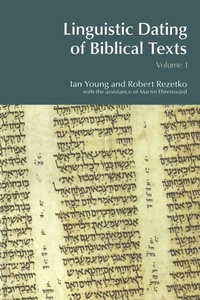
Linguistic Dating of Biblical Texts: Vol 1
Vol 1
1st Edition
Published on 1. September 2014
Book
Paperback/Softback
374 pages
978-1-84553-082-2 (ISBN)
Description
Since the beginning of critical scholarship, biblical texts have been dated using linguistic evidence. In recent years, this has been a controversial topic. However, until now, there has been no introduction to and comprehensive study of the field. Volume I introduces the field of linguistic dating of biblical texts, particularly to intermediate and advanced students of Biblical Hebrew with a reasonable background in the language, but also to scholars of the Hebrew Bibles in general who have not been exposed to the full scope of issues. It outlines topics at a basic level before entering into detailed discussion. Many text samples are presented for study, and readers are introduced to significant linguistic features of the texts through notes on the pages. Detailed notes on these text sample provide a background, concrete illustrations and a point of departure for discussion of the general and theoretical issues discussed in each chapter that will make this volume useful as a classroom textbook.
Reviews / Votes
'This thoughtful and ambitious book by talented authors who have broken with conventional thinking about the historical development of Biblical Hebrew promises a small revolution in many branches of biblical studies and will stimulate much new, intensive research in Biblical Hebrew linguistics and stylistics.' --Ziony Zevit, Distinguished Professor of Biblical Literature and Northwest Semitic Languages and Literatures, American Jewish University, and former editor of the journal Hebrew Studies 'A vivid debate has developed in recent years on the relation between SBH (/EBH) and LBH, and above all their chronology. For many scholars, the latter has direct implications for scholarly evaluations of the possible dating of biblical literature. Did the literati stop writing in SBH by the time they began writing in LBH? Can we date books to a pre-Persian period because they are written in EBH? Which roles do regional dialects of Hebrew play in this debate? This book not only addresses these and related questions, but consistently and as comprehensively as possible deals with methodological matters and previous studies. It brings forward new perspectives and shows readers how they apply to biblical texts. There is no doubt that this massive book makes a very substantial contribution to the scholarly discussion on EBH, LBH and linguistic dating of biblical texts. It will be widely read, cited and, of course, it will raise much debate. Moreover, it makes a contribution to both research and teaching in these areas. It is written not only for linguists, but for Hebrew Bible scholars in general including students. In sum, this is an important contribution for which the authors should be congratulated and thanked by all.' --Ehud Ben Zvi, Professor of History and Classics and Religious Studies, University of Alberta 'A vivid debate has developed in recent years on the relation between SBH (/EBH) and LBH, and above all their chronology. For many scholars, the latter has direct implications for scholarly evaluations of the possible dating of biblical literature. Did the literati stop writing in SBH by the time they began writing in LBH? Can we date books to a pre-Persian period because they are written in EBH? Which roles do regional dialects of Hebrew play in this debate? This book not only addresses these and related questions, but consistently and as comprehensively as possible deals with methodological matters and previous studies. It brings forward new perspectives and shows readers how they apply to biblical texts. There is no doubt that this massive book makes a very substantial contribution to the scholarly discussion on EBH, LBH and linguistic dating of biblical texts. It will be widely read, cited and, of course, it will raise much debate. Moreover, it makes a contribution to both research and teaching in these areas. It is written not only for linguists, but for Hebrew Bible scholars in general including students. In sum, this is an important contribution for which the authors should be congratulated and thanked by all.' --Ehud Ben Zvi, Professor of History and Classics and Religious Studies, University of AlbertaMore details
Series
Language
English
Place of publication
Sheffield
United Kingdom
Publishing group
Taylor & Francis Ltd
Target group
College/higher education
Dimensions
Height: 234 mm
Width: 156 mm
Thickness: 20 mm
Weight
567 gr
ISBN-13
978-1-84553-082-2 (9781845530822)
Copyright in bibliographic data and cover images is held by Nielsen Book Services Limited or by the publishers or by their respective licensors: all rights reserved.
Schweitzer Classification
Other editions
Additional editions
Ian Young | Robert Rezetko
Linguistic Dating of Biblical Texts: Vol 1
E-Book
04/2016
Routledge
€61.99
Available for download
Ian Young | Robert Rezetko
Linguistic Dating of Biblical Texts: Vol 1
E-Book
04/2016
Routledge
€61.99
Available for download
Ian Young | Robert Rezetko
Linguistic Dating of Biblical Texts: Vol 1
Book
02/2015
1st Edition
Routledge
€230.27
Shipment within 10-20 days
Persons
Ian Young is senior lecturer in the department of Hebrew, Biblical and Jewish Studies at the University of Sydney. Robert Rezetko completed his PhD in Hebrew Bible at the University of Edinburgh.
Content
Preface Abbreviations Chapter 1 Introduction Chapter 2 Early vs. Late Biblical Hebrew: Principles and Methodology Chapter 3 Early vs. Late Biblical Hebrew: Critique of Principles Chapter 4 Early vs. Late Biblical Hebrew: Critique of Methodology Chapter 5 Early vs. Late Biblical Hebrew: Linguistic Features and Rates of Accumulation Chapter 6 Hebrew Inscriptions of the Monarchic Period Chapter 7 Dialects and Diglossia Chapter 8 Aramaic Chapter 9 Mishnaic Hebrew Chapter 10 Qumran Hebrew and Ben Sira Chapter 11 Loanwords Chapter 12 Archaic Biblical Hebrew Chapter 13 Textual Criticism Chapter 14 Conclusion