

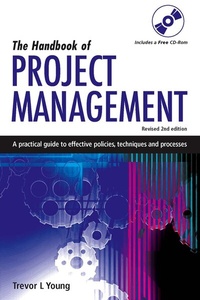
The Handbook of Project Management
Description
Written by an experienced practitioner, it will be particularly useful if you are: looking to develop project management skills; starting a new project; wishing to acquire new skills; or training others in project management skills. Online resources include checklists, score cards and guide notes for optimizing your project management. Packed with concepts and processes, and tools, this comprehensive handbook will assist anyone responsible for converting strategy into reality.
Reviews / Votes
"A practical, comprehensive guide to be used frequently." Euronet "Written specifically to help project managers improve their performance using tried and tested techniques." Computer Consultant "Includes new material on the relationship between projects and programmes, and solving common problems." Charity Times "Kogan Page have produced their usual high standard in this easy to follow guide and it is both interesting and informative for the casual reader as well as being a valuable tool to anyone involved at any level in project management." Refresh, March 2008More details
Other editions
Previous edition
Person
Content
Chapter - 01: Introduction;
Chapter - 02: Change: programmes and projects;
Chapter - 03: Organizing for programme management;
Chapter - 04: The key roles;
Section - TWO: The programme and project processes and techniques;
Chapter - 05: Starting up: ideas and opportunities for projects;
Chapter - 06: Defining the project;
Chapter - 07: Planning your project;
Chapter - 08: Launching your project;
Chapter - 09: Executing the project work;
Chapter - 10: Closing your project;
Chapter - 11: Using a computer;
Chapter - 12: Common project problems
<b>Part 1 The programme and project environment</b>
<b>1 Introduction</b>
What is special about programmes and projects?
Who is this book for?
<b>2 Change: programmes and projects</b>
Change and the programme and project manager
What is a project?
Projects and sub-projects
What is a programme?
An example programme
Why programme management?
What is programme management?
What is project management?
Why is programme management different from project
management?
What is different about programme and project management?
How are programmes and projects derived?
The dynamic life cycle
The dynamic action cycle
The programme and project process phase gates
Is the phase gate a constraint?
Is this control necessary?
Summary
<b>3 Organizing for programme management </b>
Organizing for ownership
Establishing the programme steering team
Continuous improvement and problem solving: are they projects?
The programme register
Operating a programme register
The key responsibilities of the programme steering team
Meetings of the programme steering team
Managing the portfolio: selection of programmes and projects
The inputs to effective selection
The secondary screening
The result of effective selection
Summary
<b>4 The key roles </b>
The project steering team administrator
The sponsor
The programme manager
The project manager
The functional manager
The stakeholders
Frequently used terms
The programme and project manager as a leader
The dimensions of leadership in the programme and
project environment
Dimension 1: Managing stakeholders
Dimension 2: Managing the dynamic life cycle
Dimension 3: Managing performance
Programmes, projects and teamwork
Building your team
Customer satisfaction
<b>Part 2 The programme and project processes and techniques </b>
<b>5 Starting up: ideas and opportunities for projects </b>
The fundamental data needs
What are the constraints?
What data do the programme steering team require?
Preparing the initial business case
Through Gate Zero to Gate One
Presenting the business case to the programme steering team
The kick-off meeting
Project documentation
The project brief and specification
Summary
<b>6 Defining the project </b>
What is necessary to define a project?
The stakeholder list
The project brief
The scope of work statement
Risk management
Risk assessment
Quantifying identified risks
Risk monitoring
Getting your project definition approved
Summary
<b>7 Planning your project </b>
What is not going to be done?
Who needs to be involved?
Where does planning start?
Identifying the key stages
The project work breakdown structure
Allocating responsibility
What is an estimate?
Avoid some classic pitfalls
The golden rules
Effort and duration
Estimating the durations
Contingencies
Time-limited scheduling and estimates
Practical estimating
The programme evaluation and review technique
Analysing the logic diagram
Using the PERT analysis data
Analysing your resource requirements
Optimizing your schedule
Reviewing your project risk log
Reviewing your project budget
Intermediate phase gates
Seeking approval to launch your project
Summary
<b>8 Launching your project </b>
Establishing key stage work plans
Deriving a milestone schedule
Critical success factors
Ensuring effective communication
Project status reports
Deriving a meetings schedule for your project
Managing project changes
Holding a launch meeting
Summary
<b>9 Executing the project work </b>
The project control system
Monitoring progress
Managing issues
Reviewing project issues
Tracking your project
Taking corrective action
Problem solving
Progress meetings
Progress reporting
Encouraging good time management
Controlling the project costs
Balancing the project
Approaching the closure phase
Summary
<b>10 Closing your project </b>
Why have a closure phase?
Establishing completion criteria
The acceptance process
The close-out meeting
Evaluating your project
Closing down the project
Post-project evaluation
Post-project appraisals
What next?
Summary
<b>11 Using a computer </b>
What can software do?
Using a software program
What software does not do
Selecting project software
The programme management office
<b>12 Common Project Problems</b>
Problem analysis
How projects succeed