

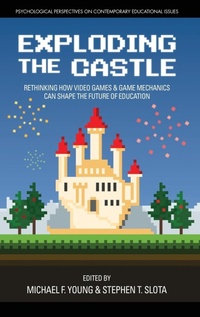
Exploding the Castle
Rethinking How Video Games & Game MechanicsCan Shape the Future of Education
Published on 20. July 2017
Book
Hardback
302 pages
978-1-68123-936-1 (ISBN)
Description
Lacking a digital crystal ball, we cannot predict the future of education or the precise instructional role games will have going forward. Yet we can safely say that games will play some role in the future of K-12 and higher education, and members of the games community will have to choose between being passive observers or active, progressive contributors to the complex and often political process of weaving together pedagogy, technology, and culture. This will involve agreeing that games-or, more specifically, game mechanics and the engagement in joyful learning that they engender-are not only critical for shaping online and classroom instruction but also the evolution of schooling as a whole. Likewise, it will involve a hard push beyond questions like "Are video games 'good' or 'bad' for education?" and "Are games 'better' for all students than traditional face-to-face teaching" to unpack how game experiences vary with individual learner goals as an interaction with the parameters of an educational environment. Simply put, we need to form a cohesive, compelling argument in support of the notion that games are entire learning ecologies in and of themselves.
This edited volume is designed to anchor collective thinking with respect to the value-added nature of games for learning and the complexities involved in player experience, narrative context, and environmental-player interactions. As could be expected, we are not interested in debates about "gamification," game violence, individual game quality, and other topics that have become standard fare in extant games literature. Instead, we seek to emphasize issues of scalability, the induction of player goal adoption, affordances of game-based instructional environments, relationships between play and transfer, and the value of games as part of an ecopsychological worldview. As long-time contributors in a field that has made a habit of playing it safe-pun intended-we seek to bring the dialogue in a more nuanced and meaningful direction that will reach teachers, researchers, designers, and players alike.
This edited volume is designed to anchor collective thinking with respect to the value-added nature of games for learning and the complexities involved in player experience, narrative context, and environmental-player interactions. As could be expected, we are not interested in debates about "gamification," game violence, individual game quality, and other topics that have become standard fare in extant games literature. Instead, we seek to emphasize issues of scalability, the induction of player goal adoption, affordances of game-based instructional environments, relationships between play and transfer, and the value of games as part of an ecopsychological worldview. As long-time contributors in a field that has made a habit of playing it safe-pun intended-we seek to bring the dialogue in a more nuanced and meaningful direction that will reach teachers, researchers, designers, and players alike.
More details
Series
Language
English
Place of publication
Charlotte
United States
Publishing group
Emerald Publishing Inc
Target group
Professional and scholarly
Dimensions
Height: 240 mm
Width: 161 mm
Thickness: 21 mm
Weight
619 gr
ISBN-13
978-1-68123-936-1 (9781681239361)
Copyright in bibliographic data and cover images is held by Nielsen Book Services Limited or by the publishers or by their respective licensors: all rights reserved.
Schweitzer Classification
Persons
Michael F. Young, University of Connecticut and Stephen T. Slota, University of Connecticut
Content
Introduction: Castle Upon a Hill; Michael F. Young and Stephen T. Slota.
Chapter 1. What Homeric Epic Can Teach Us About Educational Affordances of Interactive Narrative; Roger Travis.
Chapter 2. Structures of Play: Literacy, Games, and Creative Writing; W. Trent Hergenrader.
Chapter 3. Development: The Role of Digital Games in a Classroom Ecology: Exploring Instruction With Video Games; Amanda Bell and Melissa Gresalfi.
Chapter 4. More Than an Avatar: Unmasking the Player's Impact on an Educational Game; Jackie Barnes and Melissa Gresalfi.
Chapter 5. Ask Not What You Can Do for Badges, Ask What Badges Can Do for You; Peter Samuelson Wardrip and Samuel Abramovich.
Chapter 6. An Ecocentric Framework for Game-Enabled Impact: Lessons Learned From the Quest2Teach Project; Sasha Barab and Anna Arici.
Chapter 7. Educating Digital Natives: Possible and Prospective Futures of Students in Learning Ecologies; W. Ian O'Byrne and Nenad Radakovic.
Chapter 8. Twist: Measuring and Supporting Learning in Educational Games; Valerie J. Shute, Seyedahmad Rahimi, and Chen Sun.
Chapter 9. Situating Big Data; Jennifer Dalsen, Craig G. Anderson, Kurt Squire, and Constance Steinkuehler.
Chapter 10. Conclusion: Distributed Teaching and Learning Systems in the Wild; Jeffrey B. Holmes, Kelly M. Tran, and Elisabeth R. Gee.
Chapter 11. The Inevitability of Epic Fail: Exploding the Castle With Situated Learning; Stephen T. Slota and Michael F. Young.
Chapter 1. What Homeric Epic Can Teach Us About Educational Affordances of Interactive Narrative; Roger Travis.
Chapter 2. Structures of Play: Literacy, Games, and Creative Writing; W. Trent Hergenrader.
Chapter 3. Development: The Role of Digital Games in a Classroom Ecology: Exploring Instruction With Video Games; Amanda Bell and Melissa Gresalfi.
Chapter 4. More Than an Avatar: Unmasking the Player's Impact on an Educational Game; Jackie Barnes and Melissa Gresalfi.
Chapter 5. Ask Not What You Can Do for Badges, Ask What Badges Can Do for You; Peter Samuelson Wardrip and Samuel Abramovich.
Chapter 6. An Ecocentric Framework for Game-Enabled Impact: Lessons Learned From the Quest2Teach Project; Sasha Barab and Anna Arici.
Chapter 7. Educating Digital Natives: Possible and Prospective Futures of Students in Learning Ecologies; W. Ian O'Byrne and Nenad Radakovic.
Chapter 8. Twist: Measuring and Supporting Learning in Educational Games; Valerie J. Shute, Seyedahmad Rahimi, and Chen Sun.
Chapter 9. Situating Big Data; Jennifer Dalsen, Craig G. Anderson, Kurt Squire, and Constance Steinkuehler.
Chapter 10. Conclusion: Distributed Teaching and Learning Systems in the Wild; Jeffrey B. Holmes, Kelly M. Tran, and Elisabeth R. Gee.
Chapter 11. The Inevitability of Epic Fail: Exploding the Castle With Situated Learning; Stephen T. Slota and Michael F. Young.