

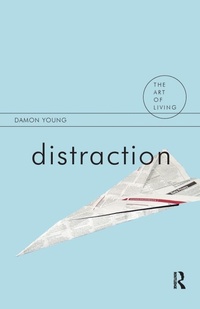
Distraction
1st Edition
Published on 26. April 2010
Book
Paperback/Softback
176 pages
978-1-84465-254-9 (ISBN)
Description
Most of us struggle with distraction every day: the familiar feeling that our attention is not quite where it should be. We feel it at work and at home and it can be frustrating and uncomfortable. But what is distraction? In his lucid, timely book, Damon Young shows that distraction is more than too many stimuli, or too little attention. It is actually a matter of value - to be distracted is to be torn away from what is worthwhile in life. And for Young, what is most worthwhile is freedom: not simply rights or legal liberties, but the capacity to patiently, creatively craft one's own life. Exploring the lives of such luminaries as Henri Matisse, Karl Marx, Seneca and Henry James, Young exposes distraction in work, technology, art, politics and intimacy. With warmth and wit, he reveals what is most valuable, and what is best avoided, in the pursuit of a life of one's own.
Reviews / Votes
"This warm and witty book does something wonderful: it brings the great ideas of philosophy into our lives. Young is a bright new voice." - John Armstrong, author of Love, Life, Goethe: How to be Happy in an Imperfect WorldMore details
Series
Language
English
Place of publication
Durham
United Kingdom
Publishing group
Taylor & Francis Ltd
Target group
College/higher education
Dimensions
Height: 216 mm
Width: 140 mm
Thickness: 10 mm
Weight
242 gr
ISBN-13
978-1-84465-254-9 (9781844652549)
Copyright in bibliographic data and cover images is held by Nielsen Book Services Limited or by the publishers or by their respective licensors: all rights reserved.
Schweitzer Classification
Other editions
Additional editions
Person
Damon Young is an Honorary Fellow in Philosophy at the University of Melbourne.
Content
Acknowledgements 1. Manholes and Tears 2. What a Piece of Work Is a Man 3. The Reins of Necessity 4. A Farewell to Arms 5. Matisse's Hernia 6. The Private Life 7. Footnotes to Plato Balancing the Books