

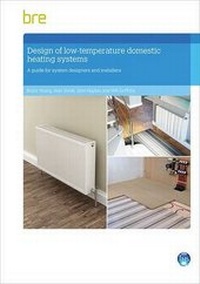
Design of Low-temperature Domestic Heating Systems
A Guide for System Designers and Installers (FB 59)
1st Edition
Will be published approx. on 12. December 2013
Book
Paperback/Softback
28 pages
978-1-84806-343-3 (ISBN)
Description
Low-temperature systems can improve energy efficiency and hence reduce fuel consumption and CO2 emissions. There is growing interest in low-temperature hydronic central heating systems, ie those where water is used as the medium to distribute heat around the building, and in which the water leaving the heat generator is limited to a lower temperature than in normal system design. This BRE Trust Report is aimed as a guide for those who wish to install low-temperature heating systems in dwellings, and concentrates on the calculations and other conditions necessary to ensure that low-temperature operation can be achieved.
It became apparent during the preparation of this guide that there is no generally well-established and understood design method for low-temperature domestic heating systems. Instead of simply gathering information on current practice, the authors found it necessary to engage in extensive debate about many of the technical parameters governing system sizing, configuration and selection of components. Some of these have not been fully resolved. In particular, leading designers should give more attention to:
-selection of a representative external temperature for heat loss calculations
-allowance for building exposure
-suitable heat loss calculators, conforming to stated rules
-refined intermittency factors, perhaps using the advanced method set out in BS EN 12831:2003
-evaluation of emitter responsiveness, especially for emitters with fans
-temperature-limiting controls, and modulation by reference to an upper temperature limit.
The last item (controls) is especially important, as it is the water temperature at the heat generator that is the principal determinant of efficiency when low-temperature system designs are contemplated. Further development of standard design and operating practices (especially for controls) for low-temperature systems will be necessary before low-temperature systems can be recognised as a mature option capable of providing energy savings in all cases.
It became apparent during the preparation of this guide that there is no generally well-established and understood design method for low-temperature domestic heating systems. Instead of simply gathering information on current practice, the authors found it necessary to engage in extensive debate about many of the technical parameters governing system sizing, configuration and selection of components. Some of these have not been fully resolved. In particular, leading designers should give more attention to:
-selection of a representative external temperature for heat loss calculations
-allowance for building exposure
-suitable heat loss calculators, conforming to stated rules
-refined intermittency factors, perhaps using the advanced method set out in BS EN 12831:2003
-evaluation of emitter responsiveness, especially for emitters with fans
-temperature-limiting controls, and modulation by reference to an upper temperature limit.
The last item (controls) is especially important, as it is the water temperature at the heat generator that is the principal determinant of efficiency when low-temperature system designs are contemplated. Further development of standard design and operating practices (especially for controls) for low-temperature systems will be necessary before low-temperature systems can be recognised as a mature option capable of providing energy savings in all cases.
More details
Language
English
Place of publication
Bracknell
United Kingdom
Target group
Professional and scholarly
Professional and Professional Practice & Development
Illustrations
3 color images, 14 color tables and 11 color line drawings
Dimensions
Height: 297 mm
Width: 210 mm
Weight
152 gr
ISBN-13
978-1-84806-343-3 (9781848063433)
Copyright in bibliographic data and cover images is held by Nielsen Book Services Limited or by the publishers or by their respective licensors: all rights reserved.
Schweitzer Classification
Persons
BRE, UK
Content
Selected Contents: 1. Introduction 2. What is Low-temperature Heating? 3. Efficiency Improvement Potential 4. Comparison of Performance with Conventional Heating Systems 5. Importance of Correct Heating System Design 6. Calculation of the Heat Loss from Each Room 7. System Parameters Affecting Emitter Size 8. Determining Emitter Sizes 9. Selection of Suitable Heat Emitters 10. Oversize Factor for Radiators and Convectors 11. Controls to Achieve Low-temperature Conditions 12. Installation, Commissioning and Labelling 13. Completion Certificate