

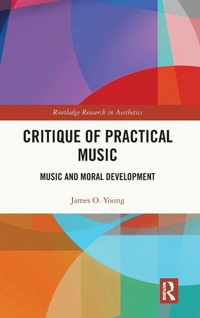
Critique of Practical Music
Music and Moral Development
1st Edition
Published on 16. July 2025
Book
Hardback
152 pages
978-1-041-05950-9 (ISBN)
Description
This book offers a systematic survey of ethos theory: the theory according to which the right sort of music can have a positive or negative effect on moral development. It also evaluates the extant empirical literature on music and moral development.
The belief that the right sort of music promotes moral development is almost ubiquitous. At every stage in the history of philosophical thinking, many philosophers have believed that the right sort of music is conducive to moral improvement and the wrong kind of music can produce moral decay. This book has three main goals. The first is to inform readers about the range of thinkers and cultures (Asian, African and European) which have adopted some version of the ethos theory. The book surveys the history of ethos theory starting with its origins in ancient Greece and ancient China, proceeding to trace its development through the Middle Ages and into the early modern period. Next, the development of ethos theory is traced from the middle of the nineteenth century to the present. The second goal is to investigate what would count as evidence that ethos theory is correct, paying specific attention to the complex ways that people experience music. Finally, the author evaluates the currently available empirical evidence for ethos theory.
Critique of Practical Music will appeal to philosophers, psychologists, musicologists and music educators who are interested in music and moral development.
The belief that the right sort of music promotes moral development is almost ubiquitous. At every stage in the history of philosophical thinking, many philosophers have believed that the right sort of music is conducive to moral improvement and the wrong kind of music can produce moral decay. This book has three main goals. The first is to inform readers about the range of thinkers and cultures (Asian, African and European) which have adopted some version of the ethos theory. The book surveys the history of ethos theory starting with its origins in ancient Greece and ancient China, proceeding to trace its development through the Middle Ages and into the early modern period. Next, the development of ethos theory is traced from the middle of the nineteenth century to the present. The second goal is to investigate what would count as evidence that ethos theory is correct, paying specific attention to the complex ways that people experience music. Finally, the author evaluates the currently available empirical evidence for ethos theory.
Critique of Practical Music will appeal to philosophers, psychologists, musicologists and music educators who are interested in music and moral development.
More details
Series
Language
English
Place of publication
London
United Kingdom
Publishing group
Taylor & Francis Ltd
Target group
College/higher education
Postgraduate and Undergraduate Advanced
Dimensions
Height: 235 mm
Width: 157 mm
Thickness: 14 mm
Weight
398 gr
ISBN-13
978-1-041-05950-9 (9781041059509)
Copyright in bibliographic data and cover images is held by Nielsen Book Services Limited or by the publishers or by their respective licensors: all rights reserved.
Schweitzer Classification
Other editions
Additional editions
E-Book
07/2025
Routledge
€60.49
Available for download
E-Book
07/2025
Routledge
€60.49
Available for download
Person
James O. Young, FRSC, is Professor of Philosophy at the University of Victoria. He is the author of several books including Cultural Appropriation and the Arts (2008), Critique of Pure Music (2014), A History of Western Philosophy of Music (2023) and more than 80 articles in refereed journals.
Content
1. Origins of the Ethos Theory 2. Modern Philosophical Views on the Ethos Theory 3. Theory into Practice 4. The Empirical Evidence