

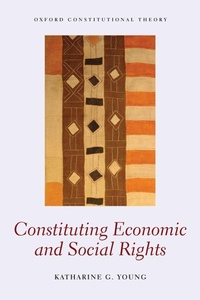
Constituting Economic and Social Rights
Published on 30. October 2014
Book
Paperback/Softback
376 pages
978-0-19-872789-7 (ISBN)
Description
Food, water, health, housing, and education are as fundamental to human freedom and dignity as privacy, religion, or speech. Yet only recently have legal systems begun to secure these fundamental individual interests as rights. This book looks at the dynamic processes that render economic and social rights in legal form. It argues that processes of interpretation, enforcement, and contestation each reveal how economic and social interests can be protected as human and constitutional rights, and how their protection changes public law.
Drawing on constitutional examples from South Africa, Colombia, Ghana, India, the United Kingdom, the United States and elsewhere, the book examines innovations in the design and role of institutions such as courts, legislatures, executives, and agencies in the organization of social movements and in the links established with market actors. This comparative study shows how legal systems protect economic and social rights by shifting the focus from minimum bundles of commodities or entitlements to processes of value-based, deliberative problem solving. Theories of constitutionalism and governance inform the potential of this approach to reconcile economic and social rights with both democratic and market principles, while addressing the material inequality, poverty and social conflict caused, in part, by law itself.
Drawing on constitutional examples from South Africa, Colombia, Ghana, India, the United Kingdom, the United States and elsewhere, the book examines innovations in the design and role of institutions such as courts, legislatures, executives, and agencies in the organization of social movements and in the links established with market actors. This comparative study shows how legal systems protect economic and social rights by shifting the focus from minimum bundles of commodities or entitlements to processes of value-based, deliberative problem solving. Theories of constitutionalism and governance inform the potential of this approach to reconcile economic and social rights with both democratic and market principles, while addressing the material inequality, poverty and social conflict caused, in part, by law itself.
Reviews / Votes
Social and economic rights are growing apace throughout the world. Anyone seeking a thoughtful and comprehensive overview of the different ways in which courts throughout the world are enforcing them could do no better than read this sharp-eyed and fluent book. * Albie Sachs * Katharine Young proposes an original theory about the development of economic and social rights, linking such development to their philosophical foundations, to their institutionalization in binding legal norms, and to their impacts in real life. It is an illuminating and well-informed account of how rights evolve, as a result of the tensions between these poles. This book is a breakthrough in scholarship on economic and social rights. * Olivier De Schutter, Former UN Special Rapporteur on the right to food (2008-2014), Member of the Committee on Economic, Social and Cultural Rights (2015-2018) * Young's work comes from a deeper sense of injustice with current world affairs and offers an imaginative and thought provoking account of the potential merits, and pitfalls, of rights based constitutionalism. * Jamie Burton, Public Law * A brilliant discussion of an extremely difficult subject of great importance to policy making and practical reasoning. Katharine Young's lucidity is exemplary, and so is the originality of her approach to human rights. * Amartya Sen, Nobel Prize winner in Economics and Thomas W. Lamont University Professor, and Professor of Economics and Philosophy, at Harvard University * Katharine Young's book is both an ideal introduction to the discourse of social and economic rights and an important advance of the field. She offers a spirited defense of the possibility of a human rights practice that is both grounded and emancipatory. Skeptics will find that their reservations are extensively and fairly considered. Activists will find many provocative challenges to their conventional wisdom. All readers will be grateful for her lucid and lively exposition. * William H. Simon, Arthur Levitt Professor of Law, Columbia Law School *More details
Series
Language
English
Place of publication
Oxford
United Kingdom
Target group
College/higher education
Dimensions
Height: 234 mm
Width: 156 mm
Thickness: 20 mm
Weight
570 gr
ISBN-13
978-0-19-872789-7 (9780198727897)
Copyright in bibliographic data and cover images is held by Nielsen Book Services Limited or by the publishers or by their respective licensors: all rights reserved.
Schweitzer Classification
Other editions
Additional editions
Katharine G. Young
Constituting Economic and Social Rights
Book
08/2012
Oxford University Press
€167.13
Shipment within 15-20 days
Person
Dr Katharine Young is Associate Professor at Boston College Law School. She completed doctoral studies at Harvard Law School and law and arts degrees at Melbourne Law School. Dr Young has served as a Fellow at a number of interdisciplinary programs, including Amartya Sen's Project on Justice, Welfare and Economics at Harvard University. She has comparative professional experience in Australia, the United States, and in the United Nations legal system.
Content
PART I: CONSTITUTING RIGHTS BY INTERPRETATION ; PART II: CONSTITUTING RIGHTS BY ENFORCEMENT ; PART III: CONSTITUTING RIGHTS BY CONTESTATION