

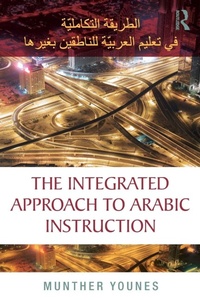
The Integrated Approach to Arabic Instruction
1st Edition
Published on 7. October 2014
Book
Paperback/Softback
66 pages
978-1-138-82232-0 (ISBN)
Description
Leading teacher of Arabic, Munther Younes, explores the realities of teaching Arabic as a foreign language (AFL) and outlines his groundbreaking approach to instruction, tried and tested over many years at Cornell University.
The Integrated Approach to Arabic Instruction introduces teachers to the features of an integrated Arabic program-one that simultaneously teaches the two varieties of the language, Modern Standard Written Arabic, fu??a, and the dialect, ammiyya, in a way that reflects the authentic practice of native Arabic speakers. This pedagogy, Younes argues, is the most logical, effective and economical method of instruction as it prepares students fully for the realities of the Arabic diglossic situation.
Younes takes teachers through the following ground:
Consideration of the current Arabic sociolinguistic situation and key debates in the field
Outline of changing student goals and the needs of the modern AFL learner
Overview of the Integrated Approach covering its rationale, features, implementation methods and usage of instructional materials in the classroom
Response to objections to the Integrated Approach, outlining its advantages over alternative practices and clarifying crucial issues in practice
The Integrated Approach to Arabic Instruction addresses a pressing issue deeply relevant to the world of Arabic language instruction, placed in the practical context of shifting attitudes among students and educators. It will be an essential resource for all teachers of Arabic as a Foreign Language.
The Integrated Approach to Arabic Instruction introduces teachers to the features of an integrated Arabic program-one that simultaneously teaches the two varieties of the language, Modern Standard Written Arabic, fu??a, and the dialect, ammiyya, in a way that reflects the authentic practice of native Arabic speakers. This pedagogy, Younes argues, is the most logical, effective and economical method of instruction as it prepares students fully for the realities of the Arabic diglossic situation.
Younes takes teachers through the following ground:
Consideration of the current Arabic sociolinguistic situation and key debates in the field
Outline of changing student goals and the needs of the modern AFL learner
Overview of the Integrated Approach covering its rationale, features, implementation methods and usage of instructional materials in the classroom
Response to objections to the Integrated Approach, outlining its advantages over alternative practices and clarifying crucial issues in practice
The Integrated Approach to Arabic Instruction addresses a pressing issue deeply relevant to the world of Arabic language instruction, placed in the practical context of shifting attitudes among students and educators. It will be an essential resource for all teachers of Arabic as a Foreign Language.
Reviews / Votes
"Anyone who has seen what Munther's students can do in Arabic knows that his integrated approach is decidedly successful. This book begins with a rigorous overview of past research about variation in Arabic. It then provides convincing argumentation in favor of adopting an integrated approach along with actual examples. Finally, it debunks opposition and shows that the integrated approach meets our students' needs by reflecting the sociolinguistic realities of the Arabic-speaking world." Jeremy Palmer, American University of Sharjah, UAE"The Integrated Approach to Arabic Instruction provides a concise, yet comprehensive overview of the linguistic research that supports using the Integrated Approach in the teaching of Arabic as a foreign language. This book presents the best methodology that successful Arabic programs should adopt to meet the aspirations of a growing community of Arabic language learners and educators." Mohammad Al-Masri, The University of Oklahoma, USA
"Dr. Younes' new book sets forth a reasoned, coherent, and realistic approach to teaching Arabic as a foreign language, providing a much-needed rationale and model for teaching spoken Arabic skills along with written Arabic. It brings together a range of theories about the nature of diglossia, and the characteristics of middle, mixed, and hybrid variants of spoken Arabic. Dr. Younes has refined a systematic and effective methodology for developing communicative competence in Arabic that incorporates both literacy and oral proficiency. This book provides a compelling argument for teaching Arabic as a multifaceted language, rather than a divided one." Karin Ryding, Georgetown University, USA.
More details
Language
English
Place of publication
London
United Kingdom
Publishing group
Taylor & Francis Ltd
Target group
Professional and scholarly
Academic and Professional Practice & Development
Illustrations
10 s/w Tabellen
10 Tables, black and white
Dimensions
Height: 234 mm
Width: 156 mm
Thickness: 4 mm
Weight
131 gr
ISBN-13
978-1-138-82232-0 (9781138822320)
Copyright in bibliographic data and cover images is held by Nielsen Book Services Limited or by the publishers or by their respective licensors: all rights reserved.
Schweitzer Classification
Other editions
Additional editions
Munther Younes
The Integrated Approach to Arabic Instruction
E-Book
10/2014
1st Edition
Routledge
€32.99
Available for download
Munther Younes
The Integrated Approach to Arabic Instruction
E-Book
10/2014
1st Edition
Routledge
€32.99
Available for download
Munther Younes
The Integrated Approach to Arabic Instruction
Book
10/2014
1st Edition
Routledge
€230.50
Shipment within 10-20 days
Person
Munther Younes is Reis Senior Lecturer of Arabic Language and Linguistics and Director of the Arabic Program in the Department of Near Eastern Studies at Cornell University, USA. His publications include the pioneering three-part textbook series, 'Arabiyyat al-Naas (2014), The Routledge Introduction to Qur'anic Arabic (2013) and Kalila wa Dimna for Students of Arabic (2013), all published with Routledge.
Content
Introduction 1. The Arabic Sociolinguistic situation 2. Changing student goals 3. Responding to the needs of the modern AFL learner 4. Integration 5. Objections to integration