

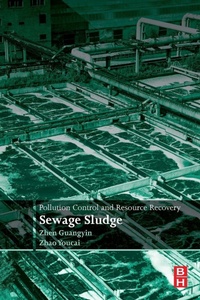
Pollution Control and Resource Recovery
Sewage Sludge
Published on 26. October 2016
Book
Paperback/Softback
394 pages
978-0-12-811639-5 (ISBN)
Description
Pollution Control and Resource Recovery: Sewage Sludge discusses several traditional and new environmentally friendly technologies for sewage sludge treatment and disposal. In addition, the book covers a range of new initiatives that are underway to promote and accelerate the development of related sciences and techniques.
The book's authors builds a framework for developing various sustainable technologies for sewage sludge treatment and disposal, including advanced dewatering through chemical conditioning, solidification/stabilization, reuse for the development of construction and building materials, anaerobic bioenergy recovery, sanitary landfill, and odor control.
The book's authors builds a framework for developing various sustainable technologies for sewage sludge treatment and disposal, including advanced dewatering through chemical conditioning, solidification/stabilization, reuse for the development of construction and building materials, anaerobic bioenergy recovery, sanitary landfill, and odor control.
More details
Language
English
Place of publication
Woburn
United States
Publishing group
Elsevier - Health Sciences Division
Target group
Professional and scholarly
Civil Engineers and Environmental Engineers, Chemical Engineers, and Environmental Scientist
Product notice
Paperback (trade)
Dimensions
Height: 229 mm
Width: 152 mm
Thickness: 22 mm
Weight
577 gr
ISBN-13
978-0-12-811639-5 (9780128116395)
Copyright in bibliographic data and cover images is held by Nielsen Book Services Limited or by the publishers or by their respective licensors: all rights reserved.
Schweitzer Classification
Other editions
Additional editions
E-Book
10/2016
Butterworth-Heinemann
€135.00
Available for download
Persons
Zhao Youcai, is currently a professor of environmental engineering at School of Environmental Science and Engineering, Tongji University. He got bachelor degree from Sichuan University (1984) and Ph.D. from Institute of Chemical Metallurgy (now Institute of Process Engineering), Chinese Academy of Sciences, Beijing (1989). After finished Post-doctoral research work at Fudan University, Shanghai, he joined in Tongji University in 1991. Meanwhile, he had ever worked at Aristotle University, Greece, National University of Singapore, Tulane University, USA, and Paul Scherrer Institute, Switzerland, for 4 years as research fellow or visiting professor. He had authored or co-authored 200 publications published in peer-reviewed internationally recognized journals, 480 publications in China journals, authored 9 English books (at Elsevier and Springer) and authored or co-authored 98 Chinese books (as an author or Editor-in-chief), 4 textbooks for undergraduate, graduate and PhD students with a fourth edition of undergraduate textbook (in Chinese). Currently, his research interests include treatment and recycling of municipal and rural solid waste, construction and demolition waste, hazardous waste, industrial waste, electric and electronic waste, and sewage sludge, and polluted soil.
Zhen Guangyin, is currently JSPS research fellow at the National Institute for Environmental Studies (NIES), Japan. He received his BEng Degree in Environmental Engineering from Hunan University, China in 2008 and his Ph.D. from Tongji University, China in 2014. Prior to joining in the NIES, he worked as a visiting researcher at the Tohoku University, Japan. He has authored or co-authored 26 peer-reviewed international papers, 5 Chinese papers and 4 invited book chapters. His principal research interests lie in sewage sludge treatment and renewable energy conversion (anaerobic digestion, microbial electrolysis cell, etc.).
Zhen Guangyin, is currently JSPS research fellow at the National Institute for Environmental Studies (NIES), Japan. He received his BEng Degree in Environmental Engineering from Hunan University, China in 2008 and his Ph.D. from Tongji University, China in 2014. Prior to joining in the NIES, he worked as a visiting researcher at the Tohoku University, Japan. He has authored or co-authored 26 peer-reviewed international papers, 5 Chinese papers and 4 invited book chapters. His principal research interests lie in sewage sludge treatment and renewable energy conversion (anaerobic digestion, microbial electrolysis cell, etc.).
Content
Chapter One. Sewage Sludge Generation and Characteristics
Chapter Two. Enhanced Sewage Sludge Dewaterability by Chemical Conditioning
Chapter Three. Sewage Sludge Solidification/Stabilization and Drying/Incineration Process
Chapter Four. Making of Sewage Sludge-Derived Controlled Low-Strength Materials (CLSMs)
Chapter Five. Harvest of Bioenergy From Sewage Sludge by Anaerobic Digestion
Chapter Six. Pollution Control and Recycling of Sludge in Sanitary Landfill
Chapter Two. Enhanced Sewage Sludge Dewaterability by Chemical Conditioning
Chapter Three. Sewage Sludge Solidification/Stabilization and Drying/Incineration Process
Chapter Four. Making of Sewage Sludge-Derived Controlled Low-Strength Materials (CLSMs)
Chapter Five. Harvest of Bioenergy From Sewage Sludge by Anaerobic Digestion
Chapter Six. Pollution Control and Recycling of Sludge in Sanitary Landfill