


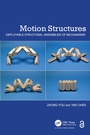
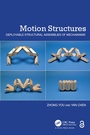
Motion Structures
Deployable Structural Assemblies of Mechanisms
1st Edition
Published on 26. August 2011
Book
Hardback
168 pages
978-0-415-55489-3 (ISBN)
Description
The Open Access version of this book, available at http://www.routledge.com, has been made available under a Creative Commons [Attribution-Non Commercial-No Derivatives (CC-BY-NC-ND)] 4.0 license.
Motion structures are simply assemblies of resistant bodies connected by movable joints. Unlike conventional structures, they allow large shape transformations to satisfy practical requirements and they can be used in:
shelters, emergency structures and exhibition stands
aircraft morphing wings
satellite solar panels and space antennas
morphing core materials for composites
medical implants for minimum invasive surgery.
Though traditionally the subject falls within structural engineering, motion structures are more closely related to other mechanisms, and they draw on the principles of kinematic and geometrical analysis in their design. Indeed their design and analysis can be viewed as an extension of the theory of mechanisms, such as rigid origami, and can make effective use of a wealth of mathematical principles.
This book outlines the relevant underlying theory of motion structural concepts, and uses a number of innovative but simple structures as examples.
Motion structures are simply assemblies of resistant bodies connected by movable joints. Unlike conventional structures, they allow large shape transformations to satisfy practical requirements and they can be used in:
shelters, emergency structures and exhibition stands
aircraft morphing wings
satellite solar panels and space antennas
morphing core materials for composites
medical implants for minimum invasive surgery.
Though traditionally the subject falls within structural engineering, motion structures are more closely related to other mechanisms, and they draw on the principles of kinematic and geometrical analysis in their design. Indeed their design and analysis can be viewed as an extension of the theory of mechanisms, such as rigid origami, and can make effective use of a wealth of mathematical principles.
This book outlines the relevant underlying theory of motion structural concepts, and uses a number of innovative but simple structures as examples.
More details
Language
English
Place of publication
London
United Kingdom
Publishing group
Taylor & Francis Ltd
Target group
College/higher education
Professional and scholarly
Postgraduate and Professional
Illustrations
20 s/w Photographien bzw. Rasterbilder, 20 Farbfotos bzw. farbige Rasterbilder, 100 s/w Zeichnungen, 10 s/w Tabellen
10 Tables, black and white; 100 Line drawings, black and white; 20 Halftones, color; 20 Halftones, black and white
Dimensions
Height: 240 mm
Width: 161 mm
Thickness: 14 mm
Weight
426 gr
ISBN-13
978-0-415-55489-3 (9780415554893)
Copyright in bibliographic data and cover images is held by Nielsen Book Services Limited or by the publishers or by their respective licensors: all rights reserved.
Schweitzer Classification
Other editions
Additional editions

Book
12/2019
1st Edition
CRC Press
€86.10
Shipment within 15-20 days
E-Book
08/2011
CRC Press
€0.00
Available for download
E-Book
08/2011
CRC Press
€0.00
Available for download

Book
08/2011
Routledge
€138.16
Article exhausted; check different version
Persons
Zhong You is a Fellow of Magdalen College, Oxford and lecturer at Oxford University
Yan Chen is an Assistant Professor at Nanyang Technological University, Singapore
Yan Chen is an Assistant Professor at Nanyang Technological University, Singapore
Content
Introduction: Deployable Structures. Mechanisms for Deployable Structures. Deployable Structures Made from 2D Mechanisms. Deployable Structures Made from 3D Mechanisms. Rigid Origami as Deployable Structures. Final Remarks.