

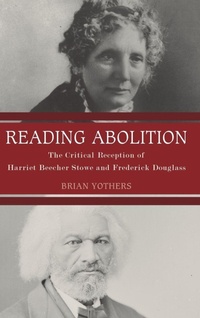
Reading Abolition
The Critical Reception of Harriet Beecher Stowe and Frederick Douglass
Published on 1. December 2016
Book
Hardback
196 pages
978-1-57113-577-3 (ISBN)
Description
A pathbreaking consideration of the intertwined critical responses to Harriet Beecher Stowe and Frederick Douglass, giants of abolitionist literature.
Harriet Beecher Stowe and Frederick Douglass represent a crucial strand in nineteenth-century American literature: the struggle for the abolition of slavery. Yet there has been no thoroughgoing discussion of the critical receptionof these two giants of abolitionist literature. Reading Abolition narrates and explores the parallels between Stowe's critical reception and Douglass's. The book begins with Stowe's Uncle Tom's Cabin, considering its initial celebration as a work of genius and conscience, its subsequent dismissal in the early twentieth century as anti-Southern and in the mid-twentieth century as racially stereotypical, and finally its recent recovery as a classic of women's, religious, and political fiction. It also considers the reception of Stowe's other, less well-known novels, non-fictional works, and poetry, and how engaging the full Stowe canon has changed the shape of Stowe studies. The second half of the study deals with the reception of Douglass both as a writer of three autobiographies that helped to define the contours of African American autobiography for later writers and critics and as an extraordinarily eloquent and influential orator and journalist. Reading Abolition shows that Stowe's and Douglass's critical destinies have long been intertwined, with questions about race, gender, nationalism, religion, and thenature of literary and rhetorical genius playing crucial roles in critical considerations of both figures.
Brian Yothers is Frances Spatz Leighton Endowed Distinguished Professor and Associate Chair of the Department ofEnglish at the University of Texas at El Paso.
Harriet Beecher Stowe and Frederick Douglass represent a crucial strand in nineteenth-century American literature: the struggle for the abolition of slavery. Yet there has been no thoroughgoing discussion of the critical receptionof these two giants of abolitionist literature. Reading Abolition narrates and explores the parallels between Stowe's critical reception and Douglass's. The book begins with Stowe's Uncle Tom's Cabin, considering its initial celebration as a work of genius and conscience, its subsequent dismissal in the early twentieth century as anti-Southern and in the mid-twentieth century as racially stereotypical, and finally its recent recovery as a classic of women's, religious, and political fiction. It also considers the reception of Stowe's other, less well-known novels, non-fictional works, and poetry, and how engaging the full Stowe canon has changed the shape of Stowe studies. The second half of the study deals with the reception of Douglass both as a writer of three autobiographies that helped to define the contours of African American autobiography for later writers and critics and as an extraordinarily eloquent and influential orator and journalist. Reading Abolition shows that Stowe's and Douglass's critical destinies have long been intertwined, with questions about race, gender, nationalism, religion, and thenature of literary and rhetorical genius playing crucial roles in critical considerations of both figures.
Brian Yothers is Frances Spatz Leighton Endowed Distinguished Professor and Associate Chair of the Department ofEnglish at the University of Texas at El Paso.
Reviews / Votes
[A]n impressive history of the critical context for two of American literature's most widely read nineteenth-century authors. . . . [E]specially good reading for graduate students, as it offers a rare combination of coverage along several metrics: field, author, historical period, and archival history. -- Faith Barter * H-EARLY AMERICA * This reevaluation of Douglass and Stowe allows readers to see them as transatlantic figures who operated within 'networks of affiliations' that range from Romanticism to the Civil Rights Movement and whose works embody crucial intersections of gender, race, and national identity. Highly recommended. Upper-level undergraduates through faculty. * CHOICE * Yothers reenacts the nineteenth-century disciplinary formation of bibliography in the best sense of the term, providing a systematic description of the scholarly works' arguments. * AMERICAN STUDIES QUARTERLY *More details
Series
Language
English
Place of publication
Columbia, MD
United States
Publishing group
Boydell & Brewer Ltd
Target group
College/higher education
Product notice
Cloth over boards
Dimensions
Height: 235 mm
Width: 157 mm
Thickness: 15 mm
Weight
445 gr
ISBN-13
978-1-57113-577-3 (9781571135773)
Copyright in bibliographic data and cover images is held by Nielsen Book Services Limited or by the publishers or by their respective licensors: all rights reserved.
Schweitzer Classification
Other editions
Additional editions
Brian Yothers
Reading Abolition
The Critical Reception of Harriet Beecher Stowe and Frederick Douglass
E-Book
12/2016
1st Edition
De Gruyter
€48.99
Available for download
Person
BRIAN YOTHERS is a professor of English and chair of the Department of English at Saint Louis University.
Content
Introduction: Interpreting and Reinterpreting Stowe and Douglass
Uncle Tom's Cabin in Its Own Time
The Eclipse of Uncle Tom's Cabin: The Early Twentieth Century
Uncle Tom's Cabin Revived: Race, Gender, Religion, and Stowe's Narrative Artistry
Beyond Uncle Tom's Cabin: The Reception of Stowe's Later Fiction, Nonfiction, and Poetry
The Critical Response to Douglass's Autobiographies
Anti-Slavery Eloquence: The Critical Response to Douglass's Anti-Slavery Speeches and Journalism
Epilogue: Critical Futures - Stowe and Douglass, Together and Separately
Works Cited
Index
Uncle Tom's Cabin in Its Own Time
The Eclipse of Uncle Tom's Cabin: The Early Twentieth Century
Uncle Tom's Cabin Revived: Race, Gender, Religion, and Stowe's Narrative Artistry
Beyond Uncle Tom's Cabin: The Reception of Stowe's Later Fiction, Nonfiction, and Poetry
The Critical Response to Douglass's Autobiographies
Anti-Slavery Eloquence: The Critical Response to Douglass's Anti-Slavery Speeches and Journalism
Epilogue: Critical Futures - Stowe and Douglass, Together and Separately
Works Cited
Index