

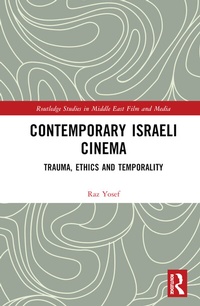
Contemporary Israeli Cinema
Trauma, Ethics and Temporality
1st Edition
Published on 30. December 2022
Book
Hardback
182 pages
978-1-032-19409-7 (ISBN)
Description
Through analysis of the complex discourse surrounding trauma and loss, this book provides a necessary examination of temporality and ethics in Israeli film and television since the turn of the millennium.
The author examines posttraumatic idioms of fragmentation and incoherence, highlighting the rising resistance towards generic categories, and the turn to unconventional and paradoxical structures with unique aesthetics. Maintaining that contemporary Israeli cinema has undergone an ethical shift, the author examines the revealing traumas and denied identities that also seek alternative ways to confront ethical question of accountability. It discusses the relationships between trauma, nationalism, and cinema through the intertwined perspectives of feminism, queer theory, and critical race and postcolonial studies, showing how national traumas are constructed by notions of gendered, sexual, and racial identity. This innovative text highlights the complexities of discourse surrounding trauma and loss, informed by multiple categories of difference. Across each chapter various elements of Israeli film are explored, spanning from strategies used to critically examine victim-perpetrator dynamics, co-existence in temporal space, women's cinema in Israel, displacement, and queer communities and identity.
Beyond its direct contribution to cinema studies and Israel studies, the book will be of interest to trauma and memory studies, postcolonial studies, gender and sexuality studies, Jewish studies, Middle Eastern studies, and cultural studies.
The author examines posttraumatic idioms of fragmentation and incoherence, highlighting the rising resistance towards generic categories, and the turn to unconventional and paradoxical structures with unique aesthetics. Maintaining that contemporary Israeli cinema has undergone an ethical shift, the author examines the revealing traumas and denied identities that also seek alternative ways to confront ethical question of accountability. It discusses the relationships between trauma, nationalism, and cinema through the intertwined perspectives of feminism, queer theory, and critical race and postcolonial studies, showing how national traumas are constructed by notions of gendered, sexual, and racial identity. This innovative text highlights the complexities of discourse surrounding trauma and loss, informed by multiple categories of difference. Across each chapter various elements of Israeli film are explored, spanning from strategies used to critically examine victim-perpetrator dynamics, co-existence in temporal space, women's cinema in Israel, displacement, and queer communities and identity.
Beyond its direct contribution to cinema studies and Israel studies, the book will be of interest to trauma and memory studies, postcolonial studies, gender and sexuality studies, Jewish studies, Middle Eastern studies, and cultural studies.
More details
Series
Language
English
Place of publication
London
United Kingdom
Publishing group
Taylor & Francis Ltd
Target group
College/higher education
Postgraduate and Undergraduate Advanced
Illustrations
22 s/w Photographien bzw. Rasterbilder, 22 s/w Abbildungen
22 Halftones, black and white; 22 Illustrations, black and white
Dimensions
Height: 234 mm
Width: 156 mm
Weight
1260 gr
ISBN-13
978-1-032-19409-7 (9781032194097)
Copyright in bibliographic data and cover images is held by Nielsen Book Services Limited or by the publishers or by their respective licensors: all rights reserved.
Schweitzer Classification
Other editions
Additional editions
E-Book
12/2022
1st Edition
Routledge
€52.49
Available for download
Book
12/2022
1st Edition
Routledge
€53.50
Shipment within 10-20 days
E-Book
12/2022
1st Edition
Routledge
€52.49
Available for download
Person
Raz Yosef is an Associate Professor and head of the Steve Tisch School of Film and Television at Tel Aviv University, Israel. His research interests are on gender and sexuality, race and ethnicity, trauma and memory in Israeli national visual culture.
Content
Introduction 1 Witnessing and Accountability 2 Documentary Reenactment and Ethics 3 Terror TV and Traumatic Time 4 Trauma and Women's Cinema 5 Melancholia and Queer Diaspora 5 Homonationalism and Transnational Temporalities