

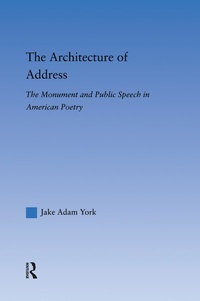
The Architecture of Address
The Monument and Public Speech in American Poetry
1st Edition
Published on 9. June 2014
Book
Paperback/Softback
232 pages
978-0-415-76267-0 (ISBN)
Description
The Architecture of Address traces the evolution of an American species of lyric capable of public pronouncement without polemic. Beginning with Whitman, Jake Adam York seeks to describe a kind of poem wherein the most ambitious poets--including Hart Crane and Robert Lowell--occupy and reconstruct important public spaces. This study argues that American poets become civic actors when their poems imagine and reconstruct the conceptual architecture of the monument.
More details
Series
Language
English
Place of publication
London
United Kingdom
Publishing group
Taylor & Francis Ltd
Target group
College/higher education
Dimensions
Height: 229 mm
Width: 152 mm
Weight
317 gr
ISBN-13
978-0-415-76267-0 (9780415762670)
Copyright in bibliographic data and cover images is held by Nielsen Book Services Limited or by the publishers or by their respective licensors: all rights reserved.
Schweitzer Classification
Other editions
Additional editions
Book
12/2004
1st Edition
Routledge
€215.41
Shipment within 15-20 days
E-Book
05/2004
Routledge
€77.49
Available for download
E-Book
05/2004
Routledge
€77.49
Available for download
Person
Jake Adam York is currently Assistant Professor at the University of Colorado. His criticism has appeared in the Walt Whitman Quarterly Review and his poems have appeared in Shenandoah , The Southern Review , Crab OrchardReview, and other periodicals.
Content
1. Introduction 2. Whitman's Ferry: Platform of Culture Whitman and the Oratory of Early Nineteenth-Century America Whitman and Nineteenth-Century Architecture The Ferry as Monument 3. Crossing Over Brooklyn Ferry: Hart Crane's The Bridge as Monument The Constuctive Principle The Architecture of Anamnesis in The Bridge The Final Figure and the Life of Monument 4. Urban Revitalization: Robert Lowell's 'For the Union Dead' and the American Tradition of Monumental Rhetoric Coordinations The Cemeteries of Culture Enabling Tradition 5. After Lowell: Some Conclusions and Final Considerations