

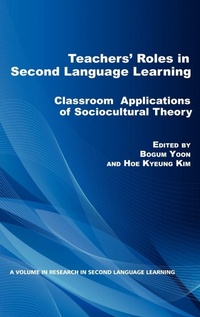
Teacher's Roles in Second Language Learning
Classroom Applications of Sociocultural Theory
Published on 29. June 2012
Book
Hardback
304 pages
978-1-61735-848-7 (ISBN)
Description
This book is designed to provide practical applications of sociocultural theory with regard to teachers' roles in second language education. By providing specific examples of teachers' roles in the classroom, the book aims to help researchers, teacher educators, and classroom teachers make clear connections between practice and theory in second language learning. All the studies in this edited book are conducted in the PreK-16 classroom setting. Each chapter presents rigorous research analysis within the framework of sociocultural theory and provides rich descriptions of teachers' roles.
The book is intended to be used in teacher education courses. The primary audience of the book is in-service teachers who work with second language learners (SLLs) in their classrooms including ESL/Bilingual classrooms or regular classrooms. Since many SLLs receive instructions both in the ESL/Bilingual classrooms and in the regular classrooms, it is important to discuss teachers' roles in both settings. The secondary audience of the book is teacher educators and researchers who work with pre-service and in-service teachers in teacher education. This book will be an excellent resource for book study groups and practitioners working with professional learning communities.
The book is intended to be used in teacher education courses. The primary audience of the book is in-service teachers who work with second language learners (SLLs) in their classrooms including ESL/Bilingual classrooms or regular classrooms. Since many SLLs receive instructions both in the ESL/Bilingual classrooms and in the regular classrooms, it is important to discuss teachers' roles in both settings. The secondary audience of the book is teacher educators and researchers who work with pre-service and in-service teachers in teacher education. This book will be an excellent resource for book study groups and practitioners working with professional learning communities.
More details
Series
Language
English
Place of publication
Charlotte
United States
Publishing group
Emerald Publishing Inc
Target group
Professional and scholarly
Dimensions
Height: 240 mm
Width: 161 mm
Thickness: 21 mm
Weight
622 gr
ISBN-13
978-1-61735-848-7 (9781617358487)
Copyright in bibliographic data and cover images is held by Nielsen Book Services Limited or by the publishers or by their respective licensors: all rights reserved.
Schweitzer Classification
Other editions
Additional editions
Bogum Yoon | Hoe Kyeung Kim
Teachers' Roles in Second Language Learning
Classroom Applications of Sociocultural Theory
E-Book
09/2012
1st Edition
Information Age Publishing
from
€62.33
Available for download
Content
Foreword by Leo van Lier.
Introduction: Sociocultural Theory as a Theoretical Framework for Understanding Teachers' Roles in Second Language Learning; Bogum Yoon and Hoe Kyeung Kim.
Part I. Linguistic Perspectives.
Chapter 1. How Teacher Talk Can Guide Student Exploratory Talk: Communication, Conjecture, and Connections in a Fourth and Fifth Grade ELL Classroom; Maureen P. Boyd.
Chapter 2. Mediating Meaning in Interaction: Researching the Connection Between Professional Development and Teacher Practice; Jose David Herazo and Richard Donato.
Chapter 3. Mediating Learning and Negotiating Curricular Ideologies in a Fourth Grade Bilingual Classroom; Lara J. Handsfield.
Chapter 4. Teacher and Students' Use of Gesture as a Meaning-Making Affordance for Second Language Learning; Alessandro Rosborough.
Chapter 5. Teacher Discourse and Code Choice in a Swedish EFL Classroom; Kristy Beers Faegersten.
Chapter 6. How Do Teachers Participate, Mediate, and Intervene in the Coconstruction of Language Knowledge During Learner Interactions?; Melinda Martin-Beltran.
Part II. Cultural Perspectives.
Chapter 7. Teacher's Use of Funds of Knowledge to Promote Class Participation and Engagement in an EFL Context; Hoe Kyeung Kim and Soyoung Lee.
Chapter 8. Teachers' Roles in Facilitating Novice Writers From Generation 1.5; Paula M. Carbone.
Chapter 9. Teachers' Cultural Inclusivity and ELLs' Participation in Language and Literacy Activities; Bogum Yoon.
Chapter 10. Working With Preschool English Language Learners: A Sociocultural Approach; Joyce Bezdicek and Georgia Earnest Garcia.
Part III. Social Perspectives.
Chapter 11. Teacher Discourse and Peer Interaction in Linguistically Diverse Classrooms; Ester J. de Jong.
Chapter 12. An ESL Instructor's Strategic Teaching in a Collaborative Learning Community; Eun-Jeong Kim.
Chapter 13. Teachers' Roles and Mediating Strategies of Learners' Engagement in the L2 Classroom; Jennifer R. Smiley and Marta Anton.
Chapter 14. Second Grade ESL Literacy Success in a U.S. Mainstream Classroom; Amma Akrofi, Carole Janisch, Amira Zebidi, and Karla Lewis.
About the Contributors.
Introduction: Sociocultural Theory as a Theoretical Framework for Understanding Teachers' Roles in Second Language Learning; Bogum Yoon and Hoe Kyeung Kim.
Part I. Linguistic Perspectives.
Chapter 1. How Teacher Talk Can Guide Student Exploratory Talk: Communication, Conjecture, and Connections in a Fourth and Fifth Grade ELL Classroom; Maureen P. Boyd.
Chapter 2. Mediating Meaning in Interaction: Researching the Connection Between Professional Development and Teacher Practice; Jose David Herazo and Richard Donato.
Chapter 3. Mediating Learning and Negotiating Curricular Ideologies in a Fourth Grade Bilingual Classroom; Lara J. Handsfield.
Chapter 4. Teacher and Students' Use of Gesture as a Meaning-Making Affordance for Second Language Learning; Alessandro Rosborough.
Chapter 5. Teacher Discourse and Code Choice in a Swedish EFL Classroom; Kristy Beers Faegersten.
Chapter 6. How Do Teachers Participate, Mediate, and Intervene in the Coconstruction of Language Knowledge During Learner Interactions?; Melinda Martin-Beltran.
Part II. Cultural Perspectives.
Chapter 7. Teacher's Use of Funds of Knowledge to Promote Class Participation and Engagement in an EFL Context; Hoe Kyeung Kim and Soyoung Lee.
Chapter 8. Teachers' Roles in Facilitating Novice Writers From Generation 1.5; Paula M. Carbone.
Chapter 9. Teachers' Cultural Inclusivity and ELLs' Participation in Language and Literacy Activities; Bogum Yoon.
Chapter 10. Working With Preschool English Language Learners: A Sociocultural Approach; Joyce Bezdicek and Georgia Earnest Garcia.
Part III. Social Perspectives.
Chapter 11. Teacher Discourse and Peer Interaction in Linguistically Diverse Classrooms; Ester J. de Jong.
Chapter 12. An ESL Instructor's Strategic Teaching in a Collaborative Learning Community; Eun-Jeong Kim.
Chapter 13. Teachers' Roles and Mediating Strategies of Learners' Engagement in the L2 Classroom; Jennifer R. Smiley and Marta Anton.
Chapter 14. Second Grade ESL Literacy Success in a U.S. Mainstream Classroom; Amma Akrofi, Carole Janisch, Amira Zebidi, and Karla Lewis.
About the Contributors.