

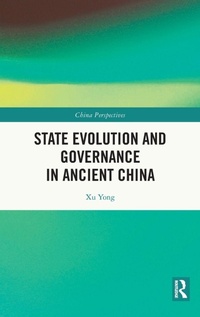
State Evolution and Governance in Ancient China
1st Edition
Published on 3. June 2026
Book
Hardback
322 pages
978-1-041-29071-1 (ISBN)
Description
This book employs the analytical framework of "relational superposition" to explain the continuity, breakthroughs, and repetitions of Chinese state evolution.
Specifically, it elucidates how, after Qin Shi Huang's unification of China, the ancient Chinese state and its governance transcended the dominance of kinship relations and shifted to territorial relations. This shift formed a super-large territorial state. Sustaining this state was an imperial system that included new institutional factors, such as centralized power represented by imperial authority, the prefecture-county bureaucracy, and the household-official system. Factors associated with the long-standing kinship system reemerged in new forms within the imperial system. Simultaneously, the imperial state reproduced relationships between itself and mandarins, scholar-officials, peasants, merchants, and soldiers that evolved through interaction. Consisting of 13 chapters, the book explores the process of state formation and governance, as well as the dominant underlying relationships from the unification of China by Qin Shi Huang to the late Qing Dynasty, through thematic discussions.
The book will be valuable for scholars and students of political science, history, and sociology.
Specifically, it elucidates how, after Qin Shi Huang's unification of China, the ancient Chinese state and its governance transcended the dominance of kinship relations and shifted to territorial relations. This shift formed a super-large territorial state. Sustaining this state was an imperial system that included new institutional factors, such as centralized power represented by imperial authority, the prefecture-county bureaucracy, and the household-official system. Factors associated with the long-standing kinship system reemerged in new forms within the imperial system. Simultaneously, the imperial state reproduced relationships between itself and mandarins, scholar-officials, peasants, merchants, and soldiers that evolved through interaction. Consisting of 13 chapters, the book explores the process of state formation and governance, as well as the dominant underlying relationships from the unification of China by Qin Shi Huang to the late Qing Dynasty, through thematic discussions.
The book will be valuable for scholars and students of political science, history, and sociology.
More details
Series
Language
English
Place of publication
London
United Kingdom
Publishing group
Taylor & Francis Ltd
Target group
College/higher education
Professional and scholarly
Academic, Postgraduate, and Undergraduate Advanced
Product notice
Laminated cover
Dimensions
Height: 234 mm
Width: 156 mm
Thickness: 19 mm
Weight
647 gr
ISBN-13
978-1-041-29071-1 (9781041290711)
Copyright in bibliographic data and cover images is held by Nielsen Book Services Limited or by the publishers or by their respective licensors: all rights reserved.
Schweitzer Classification
Other editions
Additional editions
E-Book
06/2026
1st Edition
Routledge
€225.99
Available for download
E-Book
06/2026
1st Edition
Routledge
€225.99
Available for download
Person
Xu Yong, Distinguished Professor of the "Changjiang Scholar" Program in Liberal Arts under the Ministry of Education; Senior Professor at Central China Normal University; specializes in research on Chinese politics and grassroots governance; author of Nationalisation, Peasantry and Rural Integration in China, among other works. Former Convener of the Political Science Discipline Review Group of the Academic Degrees Committee of the State Council, Member of the Social Sciences Division of the Ministry of Education's Social Science Committee, among other positions.
Content
1. The Imperial State in Territorial-Kinship Dynamics 2. The Emperor and the Patriarch in Territorial-Kinship Dynamics 3. The Emperor and His Court in Territorial-Kinship Dynamics 4. Legalism and Confucianism in Territorial-Kinship Dynamics 5. Feudalism and Local Governance in Territorial-Kinship Dynamics 6. Cities and Villages in Territorial-Kinship Dynamics 7. The Political and Clan Power in Territorial-Kinship Dynamics 8. State Law and Family Kinship in Territorial-Kinship Dynamics 9. The Imperial State and Mandarins in Territorial-Kinship Dynamics 10. The Imperial State and Literati in Territorial-Kinship Dynamics 11. The Imperial State and Peasants in Territorial-Kinship Dynamics 12. The Imperial State and Merchants in Territorial-Kinship Dynamics 13. The Imperial State and Military in Territorial-Kinship Dynamics