

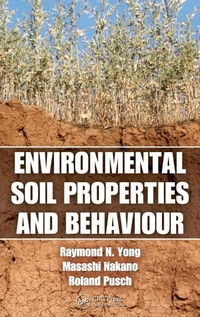
Environmental Soil Properties and Behaviour
1st Edition
Published on 5. March 2012
Book
Hardback
456 pages
978-1-4398-4529-5 (ISBN)
Description
From bridges and tunnels to nuclear waste repositories, structures require that soils maintain their design engineering properties if the structures are to reach their projected life spans. The same is true for earth dams, levees, buffers, barriers for landfills, and other structures that use soils as engineered materials. Yet soil, a natural resource, continues to change as a result of natural and anthropogenic stresses. As the discipline of soil properties and behaviours matures, new tools and techniques are making it possible to study these properties and behaviours in more depth.
What Happens to Soil Under Weathering, Aging, and Chemical Stress?
Environmental Soil Properties and Behaviour examines changes in soil properties and behaviour caused by short- and long-term stresses from anthropogenic activities and environmental forces. Introducing new concepts of soil behaviour, soil maturation, and soil functionality, it integrates soil physics, soil chemistry, and soil mechanics as vital factors in soil engineering. The book focuses on environmental soil behaviour, with particular attention to two main inter-related groups of soil-environment issues. The first is the use of soil as an environmental tool for management and containment of toxic and hazardous waste materials. The second is the impact of ageing and weathering processes and soil contamination on the properties and behaviour of soils, especially those used in geotechnical and geoenvironmental engineering projects.
A Transdisciplinary Look at Soil-Changing Processes
To determine short- and long-term soil quality and soil functionality, the authors emphasize the need to be aware of the nature of the stressors involved as well as the kinds of soil-changing processes that are evoked. This book takes a first step toward a much-needed transdisciplinary effort to develop a broader and deeper understanding of what happens to soil and how we can determine and quantify the effect of biogeochemical processes. It offers a timely resource for the study of soil properties and behaviours, effects of environmental changes, and remediation of contaminated soil.
What Happens to Soil Under Weathering, Aging, and Chemical Stress?
Environmental Soil Properties and Behaviour examines changes in soil properties and behaviour caused by short- and long-term stresses from anthropogenic activities and environmental forces. Introducing new concepts of soil behaviour, soil maturation, and soil functionality, it integrates soil physics, soil chemistry, and soil mechanics as vital factors in soil engineering. The book focuses on environmental soil behaviour, with particular attention to two main inter-related groups of soil-environment issues. The first is the use of soil as an environmental tool for management and containment of toxic and hazardous waste materials. The second is the impact of ageing and weathering processes and soil contamination on the properties and behaviour of soils, especially those used in geotechnical and geoenvironmental engineering projects.
A Transdisciplinary Look at Soil-Changing Processes
To determine short- and long-term soil quality and soil functionality, the authors emphasize the need to be aware of the nature of the stressors involved as well as the kinds of soil-changing processes that are evoked. This book takes a first step toward a much-needed transdisciplinary effort to develop a broader and deeper understanding of what happens to soil and how we can determine and quantify the effect of biogeochemical processes. It offers a timely resource for the study of soil properties and behaviours, effects of environmental changes, and remediation of contaminated soil.
More details
Language
English
Place of publication
Bosa Roca
United States
Publishing group
Taylor & Francis Inc
Target group
College/higher education
Practicing geoenvironmental engineers, geotechnical engineers, construction engineers, and engineering geologists; engineers working in mining, agriculture, and land management industries; regulators charged with responsibility for the health of the geoenvironment; senior undergraduate and post-graduate students in soil science/engineering courses in the various disciplines dealing with soil as a natural capital and as an engineering material.
Illustrations
178 s/w Abbildungen, 12 s/w Tabellen
12 Tables, black and white; 178 Illustrations, black and white
Dimensions
Height: 240 mm
Width: 161 mm
Thickness: 29 mm
Weight
845 gr
ISBN-13
978-1-4398-4529-5 (9781439845295)
Copyright in bibliographic data and cover images is held by Nielsen Book Services Limited or by the publishers or by their respective licensors: all rights reserved.
Schweitzer Classification
Other editions
Additional editions
Raymond N. Yong | Masashi Nakano | Roland Pusch
Environmental Soil Properties and Behaviour
E-Book
03/2012
1st Edition
CRC Press
€225.99
Available for download
Raymond N. Yong | Masashi Nakano | Roland Pusch
Environmental Soil Properties and Behaviour
E-Book
03/2012
1st Edition
CRC Press
€225.99
Available for download
Persons
Dr. Raymond N. Yong is the William Scott Professor Emeritus of Civil Engineering at McGill University, Canada, and emeritus professor at the University of Wales, Cardiff, United Kingdom. He is a fellow of the Royal Society (Canada), and a Chevalier de l'Orde National du Quebec. He is currently engaged in research on issues in geoenvironmental sustainability.
Dr. Masashi Nakano is the emeritus professor of soil physics and soil hydrogeology at the University of Tokyo, and director of the RISST (Research Institute of Soil Science and Technology), Japan. He was recently a member of the Science Council of Japan, and is now working on such issues in soil/clay science as adsorption/transport of chemicals on soils and mineral corrosion by microorganisms.
Dr. Roland Pusch is emeritus professor at Lund University, Sweden, and is presently guest professor at Lulea Technical University, Sweden, and honorary professor at East China Technological Institute. He is currently the scientific head and managing director of Drawrite AB, Sweden, and is working on issues of long-term stability of clay buffers in HLW repositories and on design and performance of hazardous landfills.
Dr. Masashi Nakano is the emeritus professor of soil physics and soil hydrogeology at the University of Tokyo, and director of the RISST (Research Institute of Soil Science and Technology), Japan. He was recently a member of the Science Council of Japan, and is now working on such issues in soil/clay science as adsorption/transport of chemicals on soils and mineral corrosion by microorganisms.
Dr. Roland Pusch is emeritus professor at Lund University, Sweden, and is presently guest professor at Lulea Technical University, Sweden, and honorary professor at East China Technological Institute. He is currently the scientific head and managing director of Drawrite AB, Sweden, and is working on issues of long-term stability of clay buffers in HLW repositories and on design and performance of hazardous landfills.
Content
Origin and Function of Soils. Nature of Soils. Soil-Water Systems. Swelling Clays. Stressors, Impacts, and Soil Functionality. Mechanical Properties. Thermal and Hydraulic Properties. Sorption Properties and Mechanisms. Mobility and Attenuation of Contaminants. Environmental Soil Behaviour.