

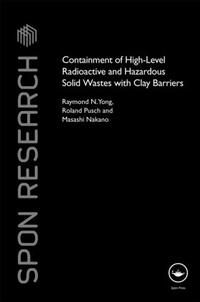
Containment of High-Level Radioactive and Hazardous Solid Wastes with Clay Barriers
1st Edition
Published on 6. October 2009
Book
Hardback
486 pages
978-0-415-45820-7 (ISBN)
Description
One of the principal objections to or problems with the use of nuclear fuel is that a proven method for safe disposal of spent nuclear fuel has yet to be established. The central focus of most schemes underway to dispose of these high-level radioactive wastes relies on clay-based buffers and barriers to isolate spent fuel canisters in boreholes deep underground in specially constructed tunnels and caverns.
Current thought on the principal methods of containment of high-level radioactive wastes is presented in this book. The authors proceed to discuss the processes and mechanisms involved in the development of long term properties and performance of clay-based buffers and backfills. The procedures and methodologies used to undertake predictions and performance assessments of these materials are also examined.
This is an invaluable reference for professionals, researchers, academics and regulators engaged in the development of radioactive waste sites.
Current thought on the principal methods of containment of high-level radioactive wastes is presented in this book. The authors proceed to discuss the processes and mechanisms involved in the development of long term properties and performance of clay-based buffers and backfills. The procedures and methodologies used to undertake predictions and performance assessments of these materials are also examined.
This is an invaluable reference for professionals, researchers, academics and regulators engaged in the development of radioactive waste sites.
More details
Series
Language
English
Place of publication
London
United Kingdom
Publishing group
Taylor & Francis Ltd
Target group
College/higher education
Professional and scholarly
Postgraduate and Professional
Product notice
Paper over boards
Illustrations
8 s/w Photographien bzw. Rasterbilder, 182 farbige Zeichnungen, 25 s/w Tabellen
25 Tables, black and white; 182 Line drawings, color; 8 Halftones, black and white
Dimensions
Height: 234 mm
Width: 156 mm
Weight
836 gr
ISBN-13
978-0-415-45820-7 (9780415458207)
Copyright in bibliographic data and cover images is held by Nielsen Book Services Limited or by the publishers or by their respective licensors: all rights reserved.
Schweitzer Classification
Other editions
Additional editions
Raymond N. Yong | Roland Pusch | Masashi Nakano
Containment of High-Level Radioactive and Hazardous Solid Wastes with Clay Barriers
Book
05/2017
1st Edition
CRC Press
€115.47
Shipment within 10-20 days
Raymond N. Yong | Roland Pusch | Masashi Nakano
Containment of High-Level Radioactive and Hazardous Solid Wastes with Clay Barriers
E-Book
05/2010
CRC Press
€107.99
Available for download
Raymond N. Yong | Roland Pusch | Masashi Nakano
Containment of High-Level Radioactive and Hazardous Solid Wastes with Clay Barriers
E-Book
05/2010
CRC Press
€107.99
Available for download

Book
10/2009
Routledge
€218.75
Article exhausted; check different version
Persons
Raymond N. Yong is Professor Emeritus of Civil Engineering and Applied Mechanics at McGill University and former Director of the Geotechnical Research Centre of McGill University, Canada.
Roland Pusch is Managing Director of Geodevelopment AB and former Professor at the Technical University of Lulea and University of Lund, Sweden.
Masashi Nakano is Emeritus Professor of Soil Physics and Soil Hydrology at the University of Tokyo and Director of the Institute of Soil Science and Engineering, Japan.
Roland Pusch is Managing Director of Geodevelopment AB and former Professor at the Technical University of Lulea and University of Lund, Sweden.
Masashi Nakano is Emeritus Professor of Soil Physics and Soil Hydrology at the University of Tokyo and Director of the Institute of Soil Science and Engineering, Japan.
Content
1. Introduction 2. Radioactive and Hazardous Solid Waste Isolation 3. Nature of Clays 4. Clay-water Reactions and Partly-saturated Water Transport 5. Contaminant-clay Interactions and Impacts 6. Thermal, Hydraulic, Mechanical, Chemical and Biological Processes 7. Clay Evolution and Long Term Buffer/Barrier Performance 8. Field and Mockup Experiments 9. Modelling for Prediction and Performance Assessment 10. Safety Assessment and Performance Determination