

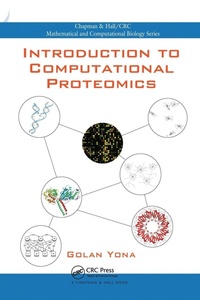
Introduction to Computational Proteomics
1st Edition
Published on 25. November 2019
Book
Paperback/Softback
768 pages
978-0-367-45228-5 (ISBN)
Description
Introduction to Computational Proteomics introduces the field of computational biology through a focused approach that tackles the different steps and problems involved with protein analysis, classification, and meta-organization. The book starts with the analysis of individual entities and works its way through the analysis of more complex entities, from protein families to interactions, cellular pathways, and gene networks.
The first part of the book presents methods for identifying the building blocks of the protein space, such as motifs and domains. It also describes algorithms for assessing similarity between proteins based on sequence and structure analysis as well as mathematical models, such as hidden Markov models and support vector machines, that are used to represent protein families and classify new instances.
The second part covers methods that investigate higher order structure in the protein space through the application of unsupervised learning algorithms, such as clustering and embedding. The book also explores the broader context of proteins. It discusses methods for analyzing gene expression data, predicting protein-protein interactions, elucidating cellular pathways, and reconstructing gene networks.
This book provides a coherent and thorough introduction to proteome analysis. It offers rigorous, formal descriptions, along with detailed algorithmic solutions and models. Each chapter includes problem sets from courses taught by the author at Cornell University and the Technion. Software downloads, data sets, and other material are available at biozon.org
The first part of the book presents methods for identifying the building blocks of the protein space, such as motifs and domains. It also describes algorithms for assessing similarity between proteins based on sequence and structure analysis as well as mathematical models, such as hidden Markov models and support vector machines, that are used to represent protein families and classify new instances.
The second part covers methods that investigate higher order structure in the protein space through the application of unsupervised learning algorithms, such as clustering and embedding. The book also explores the broader context of proteins. It discusses methods for analyzing gene expression data, predicting protein-protein interactions, elucidating cellular pathways, and reconstructing gene networks.
This book provides a coherent and thorough introduction to proteome analysis. It offers rigorous, formal descriptions, along with detailed algorithmic solutions and models. Each chapter includes problem sets from courses taught by the author at Cornell University and the Technion. Software downloads, data sets, and other material are available at biozon.org
More details
Series
Language
English
Place of publication
Oxford
United Kingdom
Publishing group
Taylor & Francis Ltd
Target group
College/higher education
Dimensions
Height: 234 mm
Width: 156 mm
Thickness: 41 mm
Weight
1147 gr
ISBN-13
978-0-367-45228-5 (9780367452285)
Copyright in bibliographic data and cover images is held by Nielsen Book Services Limited or by the publishers or by their respective licensors: all rights reserved.
Schweitzer Classification
Other editions
Additional editions
Golan Yona
Introduction to Computational Proteomics
Book
12/2010
1st Edition
Chapman & Hall/CRC
€282.73
Shipment within 15-20 days
Golan Yona
Introduction to Computational Proteomics
E-Book
12/2010
1st Edition
Chapman & Hall/CRC
€89.99
Available for download
Golan Yona
Introduction to Computational Proteomics
E-Book
12/2010
1st Edition
Chapman & Hall/CRC
€89.99
Available for download
Person
Golan Yona is a senior scientist at Stanford University. He is leader of the Biozon project, a large-scale platform for the integration of heterogeneous biological data, including DNA and protein sequences, structures, gene expression data, interactions, and pathways.
Content
The Basics. Putting All the Pieces Together. References.