

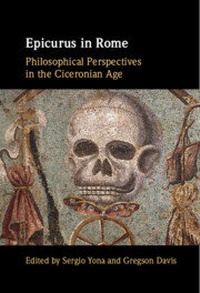
Epicurus in Rome
Philosophical Perspectives in the Ciceronian Age
Book
Paperback/Softback
978-1-108-94944-6 (ISBN)
Unfortunately, price unknown
The article will not be published
Description
The role of Greek thought in the final days of the Roman republic is a topic that has garnered much attention in recent years. This volume of essays, commissioned specially from a distinguished international group of scholars, explores the role and influence of Greek philosophy, specifically Epicureanism, in the late republic. It focuses primarily (although not exclusively) on the works and views of Cicero, premier politician and Roman philosopher of the day, and Lucretius, foremost among the representatives and supporters of Epicureanism at the time. Throughout the volume, the impact of such disparate reception on the part of these leading authors is explored in a way that illuminates the popularity as well as the controversy attached to the followers of Epicurus in Italy, ranging from ethical and political concerns to the understanding of scientific and celestial phenomena.
More details
Other editions
Additional editions
Book
01/2022
Cambridge University Press
€98.50
Article exhausted; check for reprint
Persons
Editor
University of Missouri, Columbia
Sergio Yona is an Assistant Professor in the Department of Ancient Mediterranean Studies at the University of Missouri. He is the author of Epicurean Ethics in Horace: The Psychology of Satire (2018).
Sergio Yona is an Assistant Professor in the Department of Ancient Mediterranean Studies at the University of Missouri. He is the author of Epicurean Ethics in Horace: The Psychology of Satire (2018).
Duke University, North Carolina
Gregson Davis is Andrew W. Mellon Professor Emeritus at Duke University. His major publications include: Polyhymnia: The Rhetoric of Horatian Lyric Discourse (1984) and Parthenope: The Interplay of Ideas in Vergilian Bucolic (2012).
Gregson Davis is Andrew W. Mellon Professor Emeritus at Duke University. His major publications include: Polyhymnia: The Rhetoric of Horatian Lyric Discourse (1984) and Parthenope: The Interplay of Ideas in Vergilian Bucolic (2012).
Content
1. Introduction Sergio Yona; Part I. Epicurus and Roman Identities: 2. Sint ista Graecorum: How to be an Epicurean in Late Republican Rome - Evidence from Cicero's On Ends 1-2 Geert Roskam; 3. Cicero's Rhetoric of Anti-Epicureanism: Anonymity as Critique Daniel P. Hanchey; 4. Was Atticus an Epicurean? Nathan Gilbert; 5. Caesar the Epicurean? A Matter of Life and Death Katharina Volk; 6. Otium and voluptas: Catullus and Roman Epicureanism Monica Gale; Part II. Epicurus and Lucretian Postures: 7. 'Love it or Leave it.' Nature's Ultimatum in Lucretius' On the Nature of Things (3.931-962) Elizabeth Asmis; 8. Kitsch, Death and the Epicurean Pamela Gordon; 9. Page, Stage, Image: Confronting Ennius with Lucretius' On the Nature of Things Mathias Hanses; 10. Lucretius on the Size of the Sun T. H. M. Gellar-Goad.