

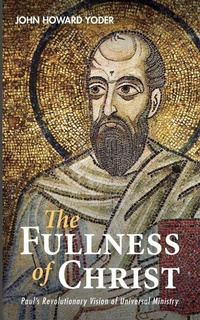
The Fullness of Christ
Published on 15. April 2019
Book
Paperback/Softback
116 pages
978-1-5326-7910-0 (ISBN)
Description
In this groundbreaking study, John Howard Yoder searches for the New Testament vision of ministry. The author examines the vocabulary used by Paul and other New Testament writers in relation to the universal ministry of the church. The theological and sociological distinctions that have since developed between clergy and laity are also examined.
Yoder concludes that the biblical texts point to the existence of a spirit-filled ministry given to all believers. While various offices of ministry are mentioned in the New Testament, the author argues that there was no laity as such in the early church. No distinctions were made between those who possessed spiritual gifts and those who did not. All members of the church were considered to have a valid ministry.
Even though this radical concept of ""universal ministry"" was soon lost from the early church, it may serve as a catalyst for discussion today as the church faces increasing challenges in leadership.
More details
Language
English
Place of publication
Eugene
United States
Product notice
Paperback (trade)
Unsewn / adhesive bound
Dimensions
Height: 203 mm
Width: 127 mm
Thickness: 7 mm
Weight
136 gr
ISBN-13
978-1-5326-7910-0 (9781532679100)
Copyright in bibliographic data and cover images is held by Nielsen Book Services Limited or by the publishers or by their respective licensors: all rights reserved.
Schweitzer Classification
Other editions
Additional editions
E-Book
04/2019
Wipf and Stock Publishers
€14.49
Available for download
Person
John Howard Yoder (1927-1997) earned his PhD from the University of Basel, and taught theology at the University of Notre Dame. For 19 years he served the Mennonite fellowship in church relations and education. Dr Yoder was Professor of Theology and President of Mennonite Bible Seminary. His published books include 'The Politics of Jesus', 'The Priestly Kingdom', 'To Hear the Word', 'When War Is Unjust, What Would You Do?', and 'He Came Preaching Peace'.