

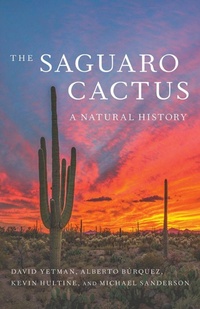
The Saguaro Cactus
A Natural History
Will be published approx. on 28. February 2020
Book
Paperback/Softback
208 pages
978-0-8165-4004-4 (ISBN)
Description
The saguaro, with its great size and characteristic shape - its arms stretching heavenward, its silhouette often resembling a human - has become the emblem of the Sonoran Desert of southwestern Arizona and northwestern Mexico. The largest and tallest cactus in the United States, it is both familiar and an object of fascination and curiosity.
This book offers a complete natural history of this enduring and iconic desert plant. Gathering everything from the saguaro's role in Sonoran Desert ecology to its adaptations to the desert climate and its sacred place in Indigenous culture, this book shares precolonial through current scientific findings.
The saguaro is charismatic and readily accessible but also decidedly different from other desert flora. The essays in this book bear witness to our ongoing fascination with the great cactus and the plant's unusual characteristics, covering the saguaro's
history of discovery,
place in the cactus family,
ecology,
anatomy and physiology,
genetics, and
ethnobotany.
The Saguaro Cactus offers testimony to the cactus's prominence as a symbol, the perceptions it inspires, its role in human society, and its importance in desert ecology.
This book offers a complete natural history of this enduring and iconic desert plant. Gathering everything from the saguaro's role in Sonoran Desert ecology to its adaptations to the desert climate and its sacred place in Indigenous culture, this book shares precolonial through current scientific findings.
The saguaro is charismatic and readily accessible but also decidedly different from other desert flora. The essays in this book bear witness to our ongoing fascination with the great cactus and the plant's unusual characteristics, covering the saguaro's
history of discovery,
place in the cactus family,
ecology,
anatomy and physiology,
genetics, and
ethnobotany.
The Saguaro Cactus offers testimony to the cactus's prominence as a symbol, the perceptions it inspires, its role in human society, and its importance in desert ecology.
Reviews / Votes
Anyone curious about the saguaro's history, ecology, and unparalleled adaptions to the desert's fierce climate will find ample answers to their questions here." - Melissa L. Sevigny, author of Under Desert Skies"The Saguaro Cactus is an extraordinary book written by extraordinary people. The authors not only summarize all you need to know about this iconic cactus, they share a wealth of new information about its relationship with the Sonoran Desert." - David E. Brown, Natural History Collections, Arizona State University
"What a rich biography chock full of amazing new secrets about our favorite old friend - the saguaro cactus! Here, through the lenses of the latest findings in genomics, ecology, biogeography, plant physiology, history, and ethnobotany, we see the giant's inner workings and meet its family-tree relatives. Descriptive photographs add layers of detail to our newfound appreciation of how this species can survive months without water in a scorching desert, and recipes for cactus fruit treats tease our palates. The Saguaro Cactus tickles our brain and gladdens our heart. Who doesn't love a saguaro?!" - Bill Broyles, co-author of Last Water on the Devil's Highway
"This contemporary look at one of the icons of the Sonoran Desert is an absolute treat! Any desert dweller or lover of cacti will be delighted to find up-to-date, detailed information on the natural and cultural history of the saguaro, along with an overview of cacti in general. Authored not only by leading authorities on the saguaro, they have written this book in a highly engaging and easily digested manner that will appeal to the academic and the lay person alike." - Craig Ivanyi, Executive Director, Arizona-Sonora Desert Museum
More details
Series
Language
English
Place of publication
Tucson
United States
Target group
Professional and scholarly
Product notice
Paperback (trade)
Unsewn / adhesive bound
Illustrations
32 colour illustrations, 24 black & white illustrations, 2 maps
Dimensions
Height: 201 mm
Width: 137 mm
Thickness: 15 mm
Weight
183 gr
ISBN-13
978-0-8165-4004-4 (9780816540044)
Copyright in bibliographic data and cover images is held by Nielsen Book Services Limited or by the publishers or by their respective licensors: all rights reserved.
Schweitzer Classification
Persons
David Yetman is a research social scientist at the Southwest Center of the University of Arizona. His research has focused on peoples and plants of the Sonoran Desert region. His books include The Great Cacti: Ethnobotany and Biogeography and The Organ Pipe Cactus. He is producer and host of the PBS television series In the Americas with David Yetman.
Alberto BUrquez is a researcher at the Instituto de EcologIa, Universidad Nacional AutOnoma de MExico. His research focuses on plant-animal interactions, biogeography, and the ecology of dryland plants.
Kevin Hultine is a research ecologist at the Desert Botanical Garden in Phoenix. He is also an adjunct faculty member in the School of Life Sciences at Arizona State University and the School of Earth & Sustainability at Northern Arizona University. His research focuses on the ecology, physiology, and climate sensitivity of dryland plants.
Michael Sanderson is a professor of ecology and evolutionary biology at the University of Arizona. His research focuses on genomics and evolutionary biology of plants (including cacti), with a special interest in computational methods and challenges.
Alberto BUrquez is a researcher at the Instituto de EcologIa, Universidad Nacional AutOnoma de MExico. His research focuses on plant-animal interactions, biogeography, and the ecology of dryland plants.
Kevin Hultine is a research ecologist at the Desert Botanical Garden in Phoenix. He is also an adjunct faculty member in the School of Life Sciences at Arizona State University and the School of Earth & Sustainability at Northern Arizona University. His research focuses on the ecology, physiology, and climate sensitivity of dryland plants.
Michael Sanderson is a professor of ecology and evolutionary biology at the University of Arizona. His research focuses on genomics and evolutionary biology of plants (including cacti), with a special interest in computational methods and challenges.