

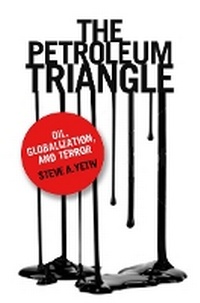
The Petroleum Triangle
Oil, Globalization, and Terror
Published on 15. October 2011
Book
Hardback
256 pages
978-0-8014-5002-0 (ISBN)
Description
In The Petroleum Triangle, Steve A. Yetiv tells the interconnected story of oil, globalization, and terrorism. Yetiv asks how Al-Qaeda, a small band of terrorists, became such a real and perceived threat to American and global security, a threat viewed as profound enough to motivate the strongest power in world history to undertake extraordinary actions, including two very costly wars.
Yetiv argues that Middle East oil and globalization have combined to augment the real and perceived threat of transnational terrorism. Globalization has allowed terrorists to do things that otherwise would be more difficult and costly: exploit technology, generate fear beyond their capabilities, target vulnerable economic and political nodes, and capitalize on socio-economic dislocation. Meanwhile, Middle East oil has fueled terrorism by helping to bolster oil-rich regimes that terrorists hate, to fund the terrorist infrastructure, and to generate anti-American and anti-Western sentiments about American support for oil-rich regimes and perceived Western designs on Middle East oil.
Together, Middle East oil and globalization have combined in various ways to help create Al-Qaeda's real and perceived threat, and that of its affiliates and offshoots. The combined effect has shaped important contours of the Petroleum Triangle and of world affairs.
A sweeping analysis of contemporary world politics and American foreign and military policy, The Petroleum Triangle convincingly argues that it is critical to understand the connections among oil, globalization, and terrorism if we seek to comprehend modern global politics. What happens within the Petroleum Triangle will help determine if the death of Osama bin Laden will ultimately cripple Al-Qaeda and its affiliates or be yet another milestone in an ongoing age of terrorism.
Yetiv argues that Middle East oil and globalization have combined to augment the real and perceived threat of transnational terrorism. Globalization has allowed terrorists to do things that otherwise would be more difficult and costly: exploit technology, generate fear beyond their capabilities, target vulnerable economic and political nodes, and capitalize on socio-economic dislocation. Meanwhile, Middle East oil has fueled terrorism by helping to bolster oil-rich regimes that terrorists hate, to fund the terrorist infrastructure, and to generate anti-American and anti-Western sentiments about American support for oil-rich regimes and perceived Western designs on Middle East oil.
Together, Middle East oil and globalization have combined in various ways to help create Al-Qaeda's real and perceived threat, and that of its affiliates and offshoots. The combined effect has shaped important contours of the Petroleum Triangle and of world affairs.
A sweeping analysis of contemporary world politics and American foreign and military policy, The Petroleum Triangle convincingly argues that it is critical to understand the connections among oil, globalization, and terrorism if we seek to comprehend modern global politics. What happens within the Petroleum Triangle will help determine if the death of Osama bin Laden will ultimately cripple Al-Qaeda and its affiliates or be yet another milestone in an ongoing age of terrorism.
Reviews / Votes
"The Petroleum Triangle is well researched, well written, and timely. Steve A. Yetiv makes a strong case that oil markets and globalization have interactively abetted transnational terrorism in recent years." -- Steven W. HookKent, State University, author of <I>U.S. Foreign Policy: The Paradox of World Power</I> "Much has been written about how the impact of oil, globalization, and terror has transformed the lives of individuals and states. Less has been written about how these three forces connect with and reinforce one another to create an entirely new phenomenon. Thankfully, Steve A. Yetiv has met this need in a beautifully written book that will be embraced by students, policymakers, and the interested public." -- Steven R. DavidThe, Johns Hopkins University, author of <I>Catastrophic Consequences: Civil Wars and American Interests</I>More details
Language
English
Place of publication
Ithaca
United States
Product notice
Paper over boards
Dimensions
Height: 235 mm
Width: 155 mm
Thickness: 22 mm
Weight
907 gr
ISBN-13
978-0-8014-5002-0 (9780801450020)
Copyright in bibliographic data and cover images is held by Nielsen Book Services Limited or by the publishers or by their respective licensors: all rights reserved.
Schweitzer Classification
Other editions
Additional editions
E-Book
10/2011
Cornell University Press
€31.99
Available for download
Person
Steve A. Yetiv is University Professor of Political Science and International Studies at Old Dominion University. He is the author of several books, including Crude Awakenings: Global Oil Security and American Foreign Policy, also from Cornell, and The Absence of Grand Strategy: U.S. Foreign Policy Toward the Persian Gulf (1972-2005). Yetiv has been a consultant to the U.S. Department of Defense, the U.S. Department of State, the U.S. General Accounting Office, and CNN International.
Content
List of Figures
Acknowledgments
List of AbbreviationsIntroduction1. America and Middle Eastern OilPart I: Oil and Transnational Terrorism
2. Explaining September 11: The Oil Factor
3. Rising Anti-Americanism in the Global Audience
4. Oil Money, Terrorist Financing, and Weapons of Mass Destruction
5. Oil Money and Hated Regimes: Fueling TerrorismPart II: Globalization and Transnational Terrorism
6. The Deadly Nexus of Globalization, Oil, and Terrorism
7. How Globalization Amplifies the Terrorist ThreatConclusionReferences
Index
Acknowledgments
List of AbbreviationsIntroduction1. America and Middle Eastern OilPart I: Oil and Transnational Terrorism
2. Explaining September 11: The Oil Factor
3. Rising Anti-Americanism in the Global Audience
4. Oil Money, Terrorist Financing, and Weapons of Mass Destruction
5. Oil Money and Hated Regimes: Fueling TerrorismPart II: Globalization and Transnational Terrorism
6. The Deadly Nexus of Globalization, Oil, and Terrorism
7. How Globalization Amplifies the Terrorist ThreatConclusionReferences
Index