

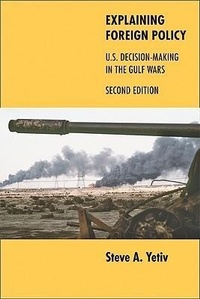
Explaining Foreign Policy
U.S. Decision-Making in the Gulf Wars
2nd Edition
Published on 26. April 2011
Book
Paperback/Softback
336 pages
978-0-8018-9894-5 (ISBN)
Description
Steve A. Yetiv has developed an interdisciplinary, integrated approach to studying foreign policy decisions, which he applies here to understand better how and why the United States went to war in the Persian Gulf in 1991 and 2003. Yetiv's innovative method employs the rational actor, cognitive, domestic politics, groupthink, and bureaucratic politics models to explain the foreign policy behavior of governments. Drawing on the widest set of primary sources to date-including a trove of recently declassified documents-and on interviews with key actors, he applies these models to illuminate the decision-making process in the two Gulf Wars and to develop theoretical notions about foreign policy. What Yetiv discovers, in addition to empirical evidence about the Persian Gulf and Iraq wars, is that no one approach provides the best explanation, but when all five are used, a fuller and more complete understanding emerges. Thoroughly updated with a new preface and a chapter on the 2003 Iraq War, Explaining Foreign Policy, already widely used in courses, will continue to be of interest to students and scholars of foreign policy, international relations, and related fields.
Reviews / Votes
"Rarely does one find a book that both thoroughly presents a theoretical framework and then actually tests that framework against reality by the vigorous use of history. Steve Yetiv... has done a remarkably good job of balancing both elements in a new study of US decision-making in the first Persian Gulf War." (Perspectives on Political Science) "An important approach to analyzing complex foreign policy decision-making." (Comparative Strategy) "An impressive foreign-policy analysis of US decision-making in the Persian Gulf War... A well-researched and highly readable book." (Political Studies Review)"More details
Edition
second edition
Language
English
Place of publication
Baltimore, MD
United States
Target group
College/higher education
Edition type
Revised edition
Product notice
Paperback (trade)
Illustrations
1 s/w Zeichnung
1 Line drawings, black and white
Dimensions
Height: 226 mm
Width: 150 mm
Thickness: 25 mm
Weight
440 gr
ISBN-13
978-0-8018-9894-5 (9780801898945)
DOI
10.56021/9780801898938
Copyright in bibliographic data and cover images is held by Nielsen Book Services Limited or by the publishers or by their respective licensors: all rights reserved.
Schweitzer Classification
Other editions
Additional editions

Book
04/2011
2nd Edition
Johns Hopkins University Press
€81.90
Article exhausted; check different version
E-Book
04/2011
2nd Edition
Johns Hopkins University Press
€20.99
Available for download
Previous edition
Book
03/2004
Johns Hopkins University Press
€39.19
Article exhausted; check for reprint
Person
Steve A. Yetiv is a university professor of political science at Old Dominion University and author of The Absence of Grand Strategy: The United States in the Persian Gulf, 1972-2005, also published by Johns Hopkins.
Content
Preface to the Second Edition
Acknowledgments
Introduction
1. The United States, Iraq, and the Crisis: Some Background
2. The Rational Actor Model
3. A Cognitive Compass: Analogies at Work
4. Constructing the Threat: Saddam the Global Menace
5. Elements of Groupthink on the Road to War
6. Government Politics: Not Much, Actually
7. Mirror, Mirror, on the Wall: Evaluating the Perspectives
8. Threading the Tale
9. Tackling Puzzles and Developing Theory
10. Understanding Government Behavior: Integrating Process, Choice, and Outcome
11. Invading Iraq
12. Beyond the Gulf: Foreign Policy and World Politics
Appendix: Core Interviews
Notes
Bibliography
Index
Acknowledgments
Introduction
1. The United States, Iraq, and the Crisis: Some Background
2. The Rational Actor Model
3. A Cognitive Compass: Analogies at Work
4. Constructing the Threat: Saddam the Global Menace
5. Elements of Groupthink on the Road to War
6. Government Politics: Not Much, Actually
7. Mirror, Mirror, on the Wall: Evaluating the Perspectives
8. Threading the Tale
9. Tackling Puzzles and Developing Theory
10. Understanding Government Behavior: Integrating Process, Choice, and Outcome
11. Invading Iraq
12. Beyond the Gulf: Foreign Policy and World Politics
Appendix: Core Interviews
Notes
Bibliography
Index