

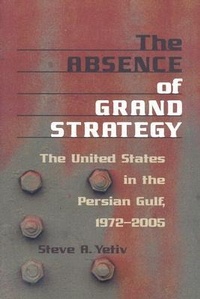
The Absence of Grand Strategy
The United States in the Persian Gulf, 1972-2005
Published on 16. June 2008
Book
Paperback/Softback
264 pages
978-0-8018-8782-6 (ISBN)
Description
Great powers and grand strategies. It is easy to assume that the most powerful nations pursue and employ consistent, cohesive, and decisive policies in trying to promote their interests in regions of the world. Popular theory emphasizes two such grand strategies that great powers may pursue: balance of power policy or hegemonic domination. But, as Steve A. Yetiv contends, things may not always be that cut and dried. Analyzing the evolution of the United States' foreign policy in the Persian Gulf from 1972 to 2005, Yetiv offers a provocative and panoramic view of American strategies in a region critical to the functioning of the entire global economy. Ten cases-from the policies of the Nixon administration to George W. Bush's war in Iraq-reveal shifting, improvised, and reactive policies that were responses to unanticipated and unpredictable events and threats. In fact, the distinguishing feature of the U.S. experience in the Gulf has been the absence of grand strategy. Yetiv introduces the concept of "reactive engagement" as an alternative approach to understanding the behavior of great powers in unstable regions. At a time when the effects of U.S. foreign policy are rippling across the globe, The Absence of Grand Strategy offers key insight into the nature and evolution of American foreign policy in the Gulf.
Reviews / Votes
It should be required reading for all graduate students contemplating a doctoral thesis in international relations theory. -- David E. Long Middle East Journal 2008 Theoretically guided but not heavily theoretical, Yetiv's book is well conceived and clearly presented... Highly recommended. Choice 2008More details
Language
English
Place of publication
Baltimore, MD
United States
Target group
College/higher education
Product notice
Paperback (trade)
Illustrations
1 Karte
1 Maps
Dimensions
Height: 183 mm
Width: 217 mm
Thickness: 14 mm
Weight
363 gr
ISBN-13
978-0-8018-8782-6 (9780801887826)
DOI
10.1353/book.3421
Copyright in bibliographic data and cover images is held by Nielsen Book Services Limited or by the publishers or by their respective licensors: all rights reserved.
Schweitzer Classification
Other editions
Additional editions
Book
06/2008
Johns Hopkins University Press
€63.00
Article not available for order
E-Book
06/2008
Johns Hopkins University Press
€20.99
Available for download
Person
Steve A. Yetiv is a professor of political science at Old Dominion University and author of Explaining Foreign Policy: U.S. Decision-Making and the Persian Gulf War, also published by Johns Hopkins.
Content
List of Tables
Preface
Introduction: No Grand Strategy
1. Exploring Great Powers in Regions
2. The Nixon Administration's Twin Pillars
3. The Reagan Administration and the Iran-Iraq War
4. The Bush Administration and Constructive Engagement
5. The Iraq War of 1991
6. The Clinton Administration and Saddam Hussein
7. Containment-Plus and Regime Change in Iraq
8. The Iraq War of 2003
9. The Decline of Balance-of-Power Policy
10. The Balance Sheet, So to Speak
11. Theory, Strategy, and Realism
Conclusion: Reactive Engagment
Appendix: Core Interviews
Notes
Bibliography
Index
Preface
Introduction: No Grand Strategy
1. Exploring Great Powers in Regions
2. The Nixon Administration's Twin Pillars
3. The Reagan Administration and the Iran-Iraq War
4. The Bush Administration and Constructive Engagement
5. The Iraq War of 1991
6. The Clinton Administration and Saddam Hussein
7. Containment-Plus and Regime Change in Iraq
8. The Iraq War of 2003
9. The Decline of Balance-of-Power Policy
10. The Balance Sheet, So to Speak
11. Theory, Strategy, and Realism
Conclusion: Reactive Engagment
Appendix: Core Interviews
Notes
Bibliography
Index