

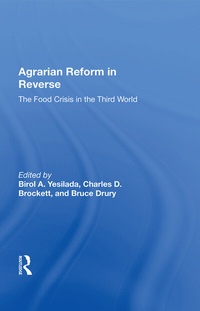
Agrarian Reform In Reverse
The Food Crisis In The Third World
1st Edition
Published on 2. October 2019
Book
Hardback
349 pages
978-0-367-01374-5 (ISBN)
Description
This book focuses on the political-economic dimensions of the food crisis, with case studies from the four regions-Africa, Asia, Latin America, and the Middle East-of the Third World. It examines various international factors that influence agricultural development in the Third World.
More details
Language
English
Place of publication
London
United Kingdom
Publishing group
Taylor & Francis Ltd
Target group
College/higher education
Dimensions
Height: 216 mm
Width: 144 mm
Weight
810 gr
ISBN-13
978-0-367-01374-5 (9780367013745)
Copyright in bibliographic data and cover images is held by Nielsen Book Services Limited or by the publishers or by their respective licensors: all rights reserved.
Schweitzer Classification
Other editions
Additional editions
Book
04/2021
1st Edition
Routledge
€55.70
Shipment within 15-20 days
E-Book
04/2019
1st Edition
Routledge
€59.49
Available for download
E-Book
04/2019
1st Edition
Routledge
€59.49
Available for download
Person
Yesilada, Birol A.
Content
1. Introduction. PART 1 CASE STUDIES OF INDUCED CHANGE IN AGRICULTURE POLICY, 2. Economic Security in the Countryside: The Impact of Agrarian Change and Public Policy in Honduras, 3. Brazilian Agriculture and the Debt Crisis, 4. Agricultural Policy and Food Security in Peru and Ecuador, 5. President Marcos, Multinationals, the World Bank, and the U.S. Government: Domestic and International, Political Economy of Philippines' Coconut, Industry, 6. Problems of Agricultural Development in Turkey, 7. The Food Crisis in Kenya, Taye, PART 2 INTERNATIONAL FACTORS AND AGRICULTURE IN THE THIRD WORLD, 8. The Impact of Dependency on Agriculture and Food, Crises in the Third World, 9. Political Implications of International Monetary Fund Conditionality for Latin America, 10. Innovation in the IMF: The Cereal Imports, Facility, 11. Who Governs the Rome Food Agencies?, 12. U.S. Foreign Agricultural Policy and the Less Developed Countries