

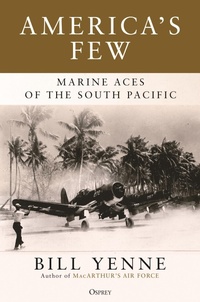
America's Few
Marine Aces of the South Pacific
Published on 6. January 2022
Book
Hardback
352 pages
978-1-4728-4749-2 (ISBN)
Description
America's Few delves into the history of US Marine Corps aviation in World War II, following the feats of the Corps' top-scoring aces in the skies over Guadalcanal.
Marine Corps aviation began in 1915, functioning as a self-contained expeditionary force. During the interwar period, the support of USMC amphibious operations became a key element of Marine aviation doctrine, and the small force gradually grew. But in December 1941 came the rude awakening. Within hours of Pearl Harbor, heroic Marine aviators were battling the Japanese over Wake Island.
In the South Pacific, the aviators of the US Marine Corps came out of the shadows to establish themselves as an air force second to none. In the summer of 1942, when Allied airpower was cobbled together into a single unified entity - nicknamed 'the Cactus Air Force' - Marine Aviation dominated, and a Marine, Major General Roy Geiger, was its commander.
Of the twelve Allied fighter squadrons that were part of the Cactus Air Force, eight were USMC squadrons. It was over Guadalcanal that Joe Foss emerged as a symbol of Marine aviation. As commander of VMF-121, he organized a group of fighter pilots that downed 72 enemy aircraft; Foss himself reached a score of 26. Pappy Boyington, meanwhile, had become a Marine aviator in 1935. Best known as the commander of VMF-214, he came into his own in late 1943 and eventually matched Foss's aerial victory score.
Through the parallel stories of these two top-scoring fighter aces, as well as many other Marine aces, such as Ken Walsh (21 victories), Don Aldrich (20), John L. Smith (19), Wilbur Thomas (18.5), and Marion Carl (18.5), many of whom received the Medal of Honor, acclaimed aviation historian Bill Yenne examines the development of US Marine Corps aviation in the South Pacific.
Marine Corps aviation began in 1915, functioning as a self-contained expeditionary force. During the interwar period, the support of USMC amphibious operations became a key element of Marine aviation doctrine, and the small force gradually grew. But in December 1941 came the rude awakening. Within hours of Pearl Harbor, heroic Marine aviators were battling the Japanese over Wake Island.
In the South Pacific, the aviators of the US Marine Corps came out of the shadows to establish themselves as an air force second to none. In the summer of 1942, when Allied airpower was cobbled together into a single unified entity - nicknamed 'the Cactus Air Force' - Marine Aviation dominated, and a Marine, Major General Roy Geiger, was its commander.
Of the twelve Allied fighter squadrons that were part of the Cactus Air Force, eight were USMC squadrons. It was over Guadalcanal that Joe Foss emerged as a symbol of Marine aviation. As commander of VMF-121, he organized a group of fighter pilots that downed 72 enemy aircraft; Foss himself reached a score of 26. Pappy Boyington, meanwhile, had become a Marine aviator in 1935. Best known as the commander of VMF-214, he came into his own in late 1943 and eventually matched Foss's aerial victory score.
Through the parallel stories of these two top-scoring fighter aces, as well as many other Marine aces, such as Ken Walsh (21 victories), Don Aldrich (20), John L. Smith (19), Wilbur Thomas (18.5), and Marion Carl (18.5), many of whom received the Medal of Honor, acclaimed aviation historian Bill Yenne examines the development of US Marine Corps aviation in the South Pacific.
Reviews / Votes
America's Few describes Marine Corps aviation's few: the two dozen 'double digit' aces who gained hard-won air superiority in the first year of the Pacific War, many of whom contributed en route to VJ Day. Bill Yenne not only describes their combat careers but the youthful backgrounds that shaped who they were beyond what they did. * Barrett Tillman, author of 'U.S. Marine Corps Fighter Squadrons of World War II' * Readable and well researched, America's Few chronicles the combat history of the 'double-digit' fighter aces, an elite cohort of Marine Corps aviators who shot down ten or more Japanese warplanes while flying the famed F4F Wildcat and F4U Corsair. An essential addition to the bookshelf of readers interested in the F4U Corsair and the remarkable pilots who flew them. * Steven K. Bailey, author of 'Bold Venture: The American Bombing of Japanese-Occupied Hong Kong, 1942-1945' * Author Bill Yenne captures the true essence of this great generation of young pilots who sacrificed so much. In 1942 the War in the Pacific Theater was not going well for the Allies and, the USMC pilots had an uphill battle to wage. The reader is immediately drawn into each dogfight, as Yenne displays a unique talent for capturing precise details. For the pilots, the obstacles were significant and an enormous psychological weight to bear. Base operations were austere, shoot down the enemy or be shot down, AAA threats, will the aircraft hold up under the stress. Every second in the air were the vivid haunting threats-bailing out over the ocean or crashing in the jungle. Will I be quickly killed or, become a POW of the Japanese? Yenne preserves the legacy of a generation of USMC airmen that deserve lasting respect. * Erik Simonsen, author of 'A Complete History of US Combat Aircraft Fly-Off Competitions' *More details
Language
English
Place of publication
United Kingdom
Publishing group
Bloomsbury Publishing PLC
Illustrations
32pp plate section in b&w
Dimensions
Height: 239 mm
Width: 159 mm
Thickness: 38 mm
Weight
738 gr
ISBN-13
978-1-4728-4749-2 (9781472847492)
Copyright in bibliographic data and cover images is held by Nielsen Book Services Limited or by the publishers or by their respective licensors: all rights reserved.
Schweitzer Classification
Other editions
Additional editions
E-Book
01/2022
1st Edition
Osprey Publishing
€21.49
Available for download
E-Book
01/2022
1st Edition
Osprey Publishing
€21.49
Available for download
Person
Bill Yenne is the author of more than three dozen non-fiction books, as well as ten novels. His work has been selected for the Chief of Staff of the Air Force Reading List. He is the recipient of the Air Force Association's Gill Robb Wilson Award for the 'most outstanding contribution in the field of arts and letters [as an] author whose works have shaped how thousands of Americans understand and appreciate airpower.' He lives in California, USA.
Content
List of Illustrations
Introduction
Double-Digit US Marine Corps Aces of World War II
Squadron Names
PART I: ORIGINS
1 Marine Corps Aviation from Flanders to Wake Island
2 Who They Were
3 Taking to the Air
4 First Combat
PART II: THE FEW
5 That Place Called Guadalcanal
6 First Blood
7 New Blood
8 Changing of the Guard
9 The Coach Takes the Field
10 Joe Foss Takes the Lead
11 Tipping Points
12 Matching the Ace of Aces
13 The Long Season of the Dancing Bears
PART III: NO LONGER A MERE FEW
14 The Corsair and the Changing Game
15 Corsair Aces Over the Solomons
16 Slow Rolls and Victories Over the Slot
17 The Ace and the Albatross
18 Finding Their Momentum
19 A Wanderer in the Wings
20 The Black Sheep Go to War
21 Three Aces Reach Double-digits
22 The Major Leagues
23 Two Squadrons Over Kahili
24 Cherry Blossom Over Bougainville
25 Two Aces Over Rabaul
26 Everything They Had Left
27 At the Top of Their Game
28 The Ending of Eras
PART IV: COUNTDOWN TO VICTORY
29 Second Acts
30 Unfinished Business
31 Victory Achieved
PART V: POSTWAR LIVES
32 In War and Peace
33 The Black Sheep and the Governor
34 Final Flights
Appendix
Abbreviations and Acronyms
Bibliography
Index
Introduction
Double-Digit US Marine Corps Aces of World War II
Squadron Names
PART I: ORIGINS
1 Marine Corps Aviation from Flanders to Wake Island
2 Who They Were
3 Taking to the Air
4 First Combat
PART II: THE FEW
5 That Place Called Guadalcanal
6 First Blood
7 New Blood
8 Changing of the Guard
9 The Coach Takes the Field
10 Joe Foss Takes the Lead
11 Tipping Points
12 Matching the Ace of Aces
13 The Long Season of the Dancing Bears
PART III: NO LONGER A MERE FEW
14 The Corsair and the Changing Game
15 Corsair Aces Over the Solomons
16 Slow Rolls and Victories Over the Slot
17 The Ace and the Albatross
18 Finding Their Momentum
19 A Wanderer in the Wings
20 The Black Sheep Go to War
21 Three Aces Reach Double-digits
22 The Major Leagues
23 Two Squadrons Over Kahili
24 Cherry Blossom Over Bougainville
25 Two Aces Over Rabaul
26 Everything They Had Left
27 At the Top of Their Game
28 The Ending of Eras
PART IV: COUNTDOWN TO VICTORY
29 Second Acts
30 Unfinished Business
31 Victory Achieved
PART V: POSTWAR LIVES
32 In War and Peace
33 The Black Sheep and the Governor
34 Final Flights
Appendix
Abbreviations and Acronyms
Bibliography
Index