

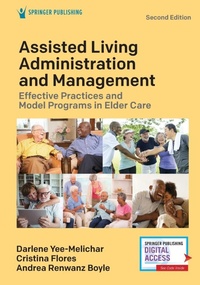
Assisted Living Administration and Management
Effective Practices and Model Programs in Elder Care
2nd Edition
Published on 12. November 2020
Book
Paperback/Softback
430 pages
978-0-8261-6194-9 (ISBN)
Description
Note to Readers: Publisher does not guarantee quality or access to any included digital components if book is purchased through a third-party seller.
Assisted Living Administration and Management: Effective Practices and Model Programs in Elder Care 2nd Edition provides students and healthcare professionals with the most up to date and essential knowledge on assisted living and residential care. This comprehensive text empowers current and future assisted living administrators to employ effective practices, understand model programs, and learn the necessary tools and tips to maximize the overall health, safety, and comfort of residents in their care. Organized by domains of practice, it also covers content information required to prepare for state-based Residential Care and Assisted Living (RC/AL) administrator certification or licensure exams.
The textbook is structured in five parts which instruct on how to build and manage effective assisted living and residential care communities, beginning with Organizational Management and progressing through Human Resources, Business and Financial Management, Environmental Management, and Resident Care Management. The second edition includes six new chapters on evolving topics, such as interprofessional practice, home and community-based services (HCBS) as alternatives to assisted living, information and communication technology (ICT), LGBT issues, memory care units, and palliative and hospice care. Chapters feature learning objectives, case studies, effective practices, and more enabling students and healthcare professionals to evaluate, analyze, and synthetize information on how to best operate, manage, and lead assisted living communities. Useful for any long-term care and health management professional or student in the fields of gerontology, health administration, and long-term care administration, this comprehensive book covers the most crucial aspects of assisted living and residential care management-the most abundant and fastest growing senior living line of service in the United States.
Key Features:Describes real-life situations and challenges associated with Assisted Living Administration with pragmatic solutions which highlight the most effective practices and model programs in elder care
Contains new chapters on interprofessional practice, home and community-based services (HCBS) as an alternative to assisted living, information and communication technology (ICT), LGBT issues, memory care units, palliative and hospice care
Highlights useful details on business and financial management, including guidelines for marketing facilities and services, important legal issues and terms, and evolving public policy issues
Incorporates chapters on environmental management, with information on accessibility, fire safety, disaster preparedness, universal design and aging in place, and much more
Emphasizes the importance of holistic, resident care management by examining the biological, psychological, and social aspects of aging
Prepares students to qualify and sit for the state certification or licensure examination as Assisted Living Administrators
Includes access to the fully downloadable eBook and instructor resources including a test bank
Assisted Living Administration and Management: Effective Practices and Model Programs in Elder Care 2nd Edition provides students and healthcare professionals with the most up to date and essential knowledge on assisted living and residential care. This comprehensive text empowers current and future assisted living administrators to employ effective practices, understand model programs, and learn the necessary tools and tips to maximize the overall health, safety, and comfort of residents in their care. Organized by domains of practice, it also covers content information required to prepare for state-based Residential Care and Assisted Living (RC/AL) administrator certification or licensure exams.
The textbook is structured in five parts which instruct on how to build and manage effective assisted living and residential care communities, beginning with Organizational Management and progressing through Human Resources, Business and Financial Management, Environmental Management, and Resident Care Management. The second edition includes six new chapters on evolving topics, such as interprofessional practice, home and community-based services (HCBS) as alternatives to assisted living, information and communication technology (ICT), LGBT issues, memory care units, and palliative and hospice care. Chapters feature learning objectives, case studies, effective practices, and more enabling students and healthcare professionals to evaluate, analyze, and synthetize information on how to best operate, manage, and lead assisted living communities. Useful for any long-term care and health management professional or student in the fields of gerontology, health administration, and long-term care administration, this comprehensive book covers the most crucial aspects of assisted living and residential care management-the most abundant and fastest growing senior living line of service in the United States.
Key Features:Describes real-life situations and challenges associated with Assisted Living Administration with pragmatic solutions which highlight the most effective practices and model programs in elder care
Contains new chapters on interprofessional practice, home and community-based services (HCBS) as an alternative to assisted living, information and communication technology (ICT), LGBT issues, memory care units, palliative and hospice care
Highlights useful details on business and financial management, including guidelines for marketing facilities and services, important legal issues and terms, and evolving public policy issues
Incorporates chapters on environmental management, with information on accessibility, fire safety, disaster preparedness, universal design and aging in place, and much more
Emphasizes the importance of holistic, resident care management by examining the biological, psychological, and social aspects of aging
Prepares students to qualify and sit for the state certification or licensure examination as Assisted Living Administrators
Includes access to the fully downloadable eBook and instructor resources including a test bank
More details
Edition
2nd New edition
Language
English
Place of publication
New York
United States
Target group
College/higher education
Edition type
New edition
Illustrations
30 Illustrations
Dimensions
Height: 254 mm
Width: 178 mm
Thickness: 23 mm
Weight
804 gr
ISBN-13
978-0-8261-6194-9 (9780826161949)
Copyright in bibliographic data and cover images is held by Nielsen Book Services Limited or by the publishers or by their respective licensors: all rights reserved.
Schweitzer Classification
Other editions
Previous edition
Darlene Yee | Andrea Boyle | Cristina Flores
Assisted Living Administration and Management
Best Practices and Model Programs for Elder Care
Book
09/2010
Springer Publishing Company
€117.55
Article exhausted; check for reprint
Persons
Darlene Yee-Melichar, EdD, FGSA, FAGHE, is professor and coordinator of gerontology at San Francisco State University (SF State) where she also serves as director of long-term care administration.
Cristina M. Flores, PhD, RN, FGSA, is the owner and licensee of three six-bed residential care facilities for the elderly in California, a lecturer in the gerontology program at SF State, and an adjunct professor for UCSF.
Andrea Renwanz Boyle, PhD, RN, FNAP, is the chair and professor of nursing at Dominican University of California and a Distinguished Practice Fellow in the National Academies of Practice. Dr. Boyle is the Co-President of Sigma Theta Tau International Nursing Honor Society (Rho Alpha Chapter) and an emerita associate professor at San Francisco State University.
Cristina M. Flores, PhD, RN, FGSA, is the owner and licensee of three six-bed residential care facilities for the elderly in California, a lecturer in the gerontology program at SF State, and an adjunct professor for UCSF.
Andrea Renwanz Boyle, PhD, RN, FNAP, is the chair and professor of nursing at Dominican University of California and a Distinguished Practice Fellow in the National Academies of Practice. Dr. Boyle is the Co-President of Sigma Theta Tau International Nursing Honor Society (Rho Alpha Chapter) and an emerita associate professor at San Francisco State University.
Content
Part One: Organizational Management
1. The Assisted Living Industry: Context, History, and Overview
2. Policy, Licensing, and Regulations
3. Organizational Overview
Part Two: Human Resources Management
4. Recruiting and Hiring Staff
5. Training Staff
6. Retaining Employees with Empowerment
7. Continuing Education
8. Interprofessional Practice: Issues for Assisted Living Administrators
Part Three: Business and Financial Management
9. Business, Management, and Marketing
10. Financial Management in Assisted Living Facilities
11. Legal Concepts and Issues in Assisted Living Facilities
Part Four: Environmental Management
12. Accessibility, Fire Safety, and Disaster Preparedness
13. Models of Care
14. Universal Design and Aging-In-Place
15. Home and Community-Based Services (HCBS) as an Alternative to Assisted Living
16. Information and Communication Technology (ICT) in Assisted Living
Part Five: Resident Care Management
17. Diversity Issues
18. LGBT Issues in Assisted Living
19. Physical Aspects of Aging
20. Psychological Aspects of Aging
21. Memory Care Units in Assisted Living: Benefits and Challenges for Administrators
22. Palliative and Hospice Care
23. Residents' Rights
1. The Assisted Living Industry: Context, History, and Overview
2. Policy, Licensing, and Regulations
3. Organizational Overview
Part Two: Human Resources Management
4. Recruiting and Hiring Staff
5. Training Staff
6. Retaining Employees with Empowerment
7. Continuing Education
8. Interprofessional Practice: Issues for Assisted Living Administrators
Part Three: Business and Financial Management
9. Business, Management, and Marketing
10. Financial Management in Assisted Living Facilities
11. Legal Concepts and Issues in Assisted Living Facilities
Part Four: Environmental Management
12. Accessibility, Fire Safety, and Disaster Preparedness
13. Models of Care
14. Universal Design and Aging-In-Place
15. Home and Community-Based Services (HCBS) as an Alternative to Assisted Living
16. Information and Communication Technology (ICT) in Assisted Living
Part Five: Resident Care Management
17. Diversity Issues
18. LGBT Issues in Assisted Living
19. Physical Aspects of Aging
20. Psychological Aspects of Aging
21. Memory Care Units in Assisted Living: Benefits and Challenges for Administrators
22. Palliative and Hospice Care
23. Residents' Rights