

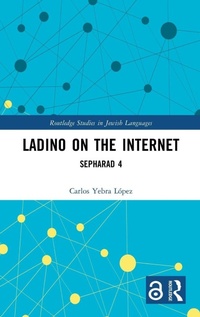
Ladino on the Internet
Sepharad 4
1st Edition
Published on 20. December 2024
Book
Hardback
258 pages
978-1-032-75365-2 (ISBN)
Description
Ladino on the Internet constitutes the first critical and systematic account written in English on the online revitalisation of Ladino.
This book conclusively demonstrates that nowadays the global Ladino-speaking community connects first and foremost online, which calls for a full, comprehensive examination of the web-based development of the Sephardic diaspora (including that of Ladino) as a qualitatively different stage, termed 'Sepharad 4' in this monograph.
Drawing upon the methodological framework of Revivalistics and including a comparative analysis with similar initiatives apropos Yiddish, this volume analyses case studies including YouTube digital archives, social media platforms, language learning apps, online schools, and Ladino on Netflix, plus on Web 3.0 platforms.
This monograph will appeal to scholars and postgraduate students seeking to familiarise themselves with the use of technological tools to further the revitalisation of endangered languages such as Ladino.
The Open Access version of this book, available at http://www.taylorfrancis.com, has been made available under a Creative Commons [Attribution-Non Commercial-No Derivatives (CC-BY)] 4.0 license.
This book conclusively demonstrates that nowadays the global Ladino-speaking community connects first and foremost online, which calls for a full, comprehensive examination of the web-based development of the Sephardic diaspora (including that of Ladino) as a qualitatively different stage, termed 'Sepharad 4' in this monograph.
Drawing upon the methodological framework of Revivalistics and including a comparative analysis with similar initiatives apropos Yiddish, this volume analyses case studies including YouTube digital archives, social media platforms, language learning apps, online schools, and Ladino on Netflix, plus on Web 3.0 platforms.
This monograph will appeal to scholars and postgraduate students seeking to familiarise themselves with the use of technological tools to further the revitalisation of endangered languages such as Ladino.
The Open Access version of this book, available at http://www.taylorfrancis.com, has been made available under a Creative Commons [Attribution-Non Commercial-No Derivatives (CC-BY)] 4.0 license.
More details
Series
Language
English
Place of publication
London
United Kingdom
Publishing group
Taylor & Francis Ltd
Target group
College/higher education
Postgraduate and Undergraduate Advanced
Dimensions
Height: 240 mm
Width: 161 mm
Thickness: 19 mm
Weight
573 gr
ISBN-13
978-1-032-75365-2 (9781032753652)
Copyright in bibliographic data and cover images is held by Nielsen Book Services Limited or by the publishers or by their respective licensors: all rights reserved.
Schweitzer Classification
Other editions
Additional editions
Book
05/2026
1st Edition
Routledge
€57.00
Shipment within 10-20 days
Person
Carlos Yebra Lopez (PhD from New York University) is an Assistant Professor in Spanish Linguistics at California State University, Fullerton. He has worked as a Ladino instructor at the Oxford School of Rare Jewish Languages, and as a CEO of Ladino 21 Community Interest Company, a public outreach initiative and digital archive devoted to grassroots documentation of Ladino.
Content
Introduction: Theoretical Framework, Scope Methodology, and Chapters
Part 1: Web 1.0: The Mostly-Read Stage (1990s-)
Chapter 1: Correspondence Circles (1999-): Ladinokomunita, Ladino Culture Forum, and SefaradiMuestro
Part 2: Web 2.0: The Participative, Multisemiotic, Multimodal Social Stage (2000s-)
Chapter 2: Digital Archives on YouTube (2011-): Autoridad Nasionala del Ladino i su Kultura, eSefarad CCSefarad, Wikitongues, Ladino 21, and VLACH
Chapter 3: Social Media and Language Learning Apps (2017-): Facebook, X, WhatsApp, TikTok, Duolingo, and uTalk
Chapter 4: Zoom Boom (2020-2): The Sephardic Digital Academy, Enkontros de Alhad, the Oxford School of Rare Jewish Languages
Chapter 5: Video-On-Demand and Streaming Services (2021-): The Netflix Shows Kuluep and The Beauty Queen of Jerusalem
Part 3: Web 3.0: The Decentralised, Blockchain- and Token-Based Stage (2010s-)
Chapter 6: Sepharad 5? (2022-): The Metaverse and The Network State
Conclusion
Part 1: Web 1.0: The Mostly-Read Stage (1990s-)
Chapter 1: Correspondence Circles (1999-): Ladinokomunita, Ladino Culture Forum, and SefaradiMuestro
Part 2: Web 2.0: The Participative, Multisemiotic, Multimodal Social Stage (2000s-)
Chapter 2: Digital Archives on YouTube (2011-): Autoridad Nasionala del Ladino i su Kultura, eSefarad CCSefarad, Wikitongues, Ladino 21, and VLACH
Chapter 3: Social Media and Language Learning Apps (2017-): Facebook, X, WhatsApp, TikTok, Duolingo, and uTalk
Chapter 4: Zoom Boom (2020-2): The Sephardic Digital Academy, Enkontros de Alhad, the Oxford School of Rare Jewish Languages
Chapter 5: Video-On-Demand and Streaming Services (2021-): The Netflix Shows Kuluep and The Beauty Queen of Jerusalem
Part 3: Web 3.0: The Decentralised, Blockchain- and Token-Based Stage (2010s-)
Chapter 6: Sepharad 5? (2022-): The Metaverse and The Network State
Conclusion