

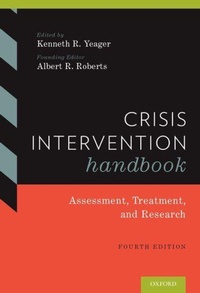
Crisis Intervention Handbook
Assessment, Treatment, and Research
4th Edition
Published on 11. June 2015
Book
Hardback
840 pages
978-0-19-020105-0 (ISBN)
Description
Fewer concepts in American society have received more attention recently than the need for skilled crisis intervention. Images of crises inundate internet and newspaper headlines, television screens and mobile devices. As a result of the growing amount of acute crisis events portrayed in the media that impact the lives of the general public, interest in crisis intervention, response teams, management, and stabilization has grown tremendously. Skills and methods to effectively manage acute crisis situations are in high demand. While many claim to understand the rapidly growing demand for effective crisis management, few provide clearly outlined step-by-step processes to educate and guide health and mental health professionals. This is a thorough revision of the first complete and authoritative handbook that prepares the crisis counselor for rapid assessment and timely crisis intervention in the 21st century.
Expanded and fully updated, the Crisis Intervention Handbook: Assessment, Treatment, and Research, Fourth Edition will focus on crisis intervention services for persons who are victims of natural disasters, school-based and home-based violence, violent crimes, and personal or family crises. It applies a unifying model of crisis intervention, making it appropriate for front-line crisis workers-clinical psychologists, social workers, psychiatric-mental health nurses, and graduate students who need to know the latest steps and methods for intervening effectively with persons in acute crisis.
Expanded and fully updated, the Crisis Intervention Handbook: Assessment, Treatment, and Research, Fourth Edition will focus on crisis intervention services for persons who are victims of natural disasters, school-based and home-based violence, violent crimes, and personal or family crises. It applies a unifying model of crisis intervention, making it appropriate for front-line crisis workers-clinical psychologists, social workers, psychiatric-mental health nurses, and graduate students who need to know the latest steps and methods for intervening effectively with persons in acute crisis.
More details
Edition
4th Revised edition
Language
English
Place of publication
New York
United States
Target group
Professional and scholarly
Edition type
Revised edition
Product notice
sewn/stitched
Cloth over boards
Dimensions
Height: 235 mm
Width: 167 mm
Thickness: 59 mm
Weight
1207 gr
ISBN-13
978-0-19-020105-0 (9780190201050)
Copyright in bibliographic data and cover images is held by Nielsen Book Services Limited or by the publishers or by their respective licensors: all rights reserved.
Schweitzer Classification
Other editions
Additional editions
E-Book
04/2015
4th Edition
OUP eBook
€61.99
Available for download
E-Book
04/2015
4th Edition
OUP eBook
€61.99
Available for download
Persons
Kenneth Yeager, PhD, LISW, is the Director of Quality and Operational Improvement for The Ohio State University Harding Hospital, Administrative Director of The OSU Harding Hospital Outpatient Psychiatric Clinics, and Clinical Associate Professor in the Department of Psychiatry, The Ohio State University.
Albert Roberts, PhD, was Professor of Social Work and Criminal Justice, Rutgers University.
Albert Roberts, PhD, was Professor of Social Work and Criminal Justice, Rutgers University.
Content
1: Bridging the Past and Present to the Future of Crisis Intervention and Crisis Management ; 2: Lethality Assessment and Crisis Intervention With Persons Presenting With Suicidal Ideation ; 3: How to Work with Clients' Strengths in Crisis Intervention: A Solution-Focused Approach ; 4: Differentiating Among Stress, Acute Stress Disorder, Acute Crisis Episodes, Trauma, and PTSD: Paradigm and Treatment Goals ; 5: Crisis Intervention for Persons Diagnosed With Clinical Disorders Based on the Stress-Crisis Continuum ; 6: Suicide Crisis Intervention ; 7: The ACT Model: Assessment, Crisis Intervention, and Trauma Treatment in the Aftermath of Community Disasters ; 8: Crisis Intervention and First Responders to Events Involving Terrorism and Weapons of Mass Destruction ; 9: An Examination of the U.S. Response to Bioterrorism: Handling the Threat and Aftermath through Crisis Intervention ; 10: Crisis Intervention Teams: Police-Based First Response for Individuals in Mental Health Crisis ; 11: Child and Adolescent Psychiatric Emergencies: Mobile Crisis Response ; 12: Crisis Intervention with Early Adolescents Who Have Suffered a Significant Loss ; 13: Crisis Intervention at College Counseling Centers ; 14: School Crisis Intervention, Crisis Prevention, and Crisis Response ; 15: Crisis Intervention with Chronic School Violence and Volatile Situations ; 16: A Comprehensive Model for Crisis Intervention with Battered Women and Their Children ; 17: Crisis Intervention With Stalking Victims ; 18: Crisis Intervention Application of Brief Solution-Focused Therapy in Addictions ; 19: Mobile Crisis Units: Frontline Community Mental Health Services ; 20: Crisis Intervention with HIV Positive Women ; 21 Animal Assisted Crisis Repsonse ; 22: Trauma Support Services for Healthcare Workers: The Stress Trauma and Resilience (STAR) Program ; 23: Crisis Intervention With Caregivers ; 24: A Model of Crisis Intervention in Critical and Intensive Care Units of General Hospitals ; 25: Models for Effective Crisis Intervention ; 26: The Crisis State Assessment Scale: Development and Psychometrics ; 27: Designs and Procedures for Evaluating Crisis Intervention