

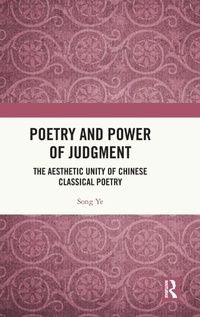
Poetry and Power of Judgment
The Aesthetic Unity of Chinese Classical Poetry
1st Edition
Published on 25. July 2024
Book
Hardback
294 pages
978-1-032-78375-8 (ISBN)
Description
This book examines Chinese traditional poetry with an emphasis on the sources of pleasure in creating and appreciating classical Chinese poems and the basis for valid aesthetic judgments about poetry.
The pleasure derived from art plays a crucial role in people's evaluation of its worth. This book shows that Chinese classical poetics and Western aesthetics agree on the sources of aesthetic pleasure. Both hold, despite their obvious differences, that aesthetic taste essentially involves cognition. The book explores important ideas in traditional Chinese poetry, emphasizing that "Poetry is founded upon the power of judgement (shi)." This central idea guides other key concepts throughout the history of Chinese poetics, revealing the fundamental principles of creating and appreciating poetic art. The author presents new views of traditional Chinese poetry and poetics by unifying these long-dispersed basic propositions into a new coherent cognitivist framework that also gives due importance to emotion.
Scholars and students studying Chinese literature, poetics, philosophy of art, and philosophy of mind will find this book interesting.
The pleasure derived from art plays a crucial role in people's evaluation of its worth. This book shows that Chinese classical poetics and Western aesthetics agree on the sources of aesthetic pleasure. Both hold, despite their obvious differences, that aesthetic taste essentially involves cognition. The book explores important ideas in traditional Chinese poetry, emphasizing that "Poetry is founded upon the power of judgement (shi)." This central idea guides other key concepts throughout the history of Chinese poetics, revealing the fundamental principles of creating and appreciating poetic art. The author presents new views of traditional Chinese poetry and poetics by unifying these long-dispersed basic propositions into a new coherent cognitivist framework that also gives due importance to emotion.
Scholars and students studying Chinese literature, poetics, philosophy of art, and philosophy of mind will find this book interesting.
More details
Language
English
Place of publication
London
United Kingdom
Publishing group
Taylor & Francis Ltd
Target group
College/higher education
Professional and scholarly
Academic, Postgraduate, Undergraduate Advanced, and Undergraduate Core
Dimensions
Height: 240 mm
Width: 161 mm
Thickness: 21 mm
Weight
617 gr
ISBN-13
978-1-032-78375-8 (9781032783758)
Copyright in bibliographic data and cover images is held by Nielsen Book Services Limited or by the publishers or by their respective licensors: all rights reserved.
Schweitzer Classification
Other editions
Additional editions
Book
approx. 07/2026
1st Edition
Routledge
€47.50
Not yet published
E-Book
07/2024
1st Edition
Routledge
€73.99
Available for download
E-Book
07/2024
1st Edition
Routledge
€73.99
Available for download
Person
Song Ye is currently a lecturer at Hebei University, China. His research interests include the Chinese classical poetics, Chinese and Western aesthetics, and Chinese classical poems. He is also a poet and has published his own classical poetic work, Collection of Poetic Insights (Yuanshi Ji, 2018).
Content
Introduction 1. Beyond aesthetic tastes: Why can beauty make universal claim? 2. Universal cognitive laws upon which aesthetic judgment of Chinese classical poetry is grounded 3. The proposition with the most salient cognitive attributes in the history of Chinese poetics: Poetry is founded upon the power of judgment 4. The relationship among "aspiration," "emotion," and "judgment," and the intermediary role of "intent" 5. An analysis of the cognitive nature of "intent" 6. How qi (vital force) and ge (manner) lead to the issue of "judgment": The examination on qi and ge 7. "Principle" (li) and "judgment": An examination of "principle" 8. "Ideorealm" and "judgment": Cognitive issues in "ideorealm"