

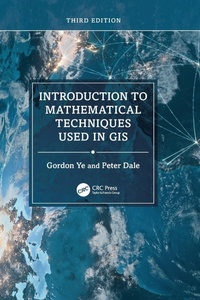
Introduction to Mathematical Techniques Used in GIS
3rd Edition
Published on 26. August 2025
Book
Hardback
346 pages
978-1-032-73472-9 (ISBN)
Description
GIS technology and applications have advanced as fast as computing technology to enhance business analytics, predictive modeling, virtual reality, and artificial intelligence. The third edition addresses these new topics of interest to students and practitioners who are using geographic information systems but have a limited mathematical background. Thoroughly updated and reorganized to focus more on applications and problem solving by mathematical techniques, this book explains the basic architecture of computing as it relates to GIS, includes new application examples of selected mathematical methods, and introduces 3D modeling, machine learning, and more.
Features
Explains the basic mathematics that underpins the manipulation of spatially related data and adds new technology direction such as machine learning
Builds logically step-by-step from simple basic assumptions to real world GIS applications to illustrate mathematical techniques covered in each chapter
Explains computing fundamentals including databases, and modeling techniques such as network modeling and topology overlay
Includes two new chapters focused on how computing relates to mathematics, and new popular applications of GIS which connect with data science and artificial intelligence
Prepares today's GIS students who do not have STEM backgrounds to follow the thought processes behind the practice of GIS
This textbook is written for those who use global information systems and applications but have a limited mathematical background. It explains the mathematics behind the applications, making it an accessible book for both undergraduate and graduate students in GIS, Computer Science, Geography, and Geomatics.
Features
Explains the basic mathematics that underpins the manipulation of spatially related data and adds new technology direction such as machine learning
Builds logically step-by-step from simple basic assumptions to real world GIS applications to illustrate mathematical techniques covered in each chapter
Explains computing fundamentals including databases, and modeling techniques such as network modeling and topology overlay
Includes two new chapters focused on how computing relates to mathematics, and new popular applications of GIS which connect with data science and artificial intelligence
Prepares today's GIS students who do not have STEM backgrounds to follow the thought processes behind the practice of GIS
This textbook is written for those who use global information systems and applications but have a limited mathematical background. It explains the mathematics behind the applications, making it an accessible book for both undergraduate and graduate students in GIS, Computer Science, Geography, and Geomatics.
More details
Edition
3rd edition
Language
English
Place of publication
London
United Kingdom
Publishing group
Taylor & Francis Ltd
Target group
College/higher education
Professional and scholarly
Professional Training, Undergraduate Advanced, and Undergraduate Core
Illustrations
1 s/w Photographie bzw. Rasterbild, 172 s/w Zeichnungen, 28 s/w Tabellen, 173 s/w Abbildungen
28 Tables, black and white; 172 Line drawings, black and white; 1 Halftones, black and white; 173 Illustrations, black and white
Dimensions
Height: 260 mm
Width: 183 mm
Thickness: 25 mm
Weight
897 gr
ISBN-13
978-1-032-73472-9 (9781032734729)
Copyright in bibliographic data and cover images is held by Nielsen Book Services Limited or by the publishers or by their respective licensors: all rights reserved.
Schweitzer Classification
Other editions
Additional editions
Gordon Ye | Peter Dale
Introduction to Mathematical Techniques Used in GIS
E-Book
08/2025
3rd Edition
CRC Press
€158.99
Available for download
Gordon Ye | Peter Dale
Introduction to Mathematical Techniques Used in GIS
E-Book
08/2025
3rd Edition
CRC Press
€158.99
Available for download
Previous edition
Peter Dale
Mathematical Techniques in GIS
Book
05/2014
2nd Edition
CRC Press
€172.80
Shipment within 15-20 days
Persons
Gordon Ye is an instructor at the City College of San Francisco who developed and taught a well-regarded GIS certificate program from 1999 to 2019 over a span of 21 years. He has a master's degree in physics from University of California at Berkeley in 1993 and started specializing in Geographic Information Systems at the UC Berkeley City Regional Planning department as a research assistant. His research projects include modeling wildfire susceptibility and modeling real estate value impacts by environmental events. In 1996 he started working for San Francisco-based Pacific Gas and Electric Co. as a GIS analyst and later as an application engineer, during which he developed GIS mapping systems for management of both gas and electric infrastructure. During 2008-2010 he worked briefly for a defense contractor as a software engineer and developed automated tools to build 3D virtual reality models of foreign war zones for military training games. He returned to work for Pacific Gas and Electric Co. after the devastating gas pipeline explosion at San Bruno, California in 2010. Since 2011 he has been focused on modeling gas pipeline integrity risks such as corrosion and earthquakes, and their potential impacts to people and the environment.
Peter Dale trained as a land surveyor and worked for seven years in Uganda before entering the academic world. He ultimately became a professor in land information management at the University College London. He is an Honorary President of the International Federation of Surveyors and was awarded an OBE in recognition of his services to surveying. He is now retired and lives in a remote area of Scotland.
Peter Dale trained as a land surveyor and worked for seven years in Uganda before entering the academic world. He ultimately became a professor in land information management at the University College London. He is an Honorary President of the International Federation of Surveyors and was awarded an OBE in recognition of his services to surveying. He is now retired and lives in a remote area of Scotland.
Content
Unit 1: Data, Information, Numbers. 1. Characteristics of Geographic Information. 2. Numbers and Numerical Analysis. 3. Data Inside Computers. Unit 2: Measuring Space. 4. Algebra: Treating Numbers as Symbols. 5. The Geometry of Common Shapes. 6. Plane and Spherical Trigonometry. 7. Applied Spatial Analysis. Unit 3: Transforming Space. 8. Vectors. 9. Matrices and Determinants. 10. Differential and Integral Calculus. Unit 4: Modeling Space. 11. 2D/3D Transformations. 12. Map Projections. 13. Curves and Surfaces. Unit 5: Finding Patterns and Predicting. 14. Basic Statistics. 15. Correlation and Regression. 16. Statistical Modeling and Machine Learning.