

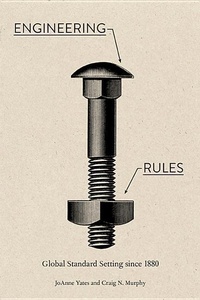
Engineering Rules
Global Standard Setting since 1880
Published on 6. August 2019
Book
Hardback
440 pages
978-1-4214-2889-5 (ISBN)
Description
The first global history of voluntary consensus standard setting.
Finalist, Hagley Prize in Business History, The Hagley Museum and Library / The Business History Conference
Private, voluntary standards shape almost everything we use, from screw threads to shipping containers to e-readers. They have been critical to every major change in the world economy for more than a century, including the rise of global manufacturing and the ubiquity of the internet. In Engineering Rules, JoAnne Yates and Craig N. Murphy trace the standard-setting system's evolution through time, revealing a process with an astonishingly pervasive, if rarely noticed, impact on all of our lives.
This type of standard setting was established in the 1880s, when engineers aimed to prove their status as professionals by creating useful standards that would be widely adopted by manufacturers while satisfying corporate customers. Yates and Murphy explain how these engineers' processes provided a timely way to set desirable standards that would have taken much longer to emerge from the market and that governments were rarely willing to set. By the 1920s, the standardizers began to think of themselves as critical to global prosperity and world peace. After World War II, standardizers transcended Cold War divisions to create standards that made the global economy possible. Finally, Yates and Murphy reveal how, since 1990, a new generation of standardizers has focused on supporting the internet and web while applying the same standard-setting process to regulate the potential social and environmental harms of the increasingly global economy.
Drawing on archival materials from three continents, Yates and Murphy describe the positive ideals that sparked the standardization movement, the ways its leaders tried to realize those ideals, and the challenges the movement faces today. Engineering Rules is a riveting global history of the people, processes, and organizations that created and maintain this nearly invisible infrastructure of today's economy, which is just as important as the state or the global market.
Finalist, Hagley Prize in Business History, The Hagley Museum and Library / The Business History Conference
Private, voluntary standards shape almost everything we use, from screw threads to shipping containers to e-readers. They have been critical to every major change in the world economy for more than a century, including the rise of global manufacturing and the ubiquity of the internet. In Engineering Rules, JoAnne Yates and Craig N. Murphy trace the standard-setting system's evolution through time, revealing a process with an astonishingly pervasive, if rarely noticed, impact on all of our lives.
This type of standard setting was established in the 1880s, when engineers aimed to prove their status as professionals by creating useful standards that would be widely adopted by manufacturers while satisfying corporate customers. Yates and Murphy explain how these engineers' processes provided a timely way to set desirable standards that would have taken much longer to emerge from the market and that governments were rarely willing to set. By the 1920s, the standardizers began to think of themselves as critical to global prosperity and world peace. After World War II, standardizers transcended Cold War divisions to create standards that made the global economy possible. Finally, Yates and Murphy reveal how, since 1990, a new generation of standardizers has focused on supporting the internet and web while applying the same standard-setting process to regulate the potential social and environmental harms of the increasingly global economy.
Drawing on archival materials from three continents, Yates and Murphy describe the positive ideals that sparked the standardization movement, the ways its leaders tried to realize those ideals, and the challenges the movement faces today. Engineering Rules is a riveting global history of the people, processes, and organizations that created and maintain this nearly invisible infrastructure of today's economy, which is just as important as the state or the global market.
Reviews / Votes
Every standards professional should own this book. Bottom line-an A+.-Standards Engineering By recounting the story of standardization, Yates and Murphy demonstrate how human and organizational actions slowly sediment into institutions that melt into the background of our lives.
-Administrative Science Quarterly Yates and Murphy provide an engaging narrative about the people and processes responsible for making the technologies we have today work with one another
-New Books Network The book is an extraordinarily detailed history of the movement from national to international standards creation and use. It introduces as its heroes . . . a series of men of rectitude and accomplishment who selflessly built the practice.
-Yale Journal on Regulation A comprehensive, readable account of private standard setting that should interest legal scholars, lawyers, and law students. Yates and Murphy have provided a great service with their illuminating history of the private world of standard setting.
-The Regulatory Review This book is history at its finest. It is not only a technical and business history of engineering standards but also a deeply researched social history of communities of standardizers. It is also elegantly written-a testament to Yates's and Murphy's research and writing skills. Historians of capitalism and technology will find it required reading, but this book also stands a fair chance of engaging a mass readership.
-Business History Review
More details
Series
Language
English
Place of publication
Baltimore, MD
United States
Target group
Professional and scholarly
Product notice
sewn/stitched
Cloth over boards
Illustrations
24 s/w Photographien bzw. Rasterbilder, 2 s/w Zeichnungen
2 Line drawings, black and white; 24 Halftones, black and white
Dimensions
Height: 236 mm
Width: 159 mm
Thickness: 35 mm
Weight
729 gr
ISBN-13
978-1-4214-2889-5 (9781421428895)
DOI
10.1353/book.66187
Copyright in bibliographic data and cover images is held by Nielsen Book Services Limited or by the publishers or by their respective licensors: all rights reserved.
Schweitzer Classification
Other editions
Additional editions
Book
05/2021
Johns Hopkins University Press
€48.30
Shipment within 10-20 days
E-Book
08/2019
Johns Hopkins University Press
€29.99
Available for download
Persons
JoAnne Yates is the Sloan Distinguished Professor of Management, Emerita, at the Massachusetts Institute of Technology. She is the author of Control through Communication: The Rise of System in American Management and Structuring the Information Age: Life Insurance and Technology in the Twentieth Century. Craig N. Murphy is the Betty Freyhof Johnson '44 Professor of Political Science at Wellesley College. He is the author of The United Nations Development Programme: A Better Way? and International Organization and Industrial Change: Global Governance since 1850.
Content
Acknowledgments
Acronyms
Introduction
Part I. The First Wave
1. Engineering Professionalization and Private Standard Setting for Industry before 1900
2. Organizing Private Standard Setting within and across Borders, 1900 to World War I
3. A Community and a Movement, World War I to the Great Depression
Part II. The Second Wave
4. Decline and Revival of the Movement, the 1930s to the 1950s
5. Standards for a Global Market, the 1960s to the 1980s
6. US Participation in International RFI/EMC Standardization, World War II to the 1980s
Part III. The Third Wave
7. Computer Networking Ushers in a New Era in Standard Setting, 1980s to 2000s
8. Development of the W3C WebCrypto API Standard, 2012 to 2017
9. Voluntary Standards for Quality Management and Social Responsibility since the 1980s
Conclusion
Essay on Primary Sources
Notes
Index
Acronyms
Introduction
Part I. The First Wave
1. Engineering Professionalization and Private Standard Setting for Industry before 1900
2. Organizing Private Standard Setting within and across Borders, 1900 to World War I
3. A Community and a Movement, World War I to the Great Depression
Part II. The Second Wave
4. Decline and Revival of the Movement, the 1930s to the 1950s
5. Standards for a Global Market, the 1960s to the 1980s
6. US Participation in International RFI/EMC Standardization, World War II to the 1980s
Part III. The Third Wave
7. Computer Networking Ushers in a New Era in Standard Setting, 1980s to 2000s
8. Development of the W3C WebCrypto API Standard, 2012 to 2017
9. Voluntary Standards for Quality Management and Social Responsibility since the 1980s
Conclusion
Essay on Primary Sources
Notes
Index