

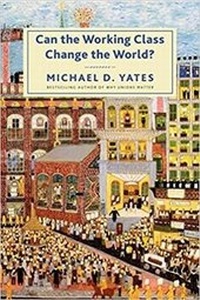
Can the Working Class Change the World?
Published on 22. August 2018
Book
Hardback
224 pages
978-1-58367-711-7 (ISBN)
Description
"Michael Yates's passion and respect for the class he came out of delivers a book that is especially accessible without retreating from the complexities and internal contradictions of working class life and organization-a book committed not only to defending workers, but also to building on their potentials to transform society."-Sam Gindin, former chief economist, Canadian Auto Workers Union; Packer Visitor in Social Justice, Political Science Dept., York University, Toronto
One of the horrors of the capitalist system is that slave labor, which was central to the formation and growth of capitalism itself, is still fully able to coexist alongside wage labor. But, as Karl Marx points out, it is the fact of being paid for one's work that validates capitalism as a viable socio-economic structure. Beneath this veil of "free commerce" - where workers are paid only for a portion of their workday, and buyers and sellers in the marketplace face each other as "equals" - lies a foundation of immense inequality. Yet workers have always rebelled. They've organized unions, struck, picketed, boycotted, formed political organizations and parties - sometimes they have actually won and improved their lives. But, Marx argued, because capitalism is the apotheosis of class society, it must be the last class society: it must, therefore, be destroyed. And only the working class, said Marx, is capable of creating that change.
In his timely and innovative book, Michael D. Yates asks if the working class can, indeed, change the world. Deftly factoring in such contemporary elements as sharp changes in the rise of identity politics and the nature of work, itself, Yates asks if there can, in fact, be a thing called the working class? If so, how might it overcome inherent divisions of gender, race, ethnicity, religion, location - to become a cohesive and radical force for change? Forcefully and without illusions, Yates supports his arguments with relevant, clearly explained data, historical examples, and his own personal experiences. This book is a sophisticated and prescient understanding of the working class, and what all of us might do to change the world.
One of the horrors of the capitalist system is that slave labor, which was central to the formation and growth of capitalism itself, is still fully able to coexist alongside wage labor. But, as Karl Marx points out, it is the fact of being paid for one's work that validates capitalism as a viable socio-economic structure. Beneath this veil of "free commerce" - where workers are paid only for a portion of their workday, and buyers and sellers in the marketplace face each other as "equals" - lies a foundation of immense inequality. Yet workers have always rebelled. They've organized unions, struck, picketed, boycotted, formed political organizations and parties - sometimes they have actually won and improved their lives. But, Marx argued, because capitalism is the apotheosis of class society, it must be the last class society: it must, therefore, be destroyed. And only the working class, said Marx, is capable of creating that change.
In his timely and innovative book, Michael D. Yates asks if the working class can, indeed, change the world. Deftly factoring in such contemporary elements as sharp changes in the rise of identity politics and the nature of work, itself, Yates asks if there can, in fact, be a thing called the working class? If so, how might it overcome inherent divisions of gender, race, ethnicity, religion, location - to become a cohesive and radical force for change? Forcefully and without illusions, Yates supports his arguments with relevant, clearly explained data, historical examples, and his own personal experiences. This book is a sophisticated and prescient understanding of the working class, and what all of us might do to change the world.
Reviews / Votes
"Michael Yates's passion and respect for the class he came out of delivers a book that is especially accessible without retreating from the complexities and internal contradictions of working class life and organization-a book committed not only to defending workers, but also to building on their potentials to transform society."-Sam Gindin, former chief economist, Canadian Auto Workers Union; Packer Visitor in Social Justice, Political Science Dept., York University, TorontoMore details
Language
English
Place of publication
New York
United States
Target group
College/higher education
Product notice
sewn/stitched
Cloth over boards
Dimensions
Height: 210 mm
Width: 140 mm
ISBN-13
978-1-58367-711-7 (9781583677117)
Copyright in bibliographic data and cover images is held by Nielsen Book Services Limited or by the publishers or by their respective licensors: all rights reserved.
Schweitzer Classification
Person
Michael D. Yates is Associate Editor of Monthly Review and Editorial Director of Monthly Review Press. For more than three decades, he was a labor educator, teaching working people in venues across the United States. Among his books are The Great Inequality, Why Unions Matter (with Paul Le Blanc), A Freedom Budget for All Americans, and The ABCs of the Economic Crisis (with Fred Magdoff).