

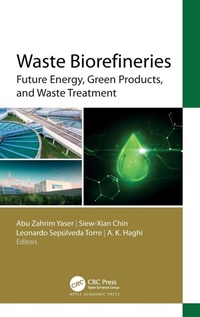
Waste Biorefineries
Future Energy, Green Products, and Waste Treatment
1st Edition
Published on 23. August 2024
Book
Hardback
282 pages
978-1-77491-546-2 (ISBN)
Description
With the growth of the world population and the production of more waste, the world needs to implement sustainable waste management to make better use of our resources. Biorefineries are an essential technology in converting biomass into useful materials. This volume provides a comprehensive overview of biorefining processing techniques, technologies, and materials that can use waste products in a number of innovative ways. It covers proven case studies that demonstrate the most advanced and innovative processes and product developments on waste biorefinery principles. This new book also provides valuable data and technologies that consider environmental impacts.
This reference book is divided into three sections that provide a thoughtful outlook on technologies associated with waste biorefinery. In the first section, the reader is introduced to recent steps toward renewable and clean energy along with waste-to-energy technologies. The second section of this book is devoted to modern technologies for waste valorization that holds a valuable prospective for a sustainable green world. In the last section of the book, the authors consider the future energy, green products, and waste treatment.
This volume is a practical guide for postgraduate scholars and scientists interested in waste biorefinery. Readers will also gain a broader overview on theory and application of this important field.
This reference book is divided into three sections that provide a thoughtful outlook on technologies associated with waste biorefinery. In the first section, the reader is introduced to recent steps toward renewable and clean energy along with waste-to-energy technologies. The second section of this book is devoted to modern technologies for waste valorization that holds a valuable prospective for a sustainable green world. In the last section of the book, the authors consider the future energy, green products, and waste treatment.
This volume is a practical guide for postgraduate scholars and scientists interested in waste biorefinery. Readers will also gain a broader overview on theory and application of this important field.
More details
Language
English
Place of publication
Oakville
Canada
Target group
College/higher education
Professional and scholarly
Academic and Postgraduate
Illustrations
86 s/w Abbildungen, 25 s/w Tabellen
25 Tables, black and white; 86 Illustrations, black and white
Dimensions
Height: 240 mm
Width: 161 mm
Thickness: 21 mm
Weight
617 gr
ISBN-13
978-1-77491-546-2 (9781774915462)
Copyright in bibliographic data and cover images is held by Nielsen Book Services Limited or by the publishers or by their respective licensors: all rights reserved.
Schweitzer Classification
Other editions
Additional editions
Abu Zahrim Yaser | Siew-Xian Chin | Leonardo Sepulveda Torre
Waste Biorefineries
Future Energy, Green Products, and Waste Treatment
E-Book
08/2024
1st Edition
Taylor & Francis
€194.99
Available for download
Abu Zahrim Yaser | Siew-Xian Chin | Leonardo Sepulveda Torre
Waste Biorefineries
Future Energy, Green Products, and Waste Treatment
E-Book
08/2024
1st Edition
Taylor & Francis
€194.99
Available for download
Persons
Abu Zahrim Yaser, PhD, is Associate Professor in Waste Processing Technology at the Faculty of Engineering, Universiti Malaysia Sabah, Malaysia. He obtained his PhD from Swansea University, Wales. His inventions on composting system have been adopted by the Tongod and Nabawan districts in Sabah, Malaysia. He is a visiting scientist at the University of Hull, England, and a member of the Institutions of Chemical Engineers (United Kingdom), Board of Engineers (Malaysia), and MyBIOGAS.
Siew-Xian Chin, PhD, is currently a Senior Lecturer at the Universiti Kebangsaan Malaysia (UKM). She received her PhD in Materials Science at UKM, Malaysia, in 2015. Her research interests include the development of new materials for wastewater treatment, such as membrane, bead, aerogel, etc. She has utilized agricultural by-products, including cellulose and chitosan, to produce adsorbent materials with high adsorption capacity by introducing various chemical modifications. She was a Visiting Doctoral Researcher at the Chinese Academy of Science in 2014.
Leonardo Sepulveda Torre, PhD, is a Researcher at the School of Chemistry at the Universidad Autonoma de Coahuila, Saltillo, Coahuila, Mexico, where he is also a member of the Bioprocesses and Microbial Biochemistry Group. His postgraduate studies were in related topics on food biotechnology in the Food Research Department of the UAdeC. In 2011, he made a research stay at the Institute of Biotechnology and Bioengineering at the University of Minho (Uminho), Braga, Portugal. He worked as a collaborator at the Center of Biological Engineering in Uminho, Braga, Portugal, with the link project "Biotechnologies for Regional Food Biodiversity in Latin America." He carried out his postdoctoral program at the same institution, writing on "Assisted Extraction by Fermentation of Polyphenols from Agroindustrial Waste."
A. K. Haghi, PhD, is a retired professor with over 250 academic research-oriented books as well as over 1000 research papers published in various journals and conference proceedings, with over 3300 citations and h-index of 30, according to the Google Scholar database. Professor Haghi has received several grants, consulted for several major corporations, and is a frequent speaker to national and international audiences. He is Founder and former Editor-in-Chief of the International Journal of Chemoinformatics and Chemical Engineering, published by IGI Global, as well as Polymers Research Journal,published by Nova Science Publishers. Professor Haghi has acted as an editorial board member of many international journals. He has served as a member of the Canadian Research and Development Center of Sciences and Cultures and the Research Chemistry Centre, Coimbra, Portugal. He has supervised several PhD and MSc theses at the University of Guilan and co-supervised international doctoral projects. Professor Haghi holds a BSc in urban and environmental engineering from the University of North Carolina (USA), and holds two MSc, one in mechanical engineering from North Carolina A&T State University (USA) and another one in applied mechanics, acoustics, and materials from the Universite de Technologie de Compiegne (France). He was awarded a PhD in engineering sciences at Universite de Franche-Comte (France).
Siew-Xian Chin, PhD, is currently a Senior Lecturer at the Universiti Kebangsaan Malaysia (UKM). She received her PhD in Materials Science at UKM, Malaysia, in 2015. Her research interests include the development of new materials for wastewater treatment, such as membrane, bead, aerogel, etc. She has utilized agricultural by-products, including cellulose and chitosan, to produce adsorbent materials with high adsorption capacity by introducing various chemical modifications. She was a Visiting Doctoral Researcher at the Chinese Academy of Science in 2014.
Leonardo Sepulveda Torre, PhD, is a Researcher at the School of Chemistry at the Universidad Autonoma de Coahuila, Saltillo, Coahuila, Mexico, where he is also a member of the Bioprocesses and Microbial Biochemistry Group. His postgraduate studies were in related topics on food biotechnology in the Food Research Department of the UAdeC. In 2011, he made a research stay at the Institute of Biotechnology and Bioengineering at the University of Minho (Uminho), Braga, Portugal. He worked as a collaborator at the Center of Biological Engineering in Uminho, Braga, Portugal, with the link project "Biotechnologies for Regional Food Biodiversity in Latin America." He carried out his postdoctoral program at the same institution, writing on "Assisted Extraction by Fermentation of Polyphenols from Agroindustrial Waste."
A. K. Haghi, PhD, is a retired professor with over 250 academic research-oriented books as well as over 1000 research papers published in various journals and conference proceedings, with over 3300 citations and h-index of 30, according to the Google Scholar database. Professor Haghi has received several grants, consulted for several major corporations, and is a frequent speaker to national and international audiences. He is Founder and former Editor-in-Chief of the International Journal of Chemoinformatics and Chemical Engineering, published by IGI Global, as well as Polymers Research Journal,published by Nova Science Publishers. Professor Haghi has acted as an editorial board member of many international journals. He has served as a member of the Canadian Research and Development Center of Sciences and Cultures and the Research Chemistry Centre, Coimbra, Portugal. He has supervised several PhD and MSc theses at the University of Guilan and co-supervised international doctoral projects. Professor Haghi holds a BSc in urban and environmental engineering from the University of North Carolina (USA), and holds two MSc, one in mechanical engineering from North Carolina A&T State University (USA) and another one in applied mechanics, acoustics, and materials from the Universite de Technologie de Compiegne (France). He was awarded a PhD in engineering sciences at Universite de Franche-Comte (France).
Content
PART I: STEPS TOWARD RENEWABLE AND CLEAN ENERGY 1. Use of Biowaste for the Preparation of Carbon Materials and Its Application in Redox Flow Batteries and Other Energy Storage Devices 2. Coupling Efficiency Measurement and Spatial Correlation of Energy Investment: Economic and Pollution Nexus in China 3. Green Energy in Malaysia: A Pathway Towards Sustainable Development PART II: EMERGING TECHNOLOGIES FOR WASTE VALORIZATION 4. Emerging and Eco-Friendly Approaches for Green Contaminated Water Effluent Remediation Alternatives: Compilations of Case-Based Analyses to Sustainability 5. From Waste to Building Blocks: How to Transform a Major Environmental Problem into a Solution 6. Biomass to Biobutanol: Current Trends and Challenges 7. The Potential of Developing Aquaculture Feed from Organic By-Products 8. Use of Pineapple (Ananas comosus L.) Waste and Its Application in Different Biotechnological Sectors PART III: POTENTIAL AND PERSPECTIVES 9. Waste Biorefineries: Future Energy, Green Products and Waste Treatment