

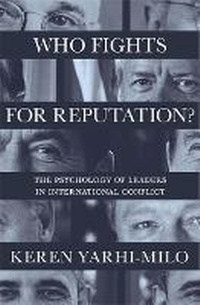
Who Fights for Reputation
The Psychology of Leaders in International Conflict
Published on 11. September 2018
Book
Hardback
376 pages
978-0-691-18034-2 (ISBN)
Description
How psychology explains why a leader is willing to use military force to protect or salvage reputation
In Who Fights for Reputation, Keren Yarhi-Milo provides an original framework, based on insights from psychology, to explain why some political leaders are more willing to use military force to defend their reputation than others. Rather than focusing on a leader's background, beliefs, bargaining skills, or biases, Yarhi-Milo draws a systematic link between a trait called self-monitoring and foreign policy behavior. She examines self-monitoring among national leaders and advisers and shows that while high self-monitors modify their behavior strategically to cultivate image-enhancing status, low self-monitors are less likely to change their behavior in response to reputation concerns.
Exploring self-monitoring through case studies of foreign policy crises during the terms of U.S. presidents Carter, Reagan, and Clinton, Yarhi-Milo disproves the notion that hawks are always more likely than doves to fight for reputation. Instead, Yarhi-Milo demonstrates that a decision maker's propensity for impression management is directly associated with the use of force to restore a reputation for resolve on the international stage.
Who Fights for Reputation offers a brand-new understanding of the pivotal influence that psychological factors have on political leadership, military engagement, and the protection of public prestige.
In Who Fights for Reputation, Keren Yarhi-Milo provides an original framework, based on insights from psychology, to explain why some political leaders are more willing to use military force to defend their reputation than others. Rather than focusing on a leader's background, beliefs, bargaining skills, or biases, Yarhi-Milo draws a systematic link between a trait called self-monitoring and foreign policy behavior. She examines self-monitoring among national leaders and advisers and shows that while high self-monitors modify their behavior strategically to cultivate image-enhancing status, low self-monitors are less likely to change their behavior in response to reputation concerns.
Exploring self-monitoring through case studies of foreign policy crises during the terms of U.S. presidents Carter, Reagan, and Clinton, Yarhi-Milo disproves the notion that hawks are always more likely than doves to fight for reputation. Instead, Yarhi-Milo demonstrates that a decision maker's propensity for impression management is directly associated with the use of force to restore a reputation for resolve on the international stage.
Who Fights for Reputation offers a brand-new understanding of the pivotal influence that psychological factors have on political leadership, military engagement, and the protection of public prestige.
Reviews / Votes
"Winner of the FPA Distinguished Scholar Award, Foreign Policy Analysis Section of the International Studies Association" "Winner of the Best Book Award, Foreign Policy Section of the American Political Science Association" "[Who Fights for Reputation] is extremely well written and lucid, and it pushes forward the fields of political psychology, international security, and foreign policy analysis in insightful ways. It is destined to become an impactful book that will be found on many undergraduate and graduate syllabi.-Marcus Holmes, Political Science Quarterly"More details
Series
Language
English
Place of publication
New Jersey
United States
Target group
College/higher education
Professional and scholarly
Product notice
Trade binding
Illustrations
15 b/w illus., 14 tables
Dimensions
Height: 235 mm
Width: 155 mm
ISBN-13
978-0-691-18034-2 (9780691180342)
Copyright in bibliographic data and cover images is held by Nielsen Book Services Limited or by the publishers or by their respective licensors: all rights reserved.
Schweitzer Classification
Other editions
Additional editions

E-Book
08/2018
1st Edition
Princeton University Press
€39.99
Available for download
Person
Keren Yarhi-Milo is associate professor of politics and international affairs at Princeton University. She is the author of Knowing the Adversary: Leaders, Intelligence, and Assessment of Intentions in International Relations (Princeton).