

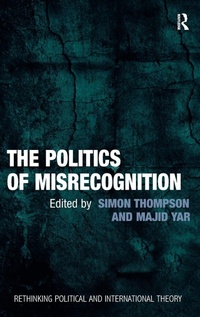
The Politics of Misrecognition
1st Edition
Published on 12. October 2011
Book
Hardback
188 pages
978-1-4094-0169-8 (ISBN)
Description
The past several decades have seen the emergence of a vigorous ongoing debate about the 'politics of recognition'. The initial impetus was provided by the reflections of Charles Taylor and others about the rights to cultural recognition of historically marginalized groups in Western societies. Since then, the parameters of the debate have considerably broadened. However, while debates about the politics of recognition have yielded significant theoretical insights into recognition, its logical and necessary counterpart, misrecognition, has been relatively neglected. 'The Politics of Misrecognition' is the most meticulous reflection to date on the importance of misrecognition for the understandings of our political and personal experience. A team of leading experts from a range of disciplines, including philosophy, political theory, sociology, psychoanalysis, history, moral economy and criminology present different theoretical frameworks in which the politics of misrecognition may be understood. They apply these frameworks to a wide variety of contexts, including those of class identity, disability, slavery, criminal victimization and domestic abuse. In this way, the book provides an essential resource for anyone interested in the dynamics of misrecognition and their implications for the development of political and social theory.
Reviews / Votes
'This groundbreaking collection offers in my view a rich and very diversified theoretical account of the phenomena associated with the concept of misrecognition. Scholars from various disciplines, including philosophy, political theory, sociology, psychoanalysis, history, moral economy and criminology take an in-depth look at this notion and offer new insights that confirm the fruitfulness of a program of research which was initiated some twenty years ago by Axel Honneth, Charles Taylor and Nancy Fraser. The book moves a step forward, further away from the abstract, idealized and simplified theories of justice, to embrace a whole range of issues that relate to the experience of injustice. It is a very original collection of essays that will have a lasting effect on future research dealing with the concept of recognition.' Michel Seymour, Universite de Montreal, Canada 'This edited volume offers a timely intervention since it is the first that explicitly shifts the theoretical focus from recognition to misrecognition as a distinctive and fruitful concept for critical theory. Some individual contributions demonstrate how a focus on misrecognition can generate new insights into a range of social phenomena including crime, disability and the unequal division of labour.' Shane O'Neill, Queen's University Belfast, UKMore details
Series
Language
English
Place of publication
London
United Kingdom
Publishing group
Taylor & Francis Ltd
Target group
College/higher education
Dimensions
Height: 240 mm
Width: 161 mm
Thickness: 15 mm
Weight
455 gr
ISBN-13
978-1-4094-0169-8 (9781409401698)
Copyright in bibliographic data and cover images is held by Nielsen Book Services Limited or by the publishers or by their respective licensors: all rights reserved.
Schweitzer Classification
Other editions
Additional editions
Majid Yar | Simon Thompson
The Politics of Misrecognition
Book
06/2019
1st Edition
Routledge
€74.00
Shipment within 10-20 days
Majid Yar | Simon Thompson
The Politics of Misrecognition
E-Book
02/2016
Routledge
€68.49
Available for download
Majid Yar | Simon Thompson
The Politics of Misrecognition
E-Book
02/2016
Routledge
€68.49
Available for download
Persons
Simon Thompson, University of the West of England, UK and Majid Yar, University of Hull, UK
Content
Contents: Introduction, Simon Thompson and Majid Yar; Misrecognition and ambivalence, Simon Thompson and Paul Hoggett; Axel Honneth's antagonism: what changes when the mode of acquiring recognition changes, Estelle Ferrarese; Overcoming the injuries of 'double consciousness', Nasar Meer; 'The imprison'd absence of your liberty': slavery, recognition and belonging, Laura Brace; Misrecognition, the unequal division of labour and contributive justice, Andrew Sayer; Disability and misrecognition, Gideon Calder; 'And every cruelty will cloud it': on love, damaged selfhood and criminal harm, Majid Yar; Recognition and esteem: a case study of the struggles of people affected by leprosy, Ricardo Fabrino MendonA?a; Conclusion, Simon Thompson and Majid Yar; Index.