

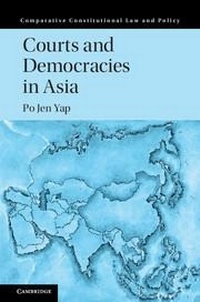
Courts and Democracies in Asia
Published on 28. September 2017
Book
Hardback
244 pages
978-1-107-19262-1 (ISBN)
Description
What is the relationship between the strength of a country's democracy and the ability of its courts to address deficiencies in the electoral process? Drawing a distinction between democracies that can be characterised as 'dominant-party' (for example Singapore, Malaysia, and Hong Kong), 'dynamic' (for example India, South Korea, and Taiwan), and 'fragile' (for example Thailand, Pakistan ,and Bangladesh), this book explores how democracy sustains and is sustained by the exercise of judicial power. In dominant-party systems, courts can only pursue 'dialogic' pathways to constrain the government's authoritarian tendencies. On the other hand, in dynamic democracies, courts can more successfully innovate and make systemic changes to the electoral system. Finally, in fragile democracies, where a country regularly oscillates between martial law and civilian rule, their courts tend to consistently overreach, and this often facilitates or precipitates a hostile take-over by the armed forces, and lead to the demise of the rule of law.
Reviews / Votes
'Po Jen Yap's new book is a must-read in the growing literature on the role of constitutional courts in democratic stabilization. Its fine-grained analyses demonstrates that the political power and vulnerability of courts in protecting democratic processes as well as their own independence is not fixed or prescribable in the abstract, but varies with the state of democratization and party contestation in which they operate.' Stephen Gardbaum, MacArthur Foundation Professor of International Justice and Human Rights, University of California, Los Angeles 'A fascinating tour through the fraught relations between courts and political power. Professor Yap provides a nuanced account of how constitutional courts in Asia balance precariously between semi-authoritarian dominant regimes and the live wire of electoral politics. A magnificent, sophisticated contribution that enriches our understanding of judicial politics in an era of weak democratic institutions.' Samuel Issacharoff, Reiss Professor of Constitutional Law, New York University 'Po Jen Yap's analysis of the role of Asian courts in three types of democracies illuminates how the possibilities for effective judicial action in connection with major political issues varies according to the type of democracy in which the courts are located. It is an important contribution to the project of integrating comparative constitutional law with comparative political studies.' Mark Tushnet, William Nelson Cromwell Professor of Law, Harvard University, Massachusetts 'Professor Yap's elegant, concise book is an important contribution to comparative constitutional studies ... Yap's book is a major advance in integrating Asian constitutionalism into comparative constitutionalism more generally and into the comparative law of democracy in particular.' Richard H. Pildes, ICONMore details
Series
Language
English
Place of publication
Cambridge
United Kingdom
Target group
Professional and scholarly
Product notice
sewn/stitched
Cloth over boards
Illustrations
Worked examples or Exercises
Dimensions
Height: 239 mm
Width: 165 mm
Thickness: 84 mm
Weight
472 gr
ISBN-13
978-1-107-19262-1 (9781107192621)
Copyright in bibliographic data and cover images is held by Nielsen Book Services Limited or by the publishers or by their respective licensors: all rights reserved.
Schweitzer Classification
Other editions
Additional editions
Po Jen Yap
Courts and Democracies in Asia
Book
01/2019
Cambridge University Press
€44.00
Shipment within 15-20 days
Po Jen Yap
Courts and Democracies in Asia
E-Book
09/2017
Cambridge University Press
€21.99
Available for download
Po Jen Yap
Courts and Democracies in Asia
E-Book
08/2017
Cambridge University Press
€26.49
Available for download
Person
Po Jen Yap is an Associate Professor at The University of Hong Kong (HKU), Faculty of Law, where he specialises in comparative constitutional law. He graduated from the National University of Singapore with an LL.B. degree and he obtained LL.M. qualifications from both Harvard Law School and University College London. He also has a Ph.D. degree from the University of Cambridge. He is an Advocate and Solicitor of the Supreme Court of Singapore and an Attorney at Law in the State of New York (USA). His publications include: Constitutional Dialogue in Common Law Asia (2015).
Content
1. Introduction; Part I. Dominant-Party Democracies: 2. Supreme Court of Singapore and the promise of enforceable constitutional conventions; 3. Malaysian courts and electoral fraud; 4. Hong Kong Courts and constitutional contradictions; Part II. Dynamic Democracies: 5. Supreme Court of India and criminality in politics; 6. Constitutional court of Taiwan and calibrated judicial review; 7. Constitutional court of Korea and systemic electoral barriers; Part III. Fragile Democracies: 8. Constitutional court of Thailand and partisan judges; 9. Supreme Court of Pakistan: accommodation and defiance of military authority; 10. Supreme Court of Bangladesh and defensive judicial review; Part IV. Democratic Values and Courts in Comparative Perspective: 11. Democratic values and the conundrum of unconstitutional constitutional amendments; 12. Conclusion; Bibliography; Index.