

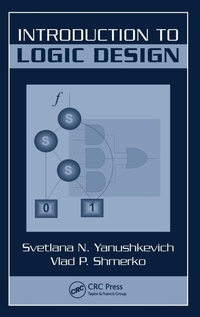
Introduction to Logic Design
1st Edition
Published on 25. January 2008
Book
Hardback
720 pages
978-1-4200-6094-2 (ISBN)
Description
With an abundance of insightful examples, problems, and computer experiments, Introduction to Logic Design provides a balanced, easy-to-read treatment of the fundamental theory of logic functions and applications to the design of digital devices and systems. Requiring no prior knowledge of electrical circuits or electronics, it supplies the essential material to understand the basic operation and design of digital systems.
Satisfying the Requirements of an Introductory Course
The text presents a clear picture of basic concepts, effective problem-solving techniques, modern technologies, and applications. It focuses on the relationships between and the manipulation of various data structures. By examining the similarities and differences between assorted theoretical approaches for the representation, manipulation, and optimization of Boolean functions, the authors provide a unified overview of the relationships among digital system design, computer organization, micro- and nanoelectronics, and numerical methods. The book also describes classical minimization techniques, along with advanced and emerging problems of logic design.
Meeting the Needs of Developing Technology
Reflecting the integrated nature of modern engineering, this text shows how theoretical ideas, physical devices, and design methodologies come together to form a successful design approach. It provides the basis to explore even more sophisticated aspects in the field.
Satisfying the Requirements of an Introductory Course
The text presents a clear picture of basic concepts, effective problem-solving techniques, modern technologies, and applications. It focuses on the relationships between and the manipulation of various data structures. By examining the similarities and differences between assorted theoretical approaches for the representation, manipulation, and optimization of Boolean functions, the authors provide a unified overview of the relationships among digital system design, computer organization, micro- and nanoelectronics, and numerical methods. The book also describes classical minimization techniques, along with advanced and emerging problems of logic design.
Meeting the Needs of Developing Technology
Reflecting the integrated nature of modern engineering, this text shows how theoretical ideas, physical devices, and design methodologies come together to form a successful design approach. It provides the basis to explore even more sophisticated aspects in the field.
Reviews / Votes
"This is a comprehensive handbook intended for introductory courses on fundamentals of logic and circuit design . . . The layout of the book is arranged very attractively . . . I was very positively impressed by this book. It may be strongly recommended for academic courses in digital design."- Antoni Michalski, in Zentralblatt Math, 2009
More details
Language
English
Place of publication
Bosa Roca
United States
Publishing group
Taylor & Francis Inc
Target group
College/higher education
Undergraduate
Illustrations
304 s/w Abbildungen
304 Illustrations, black and white
Dimensions
Height: 240 mm
Width: 161 mm
Thickness: 43 mm
Weight
1227 gr
ISBN-13
978-1-4200-6094-2 (9781420060942)
Copyright in bibliographic data and cover images is held by Nielsen Book Services Limited or by the publishers or by their respective licensors: all rights reserved.
Schweitzer Classification
Other editions
Additional editions
Svetlana N. Yanushkevich | Vlad P. Shmerko
Introduction to Logic Design
E-Book
01/2008
1st Edition
CRC Press
€244.99
Available for download
Svetlana N. Yanushkevich | Vlad P. Shmerko
Introduction to Logic Design
E-Book
01/2008
1st Edition
CRC Press
€244.99
Available for download
Persons
Svetlana N. Yanushkevich, Vlad P. Shmerko
Content
Preface. Design Process and Technology. Number Systems. Graphical Data Structures. Algebra I: Boolean. Fundamental Expansions. Boolean Data Structures. Properties of Boolean Functions. Optimization I: Algebraic and K-Maps. Optimization II: Decision Diagrams. Algebra II: Polynomial. Manipulation of Polynomial Expressions. Decision Diagrams for Polynomial Forms. Standard Modules of Combinational Networks. Combinational Logic Network Design. Standard Modules of Sequential Logic Networks. Memory and Programmable Devices. Sequential Logic Network Design. Design for Testability. Index.