

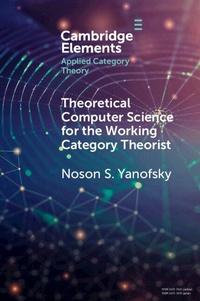
Theoretical Computer Science for the Working Category Theorist
Published on 3. March 2022
Book
Paperback/Softback
148 pages
978-1-108-79274-5 (ISBN)
Description
Using basic category theory, this Element describes all the central concepts and proves the main theorems of theoretical computer science. Category theory, which works with functions, processes, and structures, is uniquely qualified to present the fundamental results of theoretical computer science. In this Element, readers will meet some of the deepest ideas and theorems of modern computers and mathematics, such as Turing machines, unsolvable problems, the P=NP question, Kurt Goedel's incompleteness theorem, intractable problems, cryptographic protocols, Alan Turing's Halting problem, and much more. The concepts come alive with many examples and exercises.
Reviews / Votes
'As well as having a better understanding of Category Theory, I have a new perspective on theoretical computer science: the subset of functions that comprise computable functions is somewhat ugly to formalise. This is the first in a series of Cambridge Elements: shortish works on Applied Category Theory. This one is highly recommended: I will be looking out for the others.' Susan Stepney, (http://susan-stepney.blogspot.com)More details
Series
Language
English
Place of publication
Cambridge
United Kingdom
Target group
College/higher education
Edition type
New edition
Product notice
Paperback (trade)
Illustrations
Worked examples or Exercises
Dimensions
Height: 225 mm
Width: 145 mm
Thickness: 9 mm
Weight
210 gr
ISBN-13
978-1-108-79274-5 (9781108792745)
Copyright in bibliographic data and cover images is held by Nielsen Book Services Limited or by the publishers or by their respective licensors: all rights reserved.
Schweitzer Classification
Other editions
Additional editions
Noson S. Yanofsky
Theoretical Computer Science for the Working Category Theorist
E-Book
02/2022
Cambridge University Press
€15.49
Available for download
Person
Content
1. Introduction; 2. Aide-Memoire for Category Theory; 3. Models of Computation; 4. Computability Theory; 5. Complexity Theory; 6. Diagonal Arguments; 7. Conclusion; References.