

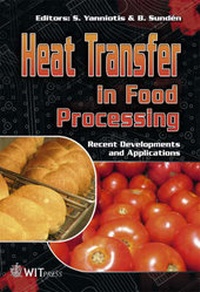
Heat Transfer in Food Processing
Recent Developments and Applications
Published on 25. July 2007
Book
Hardback
288 pages
978-1-85312-932-2 (ISBN)
Description
Heat transfer is one of the most important and most common engineering disciplines in food processing. There are many unit operations in the food industry where steady or unsteady state heat transfer is taking place. These operations are of primary importance and affect the design of equipment as well as safety, nutritional and sensory aspects of the product.The chapters in this book deal mainly with: heat transfer applications; methods that have considerable physical property variations with temperature; methods not yet widely spread in the food industry; or methods that are less developed in the food engineering literature. The application of numerical methods has received special attention with a separate chapter as well as emphasis in almost every chapter. A chapter on artificial neural networks (ANN) has also been included since ANN is a promising alternative tool to conventional methods for modelling, optimization, etc in cases where a clear relationship between the variables is not known, or the system is too complex to be modelled with conventional mathematical methods.
More details
Series
Language
English
Place of publication
Southampton
United Kingdom
Target group
College/higher education
Illustrations
Illustrations
Dimensions
Height: 230 mm
Width: 155 mm
ISBN-13
978-1-85312-932-2 (9781853129322)
Copyright in bibliographic data and cover images is held by Nielsen Book Services Limited or by the publishers or by their respective licensors: all rights reserved.
Schweitzer Classification
Content
Chapter 1: Numerical modelling of heat transfer in the food industry - recent developments and applicationsIntroduction; Finite difference (FD) methods; Finite element (FE) methods; Finite volume (FV) methods; Computational fluid dynamics (CFD); Conclusions and outlookChapter 2: Neural network applications in heat and mass transfer operations in food processingIntroduction; Principles of a basic artificial neural network (ANN) model; Developing neural networks; ANN applications in heat and mass transfer operations; Future trendsChapter 3: Freezing and thawing of foods - computation methods and thermal properties correlationEngineering calculations; Freezing points; Water and ice weight fractions; Effective heat capacities; Enthalpies; Departures from equilibrium; Volume changes; Food composition variation; Thermal conductivity; Freezing time estimation; Heat transfer coefficients; Unsteady-state freezing and thawing; Explicit numerical solution of PDE; Implicit numerical solution of PDE; Lee's method; Enthalpy step method; Multidimensional problems; Irregular shape and nonuniform compositionChapter 4: Microwave and radio frequency in sterilization and pasteurization applicationsIntroduction; Basic principles of microwave and RF heating; Microwave and RF heating systems; Review of research and industrial applications; New developments in microwave and RF sterilization researchChapter 5: Ohmic heating: models and measurementsIntroduction; The fundamentals of ohmic heating; Commercial design of the ohmic process; Modelling ohmic heating; Experimental studies on ohmic heating; Applications of ohmic heating and electric fields; ConclusionsChapter 6: Aseptic processing of liquid/particulate foodsIntroduction; Mathematical analysis; S tudy of aseptic processing of liquid/particulate foods; ConclusionsChapter 7: Deep-fat fryingIntroduction; Mathematical models; ConclusionsChapter 8: Heat and mass transfer during bakingIntroduction; Heat and mass transfer in the baking oven and within product; Physical, thermal and mass transfer properties; Starchy products as bubble foods or cellular solids; Conclusions