

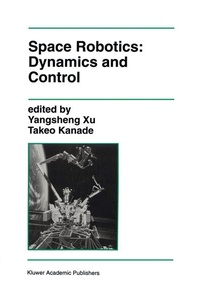
Space Robotics: Dynamics and Control
Published on 27. September 2012
Book
Paperback/Softback
IX, 285 pages
978-1-4613-6595-2 (ISBN)
Description
Robotic technology offers two potential benefits for future space exploration. One benefit is minimizing the risk that astronauts face. The other benefit is increasing their productivity.
Realizing the benefits of robotic technology in space will require solving several problems which are unique and now becoming active research topics. One of the most important research areas is dynamics, control, motion and planning for space robots by considering the dynamic interaction between the robot and the base (space station, space shuttle, or satellite). Any inefficiency in the planning and control can considerably risk by success of the space mission.
Space Robotics: Dynamics and Control presents a collection of papers concerning fundamental problems in dynamics and control of space robots, focussing on issues relevant to dynamic base/robot interaction.
The authors are all pioneers in theoretical analysis and experimental systems development of space robot technology. The chapters are organized within three problem areas: dynamics problems, nonholonomic nature problems, and control problems. This collection provides a solid reference for researchers in robotics, mechanics, control, and astronautical science.
Realizing the benefits of robotic technology in space will require solving several problems which are unique and now becoming active research topics. One of the most important research areas is dynamics, control, motion and planning for space robots by considering the dynamic interaction between the robot and the base (space station, space shuttle, or satellite). Any inefficiency in the planning and control can considerably risk by success of the space mission.
Space Robotics: Dynamics and Control presents a collection of papers concerning fundamental problems in dynamics and control of space robots, focussing on issues relevant to dynamic base/robot interaction.
The authors are all pioneers in theoretical analysis and experimental systems development of space robot technology. The chapters are organized within three problem areas: dynamics problems, nonholonomic nature problems, and control problems. This collection provides a solid reference for researchers in robotics, mechanics, control, and astronautical science.
Reviews / Votes
` In summary, the book provides an excellent account of the state of the art in the field, addressing significant problems and should be acquired by any researchers or development engineers dedicated to producing the first generation fo operational space robotic systems. 'Proceedings of the Institution of Mechanical Engineers, 208
More details
Series
Edition
Softcover reprint of the original 1st ed. 1993
Language
English
Place of publication
New York
United States
Target group
Professional and scholarly
Research
Illustrations
IX, 285 p.
Dimensions
Height: 235 mm
Width: 155 mm
Thickness: 17 mm
Weight
458 gr
ISBN-13
978-1-4613-6595-2 (9781461365952)
DOI
10.1007/978-1-4615-3588-1
Schweitzer Classification
Other editions
Additional editions
Yangsheng Xu | Takeo Kanade
Space Robotics: Dynamics and Control
E-Book
12/2012
Springer
€149.79
Available for download
Yangsheng Xu | Takeo Kanade
Space Robotics: Dynamics and Control
Book
11/1992
Kluwer Academic Publishers
€160.49
Shipment within 15-20 days
Content
1. Kinematic and Dynamic Properties of an Elbow Manipulator Mounted on a Satellite.- 2. The Kinetics and Workspace of a Satellite-Mounted Robot.- 3. On the Dynamics of Space Manipulators Using the Virtual Manipulator, with Applications to Path Planning.- 4. Dynamic Singularities in Free-floating Space Manipulators.- 5. Nonholonomic Motion Planning of Free-Flying Space Robots via a Bi-Directional Approach.- 6. Attitude Control of Space Platform/Manipulator System Using Internal Motion.- 7. Control of Space Manipulators with Generalized Jacobian Matrix.- 8. Sensory Feedback Control for Space Manipulators.- 9. Adaptive Control of Space Robot System with an Attitude Controlled Base.- 10. Experiments in Autonomous Navigation and Control of a Multi-Manipulator, Free-Flying Space Robot.