

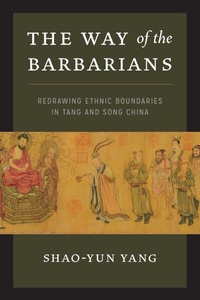
The Way of the Barbarians
Redrawing Ethnic Boundaries in Tang and Song China
Published on 14. October 2019
Book
Paperback/Softback
242 pages
978-0-295-74603-6 (ISBN)
Description
Shao-yun Yang challenges assumptions that the cultural and socioeconomic watershed of the Tang-Song transition (800-1127 CE) was marked by a xenophobic or nationalist hardening of ethnocultural boundaries in response to growing foreign threats. In that period, reinterpretations of Chineseness and its supposed antithesis, "barbarism," were not straightforward products of political change but had their own developmental logic based in two interrelated intellectual shifts among the literati elite: the emergence of Confucian ideological and intellectual orthodoxy and the rise of neo-Confucian (daoxue) philosophy. New discourses emphasized the fluidity of the Chinese-barbarian dichotomy, subverting the centrality of cultural or ritual practices to Chinese identity and redefining the essence of Chinese civilization and its purported superiority. The key issues at stake concerned the acceptability of intellectual pluralism in a Chinese society and the importance of Confucian moral values to the integrity and continuity of the Chinese state. Through close reading of the contexts and changing geopolitical realities in which new interpretations of identity emerged, this intellectual history engages with ongoing debates over relevance of the concepts of culture, nation, and ethnicity to premodern China.
Reviews / Votes
"[A]n important contribution to an evolving discourse on a critical era in both Chinese history specifically and East Asian history more broadly."(Journal of Chinese Studies) "The book would be worth reading just for its thoughtful accounts of how various writers (Han Yu, Sun Fu, Liu Chang, Cheng Yi, etc.) addressed the distinction in their studies of the Annals, but it has a much larger argument to make."
(Journal of Chinese History) "[A]n important contribution to the study of ethni-city and changing rhetorical strategies involving the ever-evolving construction of Chinese identity in premodern China."
(H-Net) "Yang has expertly painted a picture of Confucian ideological and intellectual orthodoxy, the rise of Neo-Confucianism, and the subsequent intellectual discourse that took place during the Tang-Song transition period. Those with an interest in Chinese religion have much to gain from this."
(Religious Studies Review)
More details
Series
Language
English
Place of publication
Seattle
United States
Target group
Professional and scholarly
Product notice
Paperback (trade)
Illustrations
0 illustrations
Dimensions
Height: 229 mm
Width: 152 mm
Thickness: 14 mm
Weight
399 gr
ISBN-13
978-0-295-74603-6 (9780295746036)
Copyright in bibliographic data and cover images is held by Nielsen Book Services Limited or by the publishers or by their respective licensors: all rights reserved.
Schweitzer Classification
Person
Shao-yun Yang is assistant professor of East Asian history at Denison University.