

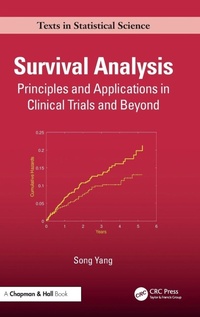
Survival Analysis
Principles and Applications in Clinical Trials and Beyond
1st Edition
Published on 28. April 2026
Book
Hardback
510 pages
978-0-367-34186-2 (ISBN)
Description
Survival analysis is crucial in many fields, including biomedical research, actuarial science, reliability analysis, business and customer analytics, econometrics, and social science. It has witnessed significant advancements in recent decades. However, most of this progress remains in scattered theoretical and applied publications, often focusing on exploratory analysis rather than the design and analysis of clinical trials. Non-proportional hazards are less well addressed. Competing risks are frequently overlooked, and the counting process approach often remains a mystery to many practitioners. Consequently, these critical topics are often not well understood or thoroughly analyzed.
Survival Analysis: Principles and Applications in Clinical Trials and Beyond aims to address these gaps. It provides an up-to-date and reader-friendly account of topics, progressing from the log-rank test, stratified analysis, and Cox regression to more advanced analyses. Heuristic arguments are used, leaving rigorous results to the appendices. The book dedicates separate chapters to topics such as clinical trials basics, modeling and analysis for non-proportional hazards, testing and summarizing treatment effects, trial design and interim monitoring, and the analysis of terminal and non-terminal events. A separate chapter is also devoted to detailed martingale heuristics beyond what is typically offered in other texts. Furthermore, a new contribution to recurrent event analysis is the rigorous formulations of marginal models and an exploration of related properties for statistical applications. The often overlooked one- and two-sample cases are also discussed.
This book provides an exposition of both the theory and practical applications of survival analysis, covering traditional topics and more recent advancements. It illustrates the methods with real world data, discussing the strengths and limitations of various approaches, and emphasizing modeling assumptions and interpretations. The three appendices offer overviews of modern analytic frameworks pivotal for understanding and developing challenging yet vital statistical solutions. R packages are also available for newer methods. It is an up-to-date, critical and accessible textbook for graduate students and researchers across industry, government, or academia that will enhance their understanding of complex topics, boosting their confidence in exploring different methods and interpreting the findings. It also encourages a critical evaluation of current literature and motivates the readers to develop new research ideas.
Key Features:
Emphasis on model interpretations and comparison of different methods
Intuitive explanations and heuristic derivation of the methods
Real large trial data applications and R packages for newer methodologies
Inclusion of more recently researched topics
Modern analytical methods applied to rigorous asymptotics for key problems (in appendices)
Survival Analysis: Principles and Applications in Clinical Trials and Beyond aims to address these gaps. It provides an up-to-date and reader-friendly account of topics, progressing from the log-rank test, stratified analysis, and Cox regression to more advanced analyses. Heuristic arguments are used, leaving rigorous results to the appendices. The book dedicates separate chapters to topics such as clinical trials basics, modeling and analysis for non-proportional hazards, testing and summarizing treatment effects, trial design and interim monitoring, and the analysis of terminal and non-terminal events. A separate chapter is also devoted to detailed martingale heuristics beyond what is typically offered in other texts. Furthermore, a new contribution to recurrent event analysis is the rigorous formulations of marginal models and an exploration of related properties for statistical applications. The often overlooked one- and two-sample cases are also discussed.
This book provides an exposition of both the theory and practical applications of survival analysis, covering traditional topics and more recent advancements. It illustrates the methods with real world data, discussing the strengths and limitations of various approaches, and emphasizing modeling assumptions and interpretations. The three appendices offer overviews of modern analytic frameworks pivotal for understanding and developing challenging yet vital statistical solutions. R packages are also available for newer methods. It is an up-to-date, critical and accessible textbook for graduate students and researchers across industry, government, or academia that will enhance their understanding of complex topics, boosting their confidence in exploring different methods and interpreting the findings. It also encourages a critical evaluation of current literature and motivates the readers to develop new research ideas.
Key Features:
Emphasis on model interpretations and comparison of different methods
Intuitive explanations and heuristic derivation of the methods
Real large trial data applications and R packages for newer methodologies
Inclusion of more recently researched topics
Modern analytical methods applied to rigorous asymptotics for key problems (in appendices)
More details
Series
Language
English
Place of publication
United Kingdom
Publishing group
Taylor & Francis Ltd
Target group
Professional and scholarly
College/higher education
Academic, Postgraduate, Undergraduate Advanced, and Undergraduate Core
Product notice
sewn/stitched
Cloth over boards
Illustrations
19 s/w Tabellen, 38 s/w Zeichnungen, 38 s/w Abbildungen
19 Tables, black and white; 38 Line drawings, black and white; 38 Illustrations, black and white
Dimensions
Height: 234 mm
Width: 156 mm
Thickness: 30 mm
Weight
921 gr
ISBN-13
978-0-367-34186-2 (9780367341862)
Copyright in bibliographic data and cover images is held by Nielsen Book Services Limited or by the publishers or by their respective licensors: all rights reserved.
Schweitzer Classification
Other editions
Additional editions
E-Book
04/2026
1st Edition
Chapman and Hall
€125.99
Available for download
E-Book
04/2026
1st Edition
Chapman and Hall
€125.99
Available for download
Person
Song Yang has been a senior mathematical statistician in the Office of Biostatistics Research, NHLBI, NIH, since 2003, following his tenure as a full professor and Statistics Coordinator in the Department of Mathematics and Statistics at Texas Tech University. He serves as an associate editor for Lifetime Data Analysis and Statistics and Probability Letters, and has given several short courses at JSM and ICSA meetings on survival analysis and clinical trials. His extensive publications in methodology and clinical research journals reflect his long experience in both areas, including his role as program office statistician on over a dozen large-scale clinical trials.
Content
1 Clinical Trial Basics 2 Estimation and Comparison of Survival Curves 3 Parametric Distributions 4 Large-Sample Theory for Inference in Parametric Models 5 Cox Proportional Hazards Model 6 Time-Dependent Covariates and Cox Multiplicative Hazards Model 7 The Model of Short-Term and Long-Term Hazard Ratios 8 Other Semiparametric Models 9 Testing and Summarizing Differences Between Comparison Groups 10 Sample Size, Power and Interim Monitoring 11 Counting Processes and Martingales 12 Correlated Survival Data 13 Competing Risks Analysis 14 Analysis of Terminal and Non-Terminal Events 15 Recurrent Event Analysis Appendix A Measure and Integration Theory Basics Appendix B Counting Process and Martingale Theory Basics Appendix C Convergence of Random Functions