

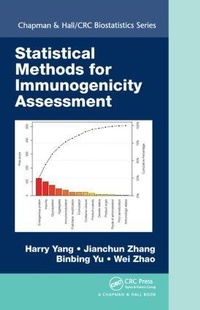
Statistical Methods for Immunogenicity Assessment
1st Edition
Will be published approx. on 3. September 2015
Book
Hardback
259 pages
978-1-4987-0034-4 (ISBN)
Description
Develop Effective Immunogenicity Risk Mitigation Strategies
Immunogenicity assessment is a prerequisite for the successful development of biopharmaceuticals, including safety and efficacy evaluation. Using advanced statistical methods in the study design and analysis stages is therefore essential to immunogenicity risk assessment and mitigation strategies. Statistical Methods for Immunogenicity Assessment provides a single source of information on statistical concepts, principles, methods, and strategies for detection, quantification, assessment, and control of immunogenicity.
The book first gives an overview of the impact of immunogenicity on biopharmaceutical development, regulatory requirements, and statistical methods and strategies used for immunogenicity detection, quantification, and risk assessment and mitigation. It then covers anti-drug antibody (ADA) assay development, optimization, validation, and transfer as well as the analysis of cut point, a key assay performance parameter in ADA assay development and validation. The authors illustrate how to apply statistical modeling approaches to establish associations between ADA and clinical outcomes, predict immunogenicity risk, and develop risk mitigation strategies. They also present various strategies for immunogenicity risk control. The book concludes with an explanation of the computer codes and algorithms of the statistical methods.
A critical issue in the development of biologics, immunogenicity can cause early termination or limited use of the products if not managed well. This book shows how to use robust statistical methods for detecting, quantifying, assessing, and mitigating immunogenicity risk. It is an invaluable resource for anyone involved in immunogenicity risk assessment and control in both non-clinical and clinical biopharmaceutical development.
Immunogenicity assessment is a prerequisite for the successful development of biopharmaceuticals, including safety and efficacy evaluation. Using advanced statistical methods in the study design and analysis stages is therefore essential to immunogenicity risk assessment and mitigation strategies. Statistical Methods for Immunogenicity Assessment provides a single source of information on statistical concepts, principles, methods, and strategies for detection, quantification, assessment, and control of immunogenicity.
The book first gives an overview of the impact of immunogenicity on biopharmaceutical development, regulatory requirements, and statistical methods and strategies used for immunogenicity detection, quantification, and risk assessment and mitigation. It then covers anti-drug antibody (ADA) assay development, optimization, validation, and transfer as well as the analysis of cut point, a key assay performance parameter in ADA assay development and validation. The authors illustrate how to apply statistical modeling approaches to establish associations between ADA and clinical outcomes, predict immunogenicity risk, and develop risk mitigation strategies. They also present various strategies for immunogenicity risk control. The book concludes with an explanation of the computer codes and algorithms of the statistical methods.
A critical issue in the development of biologics, immunogenicity can cause early termination or limited use of the products if not managed well. This book shows how to use robust statistical methods for detecting, quantifying, assessing, and mitigating immunogenicity risk. It is an invaluable resource for anyone involved in immunogenicity risk assessment and control in both non-clinical and clinical biopharmaceutical development.
Reviews / Votes
"In summary, this book is a good resource to the professionals and practitioners developing the biological therapies, including statisticians, clinicians, pharmacokineticists, regulatory reviewers, toxicologists, clinical assay developers, and biopharmaceutical engineers."~Journal of Biopharmaceutical Statistics
"The authors' work brings light into some of the issues surrounding immunogenicity of drugs. It is of great help to both clinical and nonclinical professionals, while some of the concepts can also be applied to situations when an immune response towards a drug (a vaccine) is desirable."
~Paul Tudor Tamas
More details
Series
Language
English
Place of publication
Oxford
United States
Publishing group
Taylor & Francis Inc
Target group
College/higher education
Product notice
sewn/stitched
Cloth over boards
Illustrations
52 s/w Abbildungen, 39 s/w Tabellen
39 Tables, black and white; 52 Illustrations, black and white
Dimensions
Height: 236 mm
Width: 155 mm
Thickness: 20 mm
Weight
522 gr
ISBN-13
978-1-4987-0034-4 (9781498700344)
Copyright in bibliographic data and cover images is held by Nielsen Book Services Limited or by the publishers or by their respective licensors: all rights reserved.
Schweitzer Classification
Other editions
Additional editions
Harry Yang | Jianchun Zhang | Binbing Yu
Statistical Methods for Immunogenicity Assessment
Book
12/2020
1st Edition
Chapman & Hall/CRC
€63.12
Shipment within 15-20 days
Harry Yang | Jianchun Zhang | Binbing Yu
Statistical Methods for Immunogenicity Assessment
E-Book
07/2015
Chapman & Hall/CRC
€66.99
Available for download
Harry Yang | Jianchun Zhang | Binbing Yu
Statistical Methods for Immunogenicity Assessment
E-Book
07/2015
Chapman and Hall
€67.49
Available for download
Persons
Harry Yang is a senior director, Jianchun Zhang is a principal statistician, Binbing Yu is an associate director, and Wei Zhao is a senior principal statistician at MedImmune, LLC in Gaithersburg, Maryland, USA.
Content
Introduction. ADA Assay Development and Validation. Determination of ADA Assay Cut Point. Clinical Immunogenicity Assessment. Immunogenicity Risk Control. Computational Tools for Immunogenicity Analysis. Bibliography. Index.