

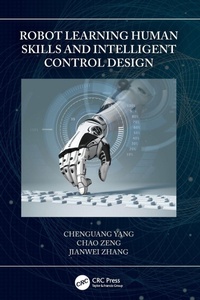
Robot Learning Human Skills and Intelligent Control Design
1st Edition
Published on 25. September 2023
Book
Paperback/Softback
174 pages
978-0-367-63437-7 (ISBN)
Description
In the last decades robots are expected to be of increasing intelligence to deal with a large range of tasks. Especially, robots are supposed to be able to learn manipulation skills from humans. To this end, a number of learning algorithms and techniques have been developed and successfully implemented for various robotic tasks. Among these methods, learning from demonstrations (LfD) enables robots to effectively and efficiently acquire skills by learning from human demonstrators, such that a robot can be quickly programmed to perform a new task.
This book introduces recent results on the development of advanced LfD-based learning and control approaches to improve the robot dexterous manipulation. First, there's an introduction to the simulation tools and robot platforms used in the authors' research. In order to enable a robot learning of human-like adaptive skills, the book explains how to transfer a human user's arm variable stiffness to the robot, based on the online estimation from the muscle electromyography (EMG). Next, the motion and impedance profiles can be both modelled by dynamical movement primitives such that both of them can be planned and generalized for new tasks. Furthermore, the book introduces how to learn the correlation between signals collected from demonstration, i.e., motion trajectory, stiffness profile estimated from EMG and interaction force, using statistical models such as hidden semi-Markov model and Gaussian Mixture Regression. Several widely used human-robot interaction interfaces (such as motion capture-based teleoperation) are presented, which allow a human user to interact with a robot and transfer movements to it in both simulation and real-word environments. Finally, improved performance of robot manipulation resulted from neural network enhanced control strategies is presented. A large number of examples of simulation and experiments of daily life tasks are included in this book to facilitate better understanding of the readers.
This book introduces recent results on the development of advanced LfD-based learning and control approaches to improve the robot dexterous manipulation. First, there's an introduction to the simulation tools and robot platforms used in the authors' research. In order to enable a robot learning of human-like adaptive skills, the book explains how to transfer a human user's arm variable stiffness to the robot, based on the online estimation from the muscle electromyography (EMG). Next, the motion and impedance profiles can be both modelled by dynamical movement primitives such that both of them can be planned and generalized for new tasks. Furthermore, the book introduces how to learn the correlation between signals collected from demonstration, i.e., motion trajectory, stiffness profile estimated from EMG and interaction force, using statistical models such as hidden semi-Markov model and Gaussian Mixture Regression. Several widely used human-robot interaction interfaces (such as motion capture-based teleoperation) are presented, which allow a human user to interact with a robot and transfer movements to it in both simulation and real-word environments. Finally, improved performance of robot manipulation resulted from neural network enhanced control strategies is presented. A large number of examples of simulation and experiments of daily life tasks are included in this book to facilitate better understanding of the readers.
More details
Language
English
Place of publication
London
United Kingdom
Publishing group
Taylor & Francis Ltd
Target group
College/higher education
Illustrations
131 s/w Abbildungen, 45 s/w Photographien bzw. Rasterbilder, 86 s/w Zeichnungen, 9 s/w Tabellen
9 Tables, black and white; 86 Line drawings, black and white; 45 Halftones, black and white; 131 Illustrations, black and white
Dimensions
Height: 234 mm
Width: 156 mm
Thickness: 10 mm
Weight
289 gr
ISBN-13
978-0-367-63437-7 (9780367634377)
Copyright in bibliographic data and cover images is held by Nielsen Book Services Limited or by the publishers or by their respective licensors: all rights reserved.
Schweitzer Classification
Other editions
Additional editions
Chenguang Yang | Chao Zeng | Jianwei Zhang
Robot Learning Human Skills and Intelligent Control Design
Book
06/2021
1st Edition
CRC Press
€186.90
Shipment within 15-20 days
Chenguang Yang | Chao Zeng | Jianwei Zhang
Robot Learning Human Skills and Intelligent Control Design
E-Book
06/2021
1st Edition
CRC Press
€67.49
Available for download
Chenguang Yang | Chao Zeng | Jianwei Zhang
Robot Learning Human Skills and Intelligent Control Design
E-Book
06/2021
1st Edition
CRC Press
€67.49
Available for download
Persons
Chenguang Yang is a Co-Chair of the Technical Committee on Collaborative Automation for Flexible Manufacturing (CAFM), IEEE Robotics and Automation Society and Co-Chair of the Technical Committee on Bio-mechatronics and Bio-robotics Systems (B2S), IEEE Systems, Man, and Cybernetics Society.
Chao Zeng is currently a Research Associate at the Institute of Technical Aspects of Multimodal Systems, Universitaet Hamburg.
Jianwei Zhang is the director of TAMS, Department of Informatics, Universitaet Hamburg, Germany.
Chao Zeng is currently a Research Associate at the Institute of Technical Aspects of Multimodal Systems, Universitaet Hamburg.
Jianwei Zhang is the director of TAMS, Department of Informatics, Universitaet Hamburg, Germany.
Content
1. Introduction. 2. Robot platforms and software systems. 3. Human-robot stiffness transfer based on sEMG signals. 4. Learning and Generalisation of Variable Impedance Skills. 5. Learning human skills from multimodal demonstration. 6. Skill Modeling based on Extreme Learning Machine. 7. Neural Network Enhanced Robot Manipulator Control.