


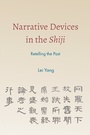
Narrative Devices in the Shiji
Retelling the Past
Published on 2. October 2024
Book
Paperback/Softback
200 pages
978-1-4384-9721-1 (ISBN)
Description
Provides a new model for reading the Shiji and other early Chinese historical texts.
Narrative Devices in the Shiji: Retelling the Past offers the first systematic analysis of narratives in early Chinese historical writings from 400 BCE to 100 CE, with a focus on the Shiji (Records of the Historian), a vast collection of historical accounts completed by Sima Qian (145-86 BCE). For centuries, the dominant approach to the Shiji has been to infer Sima's intentions from his biographical experiences and subsequently project them back into the text. This has caused the import of the work to be overshadowed by Sima's tragedy of castration, and has minimized the question of how narrative as a form affects the text's interpretation. Lei Yang fills the gap by exploring how Sima manipulated the Shiji's narrative structure to represent the past. Drawing on Gerard Genette's narratological theories, the book examines how sequences of events build causality, what is slowed down and sped up to manage information control, and how the text provides multiple perspectives on the same events. Redefining the Shiji's place as a turning point in Chinese textual history, Narrative Devices in the Shiji sheds light on the evolution of early Chinese historiography. As an interdisciplinary dialogue between Chinese texts and the Western theories, it opens the Shiji to new interpretations and provides a novel framework for Chinese historical writings.
Narrative Devices in the Shiji: Retelling the Past offers the first systematic analysis of narratives in early Chinese historical writings from 400 BCE to 100 CE, with a focus on the Shiji (Records of the Historian), a vast collection of historical accounts completed by Sima Qian (145-86 BCE). For centuries, the dominant approach to the Shiji has been to infer Sima's intentions from his biographical experiences and subsequently project them back into the text. This has caused the import of the work to be overshadowed by Sima's tragedy of castration, and has minimized the question of how narrative as a form affects the text's interpretation. Lei Yang fills the gap by exploring how Sima manipulated the Shiji's narrative structure to represent the past. Drawing on Gerard Genette's narratological theories, the book examines how sequences of events build causality, what is slowed down and sped up to manage information control, and how the text provides multiple perspectives on the same events. Redefining the Shiji's place as a turning point in Chinese textual history, Narrative Devices in the Shiji sheds light on the evolution of early Chinese historiography. As an interdisciplinary dialogue between Chinese texts and the Western theories, it opens the Shiji to new interpretations and provides a novel framework for Chinese historical writings.
Reviews / Votes
"Yang Lei's book is a highly innovative contribution to Shiji studies. Nobody has so far approached the literary techniques which Sima Qian relied on with such a sharp eye." - Monumenta Serica"this interdisciplinary research opens a new path for studying other early historical texts. While Yang acknowledges unresolved questions-such as the rise of the biographical tradition and how the Shiji's narratives influenced later generations-this breakthrough nonetheless deserves significant attention from both scholars and general readers. It demonstrates that the study of early Chinese literature and history can be expanded into a new and innovative dimension." - Chinese Literature: Essays, Articles, Reviews
"This book is a must-read for both students of early Chinese empires and Chinese literature. In addition to revising the common understanding of early Chinese historiography, it significantly contributes to the history of books in the Chinese context. The author brilliantly shows how Sima Qian's work revolutionized the transmission of historical knowledge, employing various rhetorical and structural devices to transform the laundry list of historical facts in annals into a coherent narrative. As the book powerfully demonstrates, Sima Qian's work imposed a new structure on raw materials, which indicates that authorship emerged and a closed text appeared for the first time in Chinese history." - Liang Cai, author of Witchcraft and the Rise of the First Confucian Empire
More details
Series
Language
English
Place of publication
Albany, NY
United States
Target group
Professional and scholarly
US School Grade: College Graduate Student and over
Product notice
Paperback (trade)
Dimensions
Height: 229 mm
Width: 152 mm
Thickness: 12 mm
Weight
298 gr
ISBN-13
978-1-4384-9721-1 (9781438497211)
Copyright in bibliographic data and cover images is held by Nielsen Book Services Limited or by the publishers or by their respective licensors: all rights reserved.
Schweitzer Classification
Other editions
Additional editions
E-Book
04/2024
1st Edition
State University of New York Press
from
€81.99
Available for download
Person
Lei Yang teaches Chinese literature and culture at Carleton College.
Content
Acknowledgments
Introduction
1. The Turn to Textual Unity
2. Temporal Order: Weaving a Synthesized Causality
3. Narrative Speed: Elaborating Stairs Ascending to Power
4. Multiple Points of View: Illuminating Desires and Dynamics
Conclusion
Notes
Bibliography
Index
Introduction
1. The Turn to Textual Unity
2. Temporal Order: Weaving a Synthesized Causality
3. Narrative Speed: Elaborating Stairs Ascending to Power
4. Multiple Points of View: Illuminating Desires and Dynamics
Conclusion
Notes
Bibliography
Index