

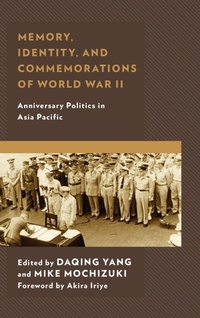
Memory, Identity, and Commemorations of World War II
Anniversary Politics in Asia Pacific
Published on 11. April 2018
Book
Hardback
194 pages
978-1-4985-6769-5 (ISBN)
Description
Why do some governments and societies attach great significance to a particular anniversary year whereas others seem less inclined to do so? What motivates the orchestration of elaborate commemorative activities in some countries? What are they supposed to accomplish, for both domestic and international audience? In what ways do commemorations in Asia Pacific fit into the global memory culture of war commemoration? In what ways are these commemorations intertwined with current international politics?
This book presents the first large-scale analysis of how countries in the Asia Pacific and beyond commemorated the seventieth anniversaries of the end of World War II. Consisting of in-depth case studies of China, Taiwan, Korea, Japan, Singapore, the Philippines, United States, Russia, and Germany, this unique collective effort demonstrates how memories of the past as reflected in public commemorations and contemporary politics-both internal and international-profoundly affect each other.
This book presents the first large-scale analysis of how countries in the Asia Pacific and beyond commemorated the seventieth anniversaries of the end of World War II. Consisting of in-depth case studies of China, Taiwan, Korea, Japan, Singapore, the Philippines, United States, Russia, and Germany, this unique collective effort demonstrates how memories of the past as reflected in public commemorations and contemporary politics-both internal and international-profoundly affect each other.
Reviews / Votes
This is a powerful, wide-ranging set of essays that provides a genuinely transnational view of the meaning of one turning-point year in modern history: 1945. Bringing together papers on Asia, Europe, and North America, this volume provides a truly innovative contribution to the field of war and memory. -- Rana Mitter, University of Oxford This is an excellent and timely collection of papers on divergent memories of World War II in the Asia-Pacific region. While Sino-Japanese disputes over islands and the controversies over comfort women make headlines, there is a great diversity of competing historical memories in the region, as this book captures very well. Of particular value is the book's comparative focus: it considers not only Northeast and Southeast Asia but also the United States-a key player in the Asia-Pacific War-and Germany, a historical benchmark for postwar reconciliation. -- Gi-Wook Shin, Stanford University Every chapter offers numerous insights, and the book makes an important contribution to the growing literature on memory and Asia-Pacific reconciliation. . . . and will remain relevantas long as contested memories of this great conflict shape prospects for reconciliation in the Asia-Pacific region. * Pacific Affairs *
More details
Language
English
Place of publication
United States
Publishing group
Bloomsbury Publishing Plc
Target group
Professional and scholarly
Product notice
sewn/stitched
Cloth over boards
With dust jacket
Dimensions
Height: 235 mm
Width: 157 mm
Thickness: 15 mm
Weight
440 gr
ISBN-13
978-1-4985-6769-5 (9781498567695)
Copyright in bibliographic data and cover images is held by Nielsen Book Services Limited or by the publishers or by their respective licensors: all rights reserved.
Schweitzer Classification
Other editions
Additional editions
Memory, Identity, and Commemorations of World War II
Anniversary Politics in Asia Pacific
E-Book
04/2018
1st Edition
Lexington Books
€39.49
Available for download
Persons
Daqing Yang is associate professor of history and international affairs at George Washington University.
Mike Mochizuki is associate professor of political science and international affairs and holds the Japan-U.S. Relations Chair in Memory of Gaston Sigur at George Washington University.
Mike Mochizuki is associate professor of political science and international affairs and holds the Japan-U.S. Relations Chair in Memory of Gaston Sigur at George Washington University.
Content
Foreword: Commemorating 1945 in Transnational History, Akira Iriye
Introduction: Anniversary Commemorations: Politics of Collective Memory and Identity, Daqing Yang and Mike Mochizuki
Chapter 1: PRC: Meanings and Contradictions of Victory, Daqing Yang
Chapter 2: Republic of China: Government Balancing Acts in Commemorating World War II, Robert Sutter
Chapter 3: Japan: Contested History and Identity Conflict, Mike Mochizuki
Chapter 4: South Korea: Commemorations, Revision and Reckoning, Christine Kim
Chapter 5: Philippines: Memorials and Commemorations in Seven Decades, Ricardo T. Jose
Chapter 6: Singapore: Commemoration and Reconciliation, Tze Loo
Chapter 7: United States: Remembrance without Recrimination, Marc Gallicchio
Chapter 8: Russia: Commemorating the War in the West More Than East, Marlene Laruelle
Chapter 9: Germany: Comprehensive and Complex "Culture of Remembrance," Lily Gardner Feldman
Introduction: Anniversary Commemorations: Politics of Collective Memory and Identity, Daqing Yang and Mike Mochizuki
Chapter 1: PRC: Meanings and Contradictions of Victory, Daqing Yang
Chapter 2: Republic of China: Government Balancing Acts in Commemorating World War II, Robert Sutter
Chapter 3: Japan: Contested History and Identity Conflict, Mike Mochizuki
Chapter 4: South Korea: Commemorations, Revision and Reckoning, Christine Kim
Chapter 5: Philippines: Memorials and Commemorations in Seven Decades, Ricardo T. Jose
Chapter 6: Singapore: Commemoration and Reconciliation, Tze Loo
Chapter 7: United States: Remembrance without Recrimination, Marc Gallicchio
Chapter 8: Russia: Commemorating the War in the West More Than East, Marlene Laruelle
Chapter 9: Germany: Comprehensive and Complex "Culture of Remembrance," Lily Gardner Feldman