

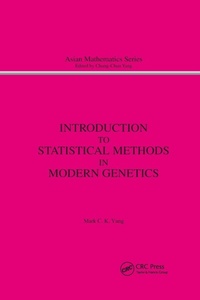
Introduction to Statistical Methods in Modern Genetics
1st Edition
Published on 5. September 2019
Book
Paperback/Softback
260 pages
978-0-367-39890-3 (ISBN)
Description
Although the basic statistical theory behind modern genetics is not very difficult, most statistical genetics papers are not easy to read for beginners in the field, and formulae quickly become very tedious to fit a particular area of application.
Introduction to Statistical Methods in Modern Genetics distinguishes between the necessary and unnecessary complexity in a presentation designed for graduate-level statistics students. The author keeps derivations simple, but does so without losing the mathematical details. He also provides the required background in modern genetics for those looking forward to entering this arena. Along with some of the statistical tools important in genetics applications, students will learn:
How a gene is found
How scientists have separated the genetic and environmental aspects of a person's intelligence
How genetics are used in agriculture to improve crops and domestic animals
What a DNA fingerprint is and why there are controversies about it
Although the author assumes students have a foundation in basic statistics, an appendix provides the necessary background beyond the elementary, including multinomial distributions, inference on frequency tables, and discriminant analysis. With clear explanations, a multitude of figures, and exercise sets in each chapter, this text forms an outstanding entree into the rapidly expanding world of genetic data analysis.
Introduction to Statistical Methods in Modern Genetics distinguishes between the necessary and unnecessary complexity in a presentation designed for graduate-level statistics students. The author keeps derivations simple, but does so without losing the mathematical details. He also provides the required background in modern genetics for those looking forward to entering this arena. Along with some of the statistical tools important in genetics applications, students will learn:
How a gene is found
How scientists have separated the genetic and environmental aspects of a person's intelligence
How genetics are used in agriculture to improve crops and domestic animals
What a DNA fingerprint is and why there are controversies about it
Although the author assumes students have a foundation in basic statistics, an appendix provides the necessary background beyond the elementary, including multinomial distributions, inference on frequency tables, and discriminant analysis. With clear explanations, a multitude of figures, and exercise sets in each chapter, this text forms an outstanding entree into the rapidly expanding world of genetic data analysis.
More details
Series
Language
English
Place of publication
London
United Kingdom
Publishing group
Taylor & Francis Ltd
Target group
Professional and scholarly
Professional
Dimensions
Height: 229 mm
Width: 152 mm
Thickness: 14 mm
Weight
382 gr
ISBN-13
978-0-367-39890-3 (9780367398903)
Copyright in bibliographic data and cover images is held by Nielsen Book Services Limited or by the publishers or by their respective licensors: all rights reserved.
Schweitzer Classification
Other editions
Additional editions
E-Book
02/2000
1st Edition
CRC Press
€89.99
Available for download
Book
02/2000
1st Edition
Taylor & Francis
€206.50
Shipment within 15-20 days
E-Book
02/2000
CRC Press
€89.99
Available for download
Person
Content
Though the basic statistical theory behind modern genetics is not that difficult, most statistical genetics papers are not easy to read for beginners, and fitting formulae to a particular area of application quickly becomes very tedious. Introduction to Statistical Methods in Modern Genetics makes a clear distinction between the necessary and unnecessary complexities. The author keeps the derivations of methods simple without losing the mathematical details. He also provides the necessary background in modern genetics for newcomers to the field, including discussion ranging from biological and molecular experiments to gene hunting and genetic engineering.