

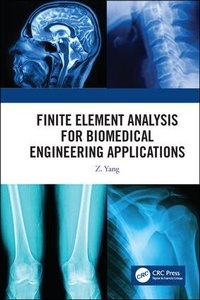
Finite Element Analysis for Biomedical Engineering Applications
1st Edition
Published on 29. March 2019
Book
Hardback
318 pages
978-0-367-18218-2 (ISBN)
Description
Finite element analysis has been widely applied to study biomedical problems. This book aims to simulate some common medical problems using finite element advanced technologies, which establish a base for medical researchers to conduct further investigations.
This book consists of four main parts: (1) bone, (2) soft tissues, (3) joints, and (4) implants. Each part starts with the structure and function of the biology and then follows the corresponding finite element advanced features, such as anisotropic nonlinear material, multidimensional interpolation, XFEM, fiber enhancement, UserHyper, porous media, wear, and crack growth fatigue analysis. The final section presents some specific biomedical problems, such as abdominal aortic aneurysm, intervertebral disc, head impact, knee contact, and SMA cardiovascular stent. All modeling files are attached in the appendixes of the book.
This book will be helpful to graduate students and researchers in the biomedical field who engage in simulations of biomedical problems. The book also provides all readers with a better understanding of current advanced finite element technologies.
Details finite element modeling of bone, soft tissues, joints, and implants
Presents advanced finite element technologies, such as fiber enhancement, porous media, wear, and crack growth fatigue analysis
Discusses specific biomedical problems, such as abdominal aortic aneurysm, intervertebral disc, head impact, knee contact, and SMA cardiovascular stent
Explains principles for modeling biology
Provides various descriptive modeling files
This book consists of four main parts: (1) bone, (2) soft tissues, (3) joints, and (4) implants. Each part starts with the structure and function of the biology and then follows the corresponding finite element advanced features, such as anisotropic nonlinear material, multidimensional interpolation, XFEM, fiber enhancement, UserHyper, porous media, wear, and crack growth fatigue analysis. The final section presents some specific biomedical problems, such as abdominal aortic aneurysm, intervertebral disc, head impact, knee contact, and SMA cardiovascular stent. All modeling files are attached in the appendixes of the book.
This book will be helpful to graduate students and researchers in the biomedical field who engage in simulations of biomedical problems. The book also provides all readers with a better understanding of current advanced finite element technologies.
Details finite element modeling of bone, soft tissues, joints, and implants
Presents advanced finite element technologies, such as fiber enhancement, porous media, wear, and crack growth fatigue analysis
Discusses specific biomedical problems, such as abdominal aortic aneurysm, intervertebral disc, head impact, knee contact, and SMA cardiovascular stent
Explains principles for modeling biology
Provides various descriptive modeling files
More details
Language
English
Place of publication
London
United Kingdom
Publishing group
Taylor & Francis Ltd
Target group
Professional and scholarly
Academic and Professional Practice & Development
Illustrations
148 s/w Abbildungen, 83 farbige Abbildungen, 8 s/w Tabellen
8 Tables, black and white; 83 Illustrations, color; 148 Illustrations, black and white
Dimensions
Height: 234 mm
Width: 156 mm
Weight
700 gr
ISBN-13
978-0-367-18218-2 (9780367182182)
Copyright in bibliographic data and cover images is held by Nielsen Book Services Limited or by the publishers or by their respective licensors: all rights reserved.
Schweitzer Classification
Other editions
Additional editions
Book
10/2023
1st Edition
CRC Press
€81.99
Shipment within 10-20 days
E-Book
03/2019
1st Edition
CRC Press
€69.99
Available for download
E-Book
03/2019
CRC Press
€69.99
Available for download
Person
Z. Yang earned a PhD in mechanical engineering at the University of Pittsburgh in 2004. Since 2001, he has conducted many bioengineering projects using finite element method and published one book chapter and twelve journal papers. His research interests include (1) application of finite element method in biomechanics and (2) application of tribology in biomechanics.
Content
1. Introduction Part I: Bone 2. Bone Structure and Material Properties 3. Simulation of Nonhomogeneous Bone 4. Simulation of Anisotropic Bone 5. Simulation of Crack Growth Using the eXtended Finite Element Method (XFEM) Part II: Soft Tissues 6. Structure and Material Properties of Soft Tissues 7. Nonlinear Behavior of Soft Tissues 8. Viscoelasticity of Soft Tissues 9. Fiber Enhancement 10. USERMAT for Simulation of Soft Tissues 11. Modeling Soft Tissues as Porous Media Part III: Joints 12. Structure and Function of Joints 13. Modeling Contact 14. Application of the Discrete Element Method for Study of the Knee Joint Part IV: Simulation of Implants 15. Study of Contact in Ankle Replacement 16. Simulation of Shape Memory Alloy (SMA) Cardiovascular Stent 17. Wear Model of Liner in Hip Replacement 18. Fatigue Analysis of a Mini Dental Implant (MDI) Part V: Retrospective 19. Retrospective