

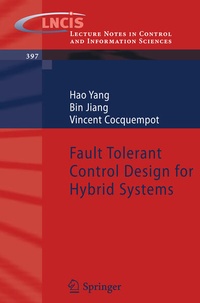
Fault Tolerant Control Design for Hybrid Systems
Published on 4. February 2010
Book
Paperback/Softback
XVI, 192 pages
978-3-642-10680-4 (ISBN)
Description
Hybridsystems(HS)aredynamicalsystemsthatinvolvetheinteractionofconti- ousanddiscretedynamics.ThestudyofHSismotivatedbythefundamentally- bridnatureofmanyreallifeapplications.Overthelastdecade,signi?cantprogress has taken place in modeling and simulation, veri?cation, stability and controller synthesisforHS. Faultsinautomatedprocessesoftencauseundesiredreactionsandshut-downof a controlledplant,andtheconsequencescouldbedamagetotechnicalpartsofthe plant or to its environment. Fault diagnosis (FD) and fault tolerant control (FTC) arehighlyrequiredforsafetypurpose,andaimatguaranteeingcertainsystemp- formances and/or properties to be maintained in spite of faults. In the past more than30years,fruitfultheoreticalresultsonFDandFTChavebeenreportedforv- iouslinearandnonlinearsystemswithmanysuccessfulengineeringapplicationsin practicalsystems. FD problem for HS has attracted some attentions. However, to the best of the authors' knowledge, until now, the FTC issue for HS has not yet been intensively studied. FTC method for HS deserves further investigations due to its academic meaningaswellaspracticalone. 1. Motivationfromacademicresearch Itiswellknownthatthestabilityandsomespeci?cationsofHScanbeachieved underquite rigorousconditions.
Most of existing results are devotedto off-line analysisanddesign,suchthattheHSworkswellaswhatitisexpected.However, faultsmayabruptlychangesystembehavior,FTCstrategiesmustbeapplied- line,notonlytokeepthestabilitybutalsotomaintainsomespeci?cationsofthe HSinpresenceoffaults.Thisresultsinagreattheoreticalchallenge,sincemany classicalFTCmethodsfornon-hybridsystemscannotbeeasilyextendedtoHS. FTCtheoryforHSneedstobedeveloped. VIII Preface 2. Motivationfrompracticalapplications Manypracticalsystemshavetobemodeledbyhybridmodels,e.g.chemicalp- cesses,switchedRLCcircuits,intelligenttransportationsystems,etc.Thesafety andreliabilityofthesesystemsareneeded,andFTCtechniquesforHSarehighly required. The HS considered in this book consists of a series of continuous modes and a switching logic. Switching from one mode to another is due to a switching law generated from the switching logic. Faulty behaviors of HS are investigated s- tematically.Two main kindsof faults are considered:Continuous faults that affect continuous modes; Discrete faults that affect the desired switching.
In these two faultycases,theFTCdesignhastwomainobjectivesasfollows: 1) maintainthecontinuousperformancesincludingvariousstabilities (e.g.L- punovstability,asymptoticalstability andinput-to-statestability)oftheoriginand theoutputtracking/regulationbehaviorsalongthetrajectoriesofHS. 2) maintain the discrete speci?cations that have to be followed by HS, e.g. a desiredswitchingsequence.
Most of existing results are devotedto off-line analysisanddesign,suchthattheHSworkswellaswhatitisexpected.However, faultsmayabruptlychangesystembehavior,FTCstrategiesmustbeapplied- line,notonlytokeepthestabilitybutalsotomaintainsomespeci?cationsofthe HSinpresenceoffaults.Thisresultsinagreattheoreticalchallenge,sincemany classicalFTCmethodsfornon-hybridsystemscannotbeeasilyextendedtoHS. FTCtheoryforHSneedstobedeveloped. VIII Preface 2. Motivationfrompracticalapplications Manypracticalsystemshavetobemodeledbyhybridmodels,e.g.chemicalp- cesses,switchedRLCcircuits,intelligenttransportationsystems,etc.Thesafety andreliabilityofthesesystemsareneeded,andFTCtechniquesforHSarehighly required. The HS considered in this book consists of a series of continuous modes and a switching logic. Switching from one mode to another is due to a switching law generated from the switching logic. Faulty behaviors of HS are investigated s- tematically.Two main kindsof faults are considered:Continuous faults that affect continuous modes; Discrete faults that affect the desired switching.
In these two faultycases,theFTCdesignhastwomainobjectivesasfollows: 1) maintainthecontinuousperformancesincludingvariousstabilities (e.g.L- punovstability,asymptoticalstability andinput-to-statestability)oftheoriginand theoutputtracking/regulationbehaviorsalongthetrajectoriesofHS. 2) maintain the discrete speci?cations that have to be followed by HS, e.g. a desiredswitchingsequence.
Reviews / Votes
From the reviews:
"Fault detection and fault tolerant control techniques have received wide attention in the field of continuous-time, especially linear, systems. . Hence the monograph in question is a very suitable addition to this field. . There is a list of references, with 157 entries, which is a very good compendium of the literature in the field. On the whole, this monograph is a good addition to the industry-relevant research in the field of fault detection and fault tolerant control." (Amit Patra, Mathematical Reviews, Issue 2011 e)More details
Series
Edition
2010 ed.
Language
English
Place of publication
Berlin
Germany
Publishing group
Springer Berlin
Target group
Professional and scholarly
Research
Illustrations
XVI, 192 p.
Dimensions
Height: 23.5 cm
Width: 15.5 cm
Weight
690 gr
ISBN-13
978-3-642-10680-4 (9783642106804)
DOI
10.1007/978-3-642-10681-1
Schweitzer Classification
Other editions
Additional editions
Hao Yang | Bin Jiang | Vincent Cocquempot
Fault Tolerant Control Design for Hybrid Systems
E-Book
12/2009
Springer
€96.29
Available for download
Content
Fault Tolerant Control and Hybrid Systems.- Hybrid Systems with Time-Dependent Switching.- Hybrid Systems with State-Dependent Switching.- Hybrid Systems with Impulsive and Stochastic Switching.- Hybrid Systems with Discrete Specifications.- Hybrid Control Approach in FTC Design.- Conclusion and Future Research Directions.